Oura Files for IPO: A Milestone Moment for the Smart Ring Market
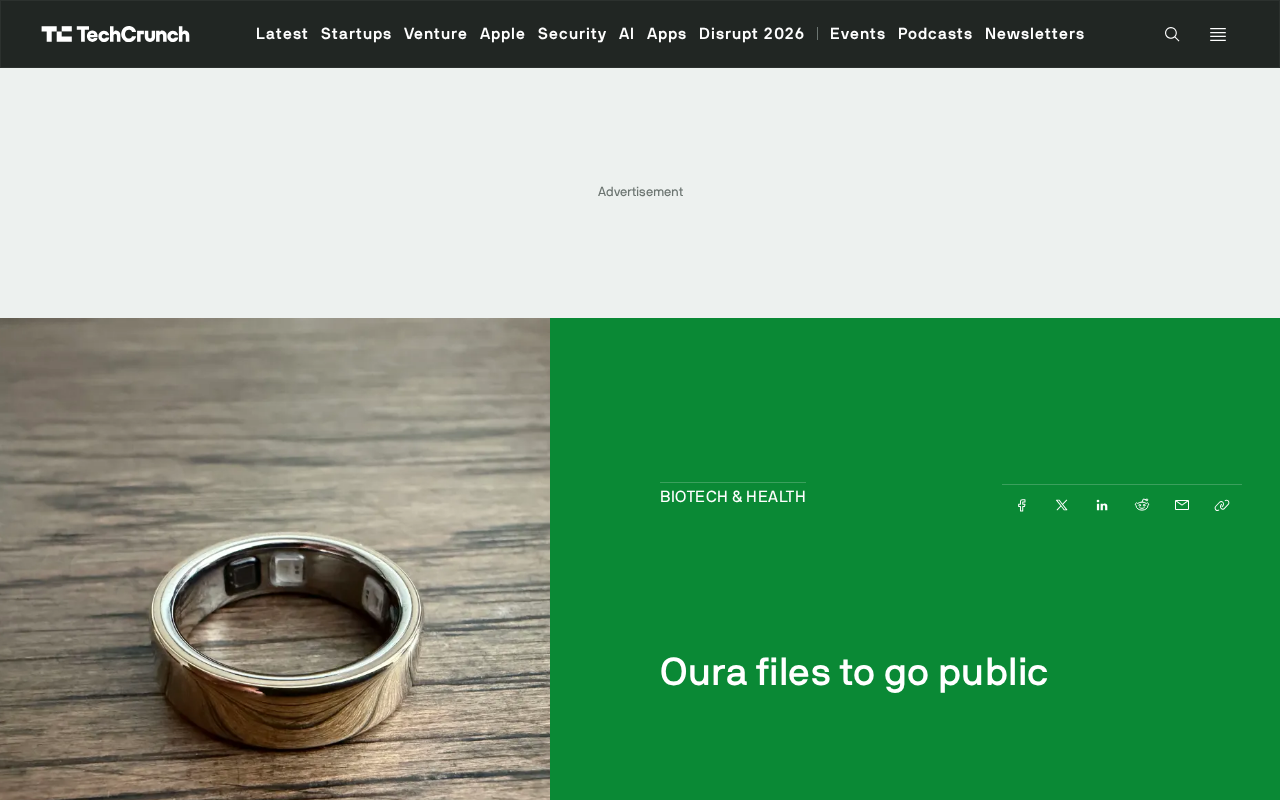
Smart ring pioneer Oura files for IPO, marking a milestone for the wearable health device market.
Oura, the pioneer and leader of the smart ring category, has officially filed to go public following significant revenue growth. Leveraging a hardware + subscription business model and a "wear-and-forget" design focused on sleep and health tracking, Oura has carved out a loyal user base. While competition intensifies with Samsung's Galaxy Ring and rumored Apple entry, Oura's IPO signals the smart ring market's maturation and could serve as a key barometer for the sector's commercial future.
Oura Files for IPO: A Milestone for the Smart Ring Market
Major news is breaking in the smart wearable device market. Smart ring maker Oura has officially filed to go public. The company has demonstrated significant revenue growth over the past year, making it one of the most closely watched IPO candidates in the wearable health device space.
As the pioneer and leader of the smart ring category, Oura's IPO is not only a critical milestone for the company—it also signals that the smart ring segment is maturing and beginning to receive serious attention from capital markets. Compared to the highly saturated smartwatch and fitness band markets, ring-form-factor health monitoring devices offer a more discreet and comfortable alternative.
From Niche Product to Revenue Engine: What Makes Oura Stand Out?
Differentiated Product Positioning
Oura's core competitive advantage lies in its unique form factor and precise health monitoring capabilities. Unlike smartwatches with their bulky screens and frequent charging needs, the Oura smart ring integrates seamlessly into daily life with a minimalist design, focusing on core health metrics such as sleep tracking, heart rate variability (HRV) monitoring, body temperature detection, and recovery assessment.
This "wear-and-forget" design philosophy gives the Oura ring a particularly strong edge in sleep monitoring—users can wear it through the night with virtually no discomfort, capturing more continuous and accurate physiological data. This is the key reason Oura has built such a loyal user base among the sea of wearable products.
Significant Revenue Growth
According to company disclosures, Oura achieved significant revenue growth over the past year, laying a solid foundation for this IPO. This performance also reflects the continued rise in consumer demand for health data tracking. In the post-pandemic era, awareness of personal health has reached unprecedented levels, with sleep quality, stress management, and physical recovery becoming metrics that mainstream consumers are willing to pay for.
One noteworthy detail: Oura employs a hardware + subscription business model. After purchasing the ring, users must pay for a subscription to unlock the full suite of health analytics features. This model generates stable recurring revenue for the company—a business structure that capital markets tend to favor.
The Smart Ring Market: Opportunities and Challenges
Big Tech Entry Intensifies Competition
Oura's success has attracted attention from tech giants. Samsung has already launched the Galaxy Ring to enter the smart ring market, and Apple is widely speculated to be developing a similar product. For Oura, the entry of major players is both a positive signal—validating the market and the category—and a warning that it will face direct competition from rivals with far greater resources.
As a category pioneer, Oura's advantages lie in years of accumulated algorithm expertise, health data models, and brand recognition. However, defending market share against the ecosystem integration capabilities of tech giants will be a key challenge the company must continually prove to investors after going public.
Deep Integration of AI and Health Data
The long-term value of smart rings depends largely on the ability to intelligently analyze health data. As AI technology matures, companies like Oura can leverage machine learning models to transform massive amounts of physiological data into personalized health insights and risk alerts—evolving from simple data recording to truly serving as health management assistants. This is the shared trajectory of the entire wearable industry.
For Oura, the strength of its AI capabilities will directly determine the perceived value of its subscription service and user retention rates. It is also a core area where the company will need to continue investing in R&D after going public.
IPO Significance and Industry Outlook
Oura's IPO filing is an important milestone for the smart wearable health device industry. It proves that the smart ring subcategory has standalone commercial value and considerable market potential, while also providing a reference path to capitalization for other health hardware startups.
For the industry as a whole, Oura's market performance post-listing will serve as a key barometer for the commercial prospects of the smart ring market. If it earns capital market approval, it could attract more funding and talent into the wearable health space, accelerating product innovation and technological iteration.
Against the backdrop of the ongoing digital health boom, Oura's move deserves continued attention. It's not just about the fate of one company—it reflects the broader industry megatrend of rising consumer health awareness converging with the deep integration of hardware, AI, and data services.
Related articles

Workbuddy for Absolute Beginners: How a Desktop AI Agent Fits Into Real Workflows
A beginner's guide to the Workbuddy desktop AI agent: installation, claiming credits, file management, and building automated workflows—compared with CodeX for fit and cost, helping professionals shift from AI question-askers to AI managers.

OpenAI's New Agent Stack: Computer Use, Decisions API, and Ultra-Fast Workflows
OpenAI Dev Day unveiled a new agent stack: Computer Use outperforms humans, Decisions API delivers ultra-low-latency classification via Luna, Agents API opens the same Computer Use capabilities, and GPT-6.1 Sol costs only one-seventh of Astra. Core updates, benchmark data, and developer insights.

Liang Wenfeng Open-Sources DeepInfo Inference Framework, Takes On U.S. Ban
DeepSeek open-sources its DeepInfo inference framework after its models, featuring GPU/CPU cross-pipelining, small-model prediction with large-model verification, and full Huawei Ascend and NVIDIA chip support—facing the U.S. federal ban head-on. This article analyzes its significance for AI deployment and open-source strategy.