Oura Shelves $2.2 Billion IPO: Health Tech's Dilemma Amid Market Uncertainty

Oura pauses its $2.2B IPO citing market uncertainty, highlighting caution across health tech hardware.
Smart ring leader Oura has shelved its roughly $2.2 billion IPO, citing market "uncertainty." The decision reflects a strategic read on capital market timing rather than any fundamental business problem — forcing ahead in a weak market risked a discounted valuation and lasting reputational damage. The immediate costs include delayed funding for R&D and expansion, and deferred liquidity for early investors and employee shareholders. From an industry perspective, Oura's move signals the real pressure smart ring companies face in proving their growth story and subscription monetization model to increasingly cautious investors.
Oura Hits Pause on IPO: An Unsurprising Halt
Oura, the frontrunner in the smart ring space, has decided to shelve its initial public offering — a deal targeting a valuation of roughly $2.2 billion — citing significant market "uncertainty." The move means the company will have to delay a series of expansion plans that were contingent on IPO proceeds, while also pushing back the timeline for existing shareholders to achieve liquidity through a public listing.
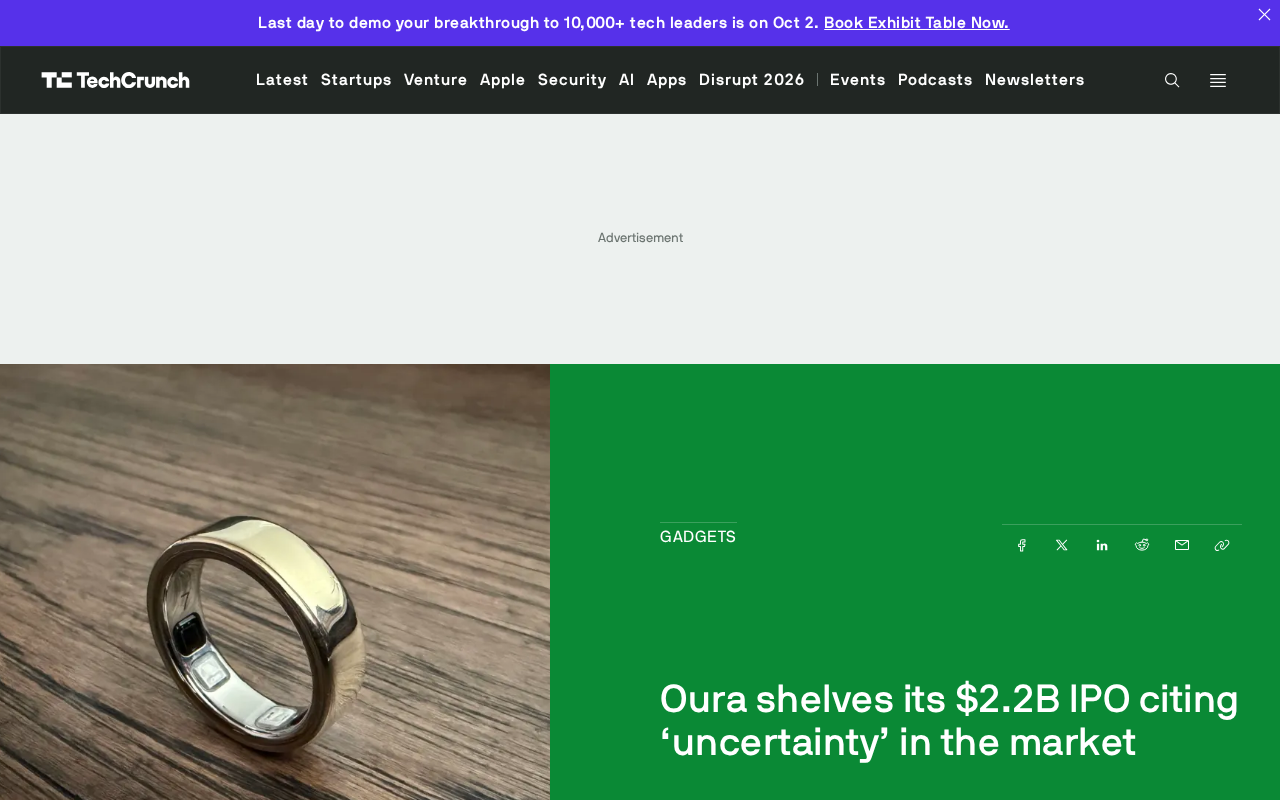
For a company that has already built meaningful brand recognition in the wearable health device space, voluntarily hitting pause on an IPO rarely signals a fundamental business problem. More often, it reflects a careful read of external capital market timing. Oura's decision to step back at this juncture is emblematic of the broader caution health tech companies are exercising in today's fundraising environment.
The Capital Logic Behind "Market Uncertainty"
Oura attributed the IPO delay to market "uncertainty" — a phrase commonly used by tech companies when postponing listings, but one worth unpacking. IPO pricing and final fundraising size are highly sensitive to sentiment in the secondary market. When volatility spikes and investor risk appetite contracts, companies often find they cannot complete an offering at their desired valuation.
For Oura, a $2.2 billion target valuation requires genuine buy-in from capital markets. Pressing forward in a subdued environment risks not only a discounted pricing outcome, but also reputational damage to the brand and a weakened position for future fundraising. Choosing to delay is fundamentally a strategy of trading time for leverage — waiting for a more favorable window to secure a more reasonable valuation.
The mechanics of IPO pricing amplify the importance of timing. Companies typically go through a roadshow phase before listing, presenting their business model and financial projections to institutional investors before settling on a price range through a bookbuilding process. This process is acutely sensitive to market sentiment: when indices like the Nasdaq are in a downtrend, the price-to-earnings or price-to-sales (P/S) multiples of comparable companies compress, directly pulling down the valuation anchor for Oura. Since 2022, a string of consumer health tech companies — including Bausch+Lomb and Corebridge — have broken their IPO prices shortly after listing, cementing more conservative pricing expectations among institutional investors. For hardware companies that are either pre-profitability or whose growth story hinges on subscription revenue expansion, this valuation pressure is especially acute. Had Oura pushed ahead in this window, the gap between its $2.2 billion target and what the market was actually willing to pay would have shown up as an issuance discount — damaging its first impression in the public markets.
Dual Impact on the Company and Its Shareholders
As indicated in the original reporting, the IPO delay will push back Oura's timeline for deploying the capital it had planned to raise. For a hardware and health data company still in expansion mode, IPO proceeds are typically earmarked for R&D, market development, supply chain investment, and potential M&A activity. A delay in when those funds arrive means the cadence of all those plans must be adjusted accordingly.
Existing shareholders are affected as well. An IPO is the primary exit and liquidity mechanism for early investors and employee stockholders. With the listing on hold, liquidity expectations for these stakeholders are deferred, and the equity they hold cannot be readily converted into cash returns in the near term. Managing these expectations internally is one of the more delicate communication challenges any company faces when postponing a planned IPO.
A Real-World Test for the Smart Ring Category
As the defining player in the smart ring category, Oura's IPO pause also reflects the broader capital market test facing wearable health tech. Compared to mature categories like smartwatches, smart rings remain a relatively niche market — one whose growth potential and path to commercialization still needs to be convincingly demonstrated to investors.
In an environment of rising uncertainty, investors tend to scrutinize hardware companies far more rigorously on profitability, user retention, and the monetization power of subscription services. Oura's choice to wait is, in part, an effort to arrive at a more favorable moment with a fuller set of business metrics — a stronger story to tell.
For the broader health tech industry, Oura's decision may carry some signal value: even category leaders must carefully weigh the timing and cost of going public when capital is becoming more selective.
As a subcategory, smart rings have a structurally different business model from smartwatches. Oura's core monetization logic runs on parallel tracks of hardware sales and monthly or annual subscription fees: users who buy the ring must pay a subscription to unlock the full suite of health data analytics (including sleep scores, readiness indices, and more). This "hardware + SaaS" hybrid model theoretically yields higher lifetime value (LTV), but it also means investors need to evaluate multiple dimensions simultaneously — hardware repurchase rates, subscription retention, and average revenue per user (ARPU). Unlike Apple Watch, which benefits from natural retention baked into the iOS ecosystem, Oura must independently prove that its data value proposition is compelling enough to sustain ongoing payment willingness. The entry of major players like the Samsung Galaxy Ring has also prompted capital markets to question the depth of Oura's moat — a key narrative challenge the company needs to address with business data before it can make a credible case for going public.
Conclusion
Oura's decision to shelve its $2.2 billion IPO is a rational, timing-driven choice — not a business-level setback. The real costs of delay — deferred capital deployment and postponed shareholder liquidity — are genuine, but securing a more favorable listing window may ultimately serve the company's long-term value far better. When Oura decides to restart its IPO process will depend on how market sentiment recovers and how the company's own business continues to perform.
Related articles

uGAP: An AI Platform Unifying 100+ African Geospatial Datasets
uGAP is an African geospatial AI platform by a University of Cape Town team, unifying 120+ African datasets with a Python SDK for discovery, processing, and model training, already used in cyclone flood mapping.

Cursor Can Now Control Your Computer: AI Agents Can Drive Desktop Apps for Testing
Cursor adds desktop control: AI agents can drive desktop apps like the iOS Simulator to test their own features. We analyze the impact on dev workflows, possible technical approaches, and reliability concerns.

Vibecoding a Custom Inference Engine: High Hopes, Harsh Reality
A Reddit developer shares the real experience of vibecoding a custom inference engine: running GGUF Q4 models in the browser with WebGL2 and GLSL, only to fall into tokenizer debugging hell. This article analyzes the engineering challenges of browser-side LLM inference and why cloning llama.cpp is the more rational choice.