Output Format Determines Silent Error Rate in Small-Model Semantic Parsing

For small-model semantic parsing, natural-language word encodings are more accurate, more token-efficient, and produce fewer silent errors than compact symbolic formats.
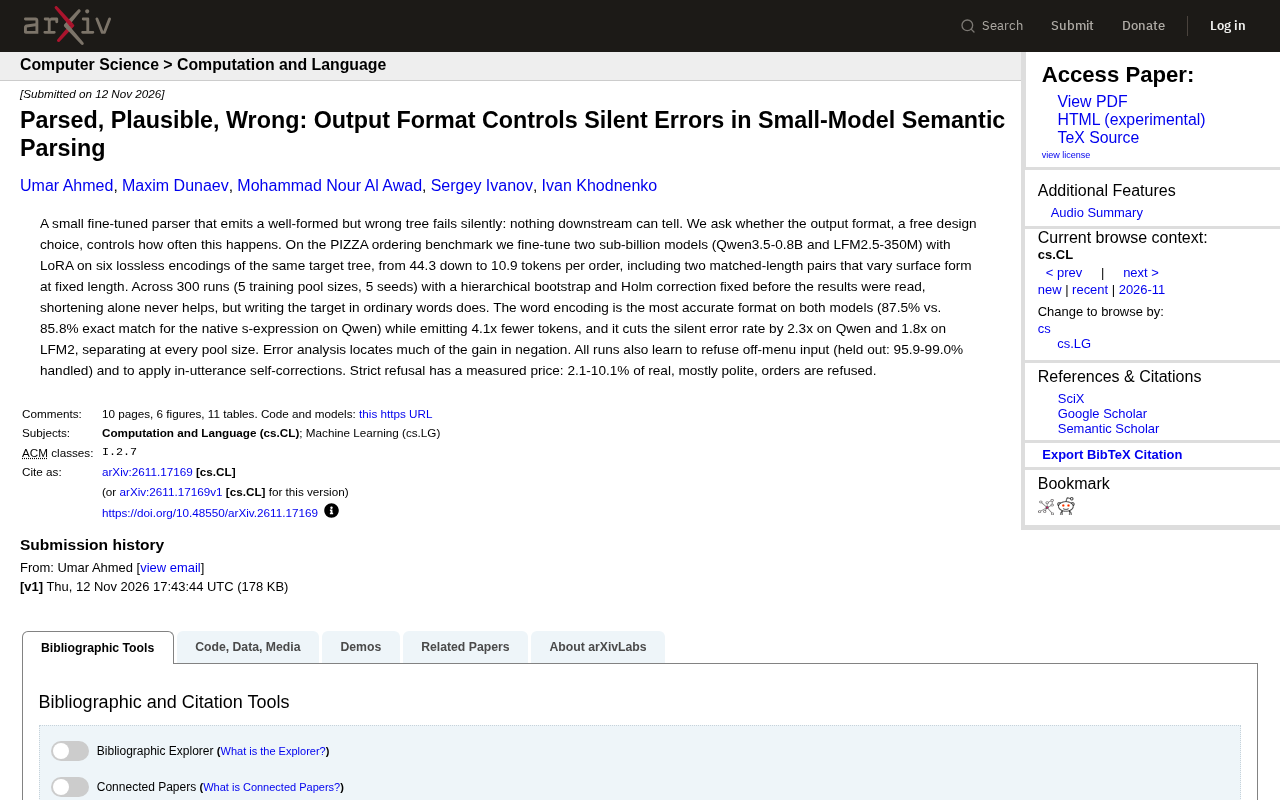
The study fine-tunes two sub-billion-parameter models on the PIZZA ordering benchmark, comparing six lossless output encodings. Simply shortening length does not help, but writing target trees in ordinary words significantly improves accuracy: on Qwen, exact match is 87.5% vs. 85.8% for s-expression, with 4.1× fewer tokens and a 2.3× lower silent error rate (1.8× on LFM2). Gains mainly come from negation handling. Models reject out-of-menu inputs at 95.9%–99.0%, but strict rejection falsely rejects 2.1%–10.1% of real orders. Output format is a key design choice affecting silent errors; natural-language encodings should be tested first.
When a small fine-tuned parser generates a syntactically well-formed but semantically incorrect tree, downstream systems cannot detect it—does this "silent error" depend on the free design choice of output format? A study on the PIZZA ordering benchmark answers yes, and overturns the intuition that "shorter is better."
Experimental Design: Six Lossless Encodings and Rigorous Statistics
The research team used LoRA to fine-tune two sub-billion-parameter models (Qwen3.5-0.8B and LFM2.5-350M), aiming to encode the same semantic tree in six lossless formats, compressing length from 44.3 tokens per order down to 10.9 tokens. These included two pairs of length-matched but surface-form-different encodings to disentangle the effects of "length" from "form."
The experiment covered 300 runs (5 training pool sizes × 5 random seeds), using hierarchical bootstrap and Holm correction, with the correction scheme fixed before reading results, ensuring statistical rigor.
Hierarchical bootstrap is a resampling statistical technique used to estimate confidence intervals for metrics (such as exact match rate). When data has a nested structure (e.g., multiple random seed runs under the same training pool size), ordinary bootstrap underestimates uncertainty. Hierarchical bootstrap first resamples at the higher level (e.g., training pool size), then at the lower level (e.g., random seed), thereby respecting the hierarchical dependence of the data and giving more conservative, reliable interval estimates. Combined with Holm correction (a method for controlling the false positive rate in multiple comparisons), the study can fix the analysis plan before reading results, avoiding p-hacking and ensuring that differences between formats are not random fluctuations.
Core Findings: Shortening Is Ineffective; Natural Language Encoding Wins
Simply shortening length never helped, but writing the target tree in ordinary words was significantly effective. Word encoding was the most accurate format on both models: on Qwen, exact match reached 87.5%, higher than native s-expression's 85.8%, while generating 4.1× fewer tokens.
More critically, the silent error rate: word encoding reduced it by 2.3× on Qwen and 1.8× on LFM2, and remained separated across every training pool size. This indicates that format choice has a substantive causal impact on error rate, not random fluctuation.
S-expression (symbolic expression) is a text format that represents tree structures with nested parentheses, e.g., (order (pizza (size large) (topping mushroom))). It is the native output form of Lisp-family languages and many parser generators, with the advantages of explicit structure and machine parseability, but lower token efficiency and a large gap from natural language surface forms. In the study, word encoding (e.g., writing the same tree in ordinary English words) slightly exceeded s-expression in exact match rate while reducing token count by 4.1×, showing that "symbolic compactness" is not equivalent to "model friendliness."
Error Analysis: Negation Is the Main Beneficiary
Error analysis localized most of the gain to negation handling. Natural language encoding makes it easier for the model to correctly parse negation constraints like "no onions," whereas compact symbolic formats may lose or confuse negation markers.
All runs also learned to reject out-of-menu inputs (95.9%–99.0% correctly handled on the held-out set) and could apply self-correction within an utterance. But strict rejection has a cost: 2.1%–10.1% of real orders (mostly polite expressions) were incorrectly rejected.
Silent error refers to an error where the tree generated by the parser is syntactically well-formed and can be normally accepted downstream, but is semantically inconsistent with the input. Unlike syntax errors, silent errors do not trigger parsing failures or exceptions, so downstream systems cannot detect them and may directly execute incorrect instructions (e.g., parsing "no onions" as "with onions"). In safety-sensitive scenarios such as ordering, silent errors are more dangerous than explicit failures. The study uses silent error rate as a core metric precisely because format choice may affect semantic fidelity without changing syntactic correctness.
Practical Implications
For small-model semantic parsing tasks, output format is not an irrelevant implementation detail. Encoding the target structure in natural language words can improve accuracy, substantially reduce tokens, and lower downstream-undetectable silent errors—especially when the task involves subtle semantics such as negation. When designing parsers, one should prioritize testing natural language output encodings rather than defaulting to the most compact symbolic representation.
One-line Summary
In small-model semantic parsing, natural language word encoding is more accurate, more token-efficient, and produces fewer silent errors than compact symbolic formats.
Paragraph Summary
The study fine-tunes two sub-billion-parameter models on the PIZZA ordering benchmark, comparing six lossless output encodings for semantic parsing. Results show that simply shortening length is not beneficial, while writing the target tree in ordinary words significantly improves accuracy: on Qwen, exact match of 87.5% exceeds s-expression's 85.8%, with 4.1× fewer tokens and a 2.3× reduction in silent error rate (1.8× on LFM2). Error analysis indicates the gain mainly comes from negation handling. The study also finds that models can reject out-of-menu inputs at a high rate, but strict rejection causes 2.1%–10.1% of real orders to be falsely rejected. The conclusion is that output format is a key design choice affecting silent errors, and natural language encodings should be prioritized for testing.
Related articles

Prompt Engineering for Beginners: From Writing Prompts to Engineering Thinking
Starting from the essence and four functions of prompts, this article systematically explains the six-step process, four success criteria, learning value, and practical limitations of prompt engineering to help you build a complete understanding.

Anthropic Launches Nasdaq IPO: AI Giant's Listing and Risk Disclosures
Anthropic officially launches its Nasdaq IPO under ticker ANT, with market valuation expected to potentially exceed SpaceX's record. The prospectus devotes nearly 100 pages to AI risks, while first-half revenue grew over 14x but net losses widened sharply, reigniting the AI bubble debate.

Rust cURL Clone Uses 4,832 unsafe Blocks—Is the Memory Safety Myth Broken?
A Rust cURL clone uses 4,832 unsafe keywords, challenging Rust's memory safety narrative. We analyze what unsafe really means, compare Fil-C, and examine rewrite motives.