Ovren Live Preview: Real-Time Product Change Previews in Natural Language

Ovren describes changes in natural language, generates code on a safe copy, and provides live real-page previews before merging the PR.
Ovren Live Preview is an AI coding collaboration tool that earned 135 votes and ranked 3rd on Product Hunt. Users describe front-end changes in natural language; Ovren generates code on a safe copy of the project and provides interactive live previews on the real page. After confirmation, the team merges the pull request. This moves preview before code merge, shortens feedback loops, and lets non-technical members participate in change verification. The article analyzes its positioning between AI code generation tools and low-code platforms and discusses challenges around complex project support, code quality, integration, and team trust.
In today's landscape of endless AI coding tools, Ovren Live Preview proposes an interaction model more aligned with team collaboration: describe a change in natural language, see it applied to your real page in real time, and merge the code after confirming. The product earned 135 votes and 38 comments on Product Hunt, ranking 3rd, categorized under Developer Tools, Artificial Intelligence, and No-Code.
What Is Ovren?
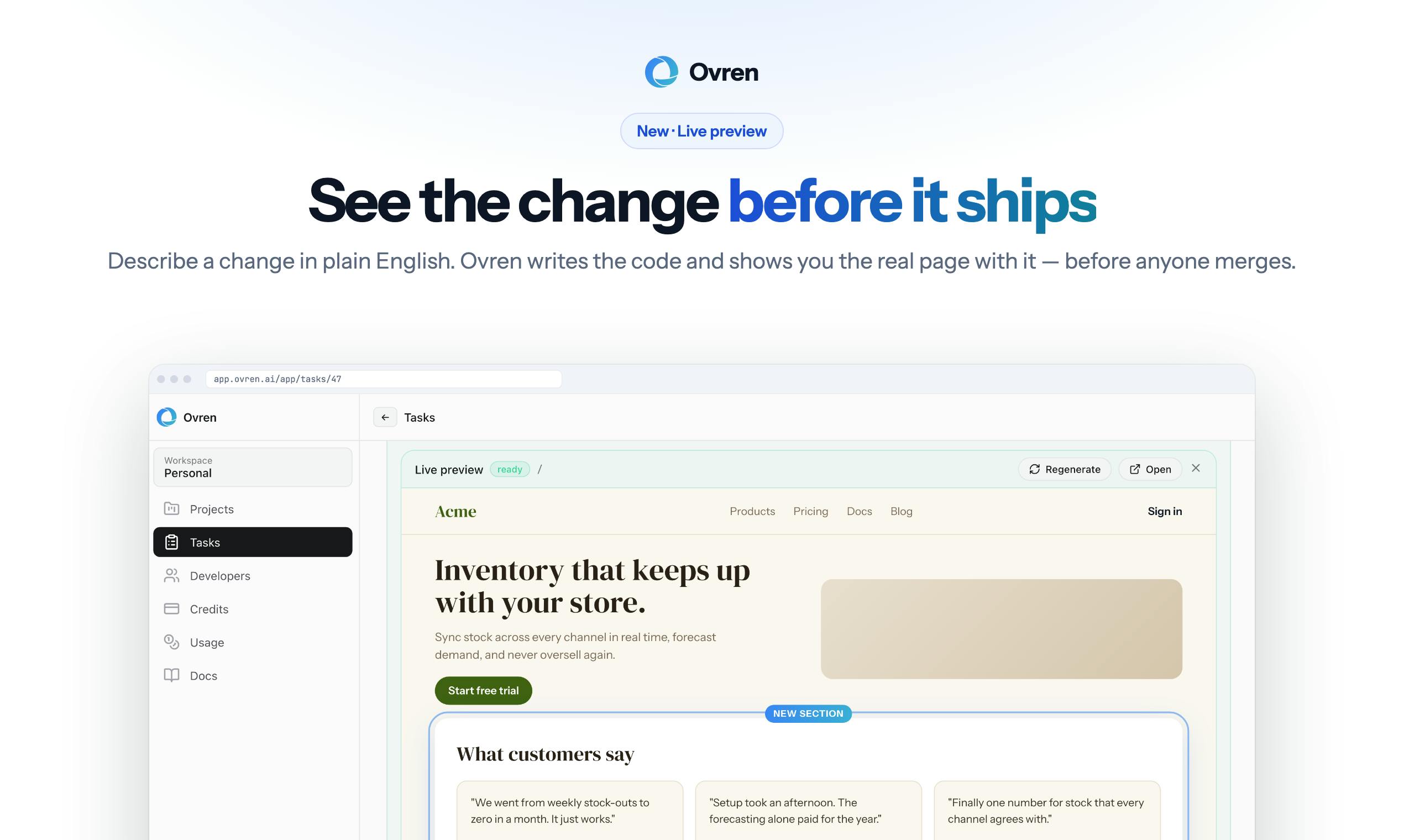
Ovren's core workflow is elegantly simple: you describe a change, Ovren writes code on a safe copy of your project, and provides a live preview of every front-end change — what you see is the real page, just with the new changes applied. You can click around, confirm, and your team merges the pull request.
This solves a common pain point of AI coding tools: generated code must go through merging and deployment before you can see the result, creating a long feedback loop and making it easy to discover issues only after merging. Ovren moves the preview to before the code merge, letting non-technical members participate in decisions intuitively.
Core Features Breakdown
Natural Language-Driven Changes
You don't need to write code or operate complex interfaces — just describe the desired change in plain language. Ovren converts it into code and executes it in an isolated environment. This lowers the barrier to participating in product iteration: product managers, designers, and even business stakeholders can directly propose and verify changes.
Natural Language to Code (NL2Code) refers to using large language models to automatically translate human intent described in everyday language into executable program code. Such systems are typically based on models pre-trained on massive code corpora (such as Codex, StarCoder, Code Llama, etc.), generating syntactically and stylistically appropriate code snippets by understanding context (such as project structure, existing files, dependencies). Because natural language is ambiguous, models often need to combine retrieval-augmented generation (RAG) or repository-level context to improve accuracy. In Ovren's scenario, NL2Code must not only generate code but also ensure the changes are runnable and previewable, placing higher demands on the model's ability to understand the specific project.
Real-Time Preview on the Real Page
The preview is not a static screenshot or simulator — it's the application running on the real page. You can click, navigate, and interact to experience the complete flow after the change. This "what you see is what you get" approach makes verification closer to the final user experience.
Live Preview in web development typically refers to the development server automatically rebuilding after code changes and instantly presenting updates via Hot Module Replacement (HMR) or hot reload technology without refreshing the page. Unlike static screenshots or design mockups, live preview runs the real front-end runtime, including real styles, scripts, and routing. To make the preview work on a "safe copy," the tool needs an isolated runtime environment (such as containerized sandboxes, separate branch deployments, or preview URLs) and injects changes into that environment. The consistency between preview and production depends on whether build configurations, dependency versions, and runtime environments match production — which is also one of the main engineering challenges such tools face in practice.
Safe Copy and Human Approval
All changes are made on a safe copy of the project, without directly affecting the main branch. After you confirm the preview, the team merges the pull request. This human-AI collaboration model improves efficiency while preserving code review and quality control.
Workflow and Team Collaboration
Ovren's flow can be summarized as: describe change → generate code on safe copy → live preview → click to confirm → team merges PR.
This flow integrates AI-generated content into the existing Git workflow rather than creating a separate system. For teams already using pull requests for code review, migration costs are low. Meanwhile, live preview means reviews no longer rely solely on code diffs — reviewers can intuitively see interface changes, which is especially suitable for products with frequent front-end changes.
Significance for the AI Coding Tools Market
Current AI coding tools roughly fall into two categories: code completion and generation tools that help developers write code faster, and low-code/no-code platforms that let non-developers build applications. Ovren sits between the two — it uses natural language to lower the barrier to changes while retaining code and PR processes.
The cleverness of this positioning is that it doesn't try to replace developers but brings product managers, designers, and other roles into the change verification process. As AI-generated code becomes increasingly common, "how to efficiently verify AI-generated changes" is becoming an independent problem, and Ovren offers an actionable answer.
Potential Challenges and Observations
Judging by the number of comments and votes on Product Hunt, Ovren has gained initial attention from developers and product teams. However, the success of such tools depends on several factors: the degree of support for complex front-end projects, the quality and maintainability of generated code, integration capability with existing tech stacks, and teams' trust in AI-generated code.
Additionally, how the "safe copy" mechanism is implemented and how consistency between preview and production environments is ensured are also key points to verify in actual use. Currently, details on these aspects are limited in public information and worth following up on.
Who Is It For?
Ovren seems best suited for the following scenarios:
- Product teams need to quickly verify front-end changes without waiting for the full development-deployment cycle;
- Non-technical members want to directly participate in change confirmation, reducing communication costs;
- Development teams want to accelerate iteration feedback without sacrificing code review.
If your team is looking for a way to make AI-assisted development more transparent and controllable, Ovren is worth adding to your watch list.
One-line Summary
Ovren describes changes in natural language, generates code on a safe copy, provides live previews on the real page, and merges the PR after confirmation.
Paragraph Summary
Ovren Live Preview is an AI coding collaboration tool that earned 135 votes and ranked 3rd on Product Hunt. Its core workflow: users describe front-end changes in natural language, Ovren generates code on a safe copy of the project, and provides interactive live previews directly on the real page; after users confirm the result, the team merges the pull request. This design moves the preview stage to before code merging, shortening the feedback loop and enabling non-technical members like product managers and designers to intuitively participate in change verification. The article analyzes its positioning between AI code generation tools and low-code platforms, noting its advantage of not replacing developers and preserving code review, while discussing potential challenges such as complex project support, code quality, tech stack integration, and team trust.
Related articles
Getting Started with Gemini 4 Argonne: A Hands-On Guide from Building Sites to Agents
Complete Gemini 4 Argonne tutorial: build a calorie tracker app with one prompt in Google AI Studio, review 10-page technical documents with long context, develop a browser game as a coding Agent in Anti-Gravity, plus API Key setup, pricing, and subscription requirements.

Cursor vs. Claude Code vs. Copilot: A Scenario-Based Selection Guide
Cursor, Claude Code, or GitHub Copilot? A scenario-based guide covering daily coding, large refactors and long tasks, and teams locked into existing IDEs—plus common pitfalls and combined-use advice.
DB Chat: Conversing with PostgreSQL in Natural Language, with AI Auto-Generating SQL
dbchat lets users converse with a PostgreSQL database in natural language, with an AI agent auto-generating SQL and returning live results. This article analyzes its MCP Server + Next.js + AWS full-stack architecture and anti-hallucination guardrail design.