OzBrain: A Shared Knowledge Brain for AI Agents, Solving the Team Knowledge Silo Problem
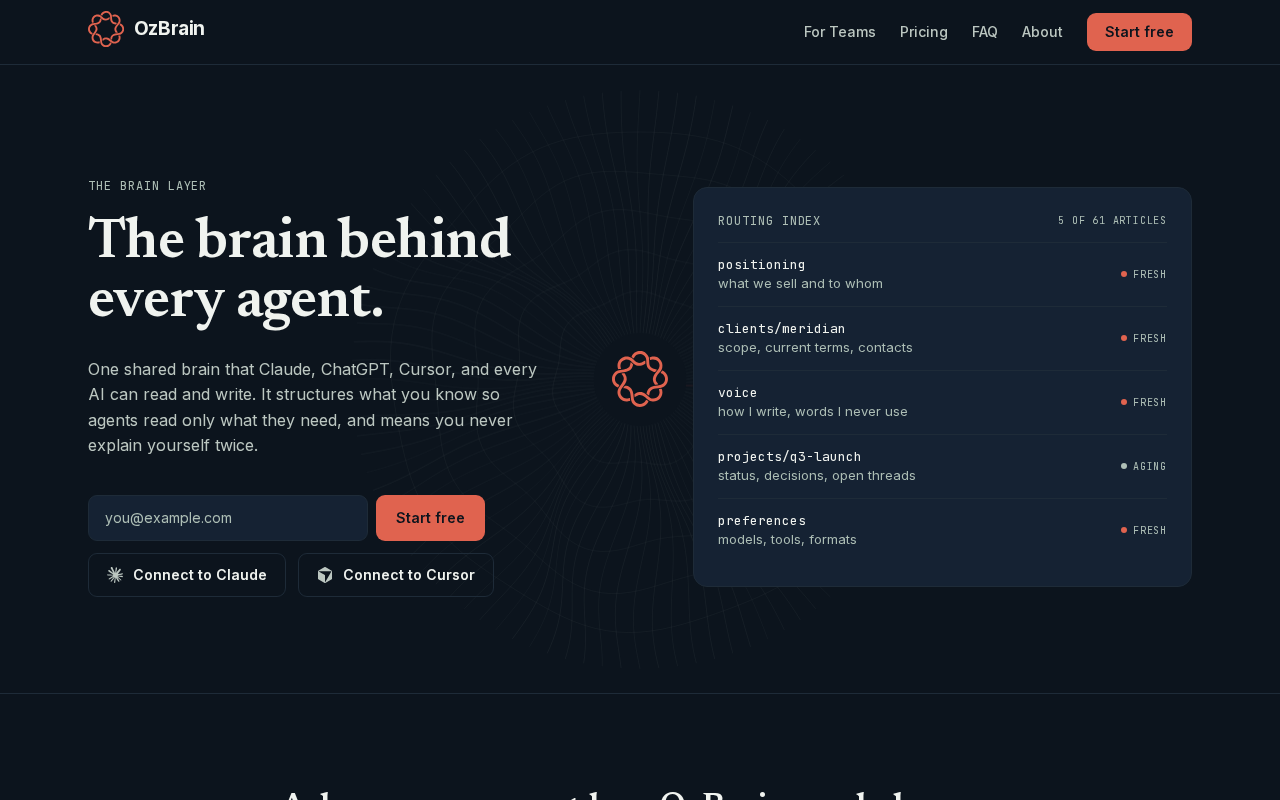
OzBrain builds a shared knowledge layer to unify AI Agent memory and team knowledge management.
OzBrain is a new project that addresses the growing problem of knowledge silos in AI-assisted development. By creating a centralized knowledge layer that both AI Agents and human team members can read from and write to, it aims to serve as a single source of truth for teams. The project unifies Agent memory with team knowledge management, tackling challenges like cross-tool knowledge sync, knowledge freshness, and secure multi-Agent collaboration.
When AI Agents Hit the Knowledge Silo Wall
Over the past two years, AI coding assistants and autonomous Agents have been rapidly integrating into software development workflows. However, an increasingly obvious pain point has emerged: the knowledge of each Agent and each team member is fundamentally siloed. After you've explained your project's architectural conventions, coding standards, or business context to one AI assistant, the next time you switch tools or open a new conversation window, you have to start from scratch. The same problem exists among human team members — new hires have to repeatedly ask questions, while experienced employees' knowledge is scattered across chat logs and their own heads.
Current mainstream AI coding tools like GitHub Copilot, Cursor, and Windsurf are all exploring different forms of context persistence. For example, Cursor supports .cursorrules files for defining project-level coding standards, and Claude's MCP (Model Context Protocol) aims to standardize how AI connects with external data sources. However, these mechanisms are fundamentally single-user, single-tool solutions that cannot achieve cross-tool, cross-person knowledge synchronization. It's like every developer maintaining their own private notes without a shared team Wiki.
Recently, the OzBrain project, launched as a Show HN on Hacker News, targets precisely this problem. Positioning itself as "a shared brain for knowledge between agents and your team," it quickly gained community attention and sparked lively discussion after its release — reflecting strong developer demand for AI knowledge sharing solutions.
What Problem Does OzBrain Solve?
From "Personal Memory" to "Shared Memory"
Most current mainstream AI coding tools have some form of contextual memory mechanism, but this memory is typically confined to a single user or a single session. OzBrain's core idea is to build a centralized knowledge layer that allows different AI Agents and human team members to read from and write to the same knowledge base.
In other words, when Agent A learns critical information about a code module while handling a task, that knowledge shouldn't vanish when the session ends. Instead, it should be preserved and made available on demand to Agent B, Agent C, and even the engineers on the team. This essentially upgrades "memory" from a tool's private attribute to team-level public infrastructure.
Current mainstream AI Agent frameworks like LangChain, LlamaIndex, AutoGen, and CrewAI all include memory modules at various levels. These memories are typically categorized as short-term memory (current conversation context), long-term memory (persistent storage across sessions), and working memory (intermediate states during current task execution). For instance, LangChain provides multiple memory strategies such as ConversationBufferMemory and ConversationSummaryMemory; Mem0 (formerly OpenMemory) focuses on providing an independent memory layer service for AI applications. However, most of these solutions focus on single-Agent scenarios. When multiple Agents need to collaborate, synchronizing and sharing memory among them remains an open challenge. OzBrain aims to provide a solution at this level, elevating memory from an internal Agent component to an independent shared infrastructure.
Why Knowledge Sharing Is Especially Critical in the Agent Era
As more Agents run in parallel within development workflows, knowledge consistency issues get amplified. If each Agent acts on its own incomplete context, contradictory decisions easily arise — for example, one Agent following an old API convention while another uses a new specification. A shared knowledge source can serve as a "single source of truth" (SSOT), reducing the rework and errors caused by such inconsistencies.
Single Source of Truth (SSOT) is a core principle in software engineering and data management, stating that each piece of data or knowledge in a system architecture should have one and only one authoritative source. This principle is widely applied in microservices architecture, database design, configuration management, and more. For example, in DevOps practices, Infrastructure as Code (IaC) tools like Terraform emphasize using declarative configuration files as the sole source of truth for infrastructure state. In AI Agent collaboration scenarios, the lack of SSOT leads to so-called "knowledge drift" — different Agents holding different versions of the same concept. Over time, this divergence compounds like a split-brain problem in distributed systems, eventually making system behavior unpredictable.
OzBrain's Technical Positioning and Design Philosophy
A Knowledge Hub for Human-Machine Collaboration
The most noteworthy aspect of OzBrain is that it doesn't treat "Agent memory" and "team knowledge management" as separate concerns — instead, it unifies both within a single system. This design philosophy means:
- For AI Agents, it serves as an external memory layer for retrieval and writing, compensating for large models' limited context windows and inability to persist information across sessions;
- For teams, it functions as a dynamically updated knowledge base that is not only maintained by humans but can also be automatically enriched by AI during its workflow.
This human-machine co-authoring model could theoretically keep the knowledge base perpetually "fresh," avoiding the traditional Wiki's pitfall of "written once, never maintained." Managing knowledge freshness is a long-standing challenge for all knowledge management systems. In software development, API interfaces get upgraded, framework versions iterate, and architectural decisions get overturned — meaning information in knowledge bases has a natural "half-life." The core reason traditional internal Wikis (like Confluence or Notion) often devolve into "knowledge graveyards" is the lack of effective knowledge decay and update mechanisms — documents go unmaintained after being written and gradually diverge from reality. Technical approaches to solving this include: time-stamp-based knowledge weight decay, automatically triggering related documentation reviews upon code changes, and leveraging AI Agents to automatically verify and update the accuracy of existing knowledge during task execution. OzBrain's proposed "human-machine co-authoring" model is precisely an exploration in this direction.
Relationship to RAG and AI Memory Systems
From a technical lineage perspective, OzBrain belongs to the rapidly evolving "AI memory systems" space, closely related to Retrieval-Augmented Generation (RAG), vector databases, and memory modules in various Agent frameworks. The key difference is its emphasis on cross-Agent, cross-team shareability, rather than private memory within a single application.
RAG (Retrieval-Augmented Generation) is currently the mainstream technical paradigm for addressing large models' knowledge staleness and domain knowledge gaps. The core approach is: before generating a response, retrieve document fragments relevant to the user's query from an external knowledge base and inject them as context into the prompt, enabling the model to reason based on the most current and accurate information. RAG systems typically rely on vector databases (such as Pinecone, Weaviate, Milvus, etc.) for semantic retrieval — documents are first converted into high-dimensional vectors through embedding models, then content semantically closest to the query is found using algorithms like cosine similarity. Shared knowledge systems like OzBrain essentially need to solve more complex problems on top of RAG: knowledge fusion from multiple write sources, conflict detection, and cross-role permission management.
Key challenges for such systems typically include:
- Accuracy of structured knowledge storage and semantic retrieval
- Conflict handling during concurrent writes from multiple Agents
- Fine-grained permission and privacy boundary control
- Knowledge freshness management and version traceability
Core Concerns from Community Discussion
As a Show HN project, OzBrain sparked discussion centered on several practical questions:
- Integration capabilities: How does this system integrate with existing AI coding tools (like Cursor, Copilot, etc.)?
- Write mechanisms: Is knowledge ingestion automatic or does it require human review?
- Security boundaries: How do you ensure sensitive information isn't incorrectly shared with unauthorized Agents or team members?
These questions point directly to the most realistic barriers for deploying shared knowledge systems. The more knowledge is shared, the more critical permission and trust management becomes. Once a team-level brain is contaminated with incorrect information or leaks content that shouldn't spread, the damage can be worse than not having it at all. Therefore, trustworthiness, auditability, and fine-grained access control are often the decisive factors determining whether enterprises will adopt such products.
Deploying AI knowledge sharing systems in enterprise environments faces strict security and compliance requirements. First is the data classification challenge — information at different sensitivity levels (such as customer data, trade secrets, internal architecture details) requires different access control policies. Second is audit traceability — compliance frameworks like GDPR and SOC 2 require complete logging of data access and modification activities. Additionally, there's the emerging topic of "AI supply chain security": when AI Agents automatically write information to the knowledge base, how do you prevent Prompt Injection attacks from contaminating it? How do you prevent incorrect information generated by AI Hallucinations from being preserved as fact? These issues require systems to go beyond traditional RBAC (Role-Based Access Control) mechanisms, incorporating multiple layers of protection such as knowledge quality assessment, source credibility scoring, and human review workflows.
Industry Trends in AI Knowledge Management
OzBrain's emergence is not an isolated case but reflects a trend that's taking shape: AI infrastructure is extending from "model capabilities" to "memory and knowledge management." As the reasoning capabilities of large models become increasingly commoditized, how to efficiently accumulate, organize, and reuse knowledge with AI is becoming the new battleground for differentiation.
For development teams, the value of such tools lies in reducing "knowledge transfer costs" — whether the transfer is human-to-human, human-to-AI, or AI-to-AI. If this link can be truly connected, both team collaboration efficiency and Agent reliability stand to gain substantial improvements.
Of course, as an early-stage project, OzBrain still needs to validate its retrieval quality, integration convenience, and security model through real-world usage. But the direction it represents — building a shared, persistent knowledge layer for humans and AI — is undoubtedly one of the most imaginative propositions of the Agent era.
Summary
OzBrain attempts to answer an increasingly urgent question: in an environment where humans collaborate with multiple AI Agents, how should knowledge be shared and preserved? By unifying Agent memory and team knowledge management into a "shared brain," its approach aligns with the broader trend of AI infrastructure evolving toward a memory layer. For developers focused on AI engineering in production, projects like this are worth following closely — their level of maturity will largely determine the ceiling of what human-machine collaboration can achieve in the future.
Related articles
ROS2 Beginner's Guide: Understanding the Core Framework for Robot Development from Scratch
A comprehensive introduction to ROS2 core concepts, version selection, and learning paths. Covers ROS1 vs ROS2 differences, Humble vs Jazzy comparison, and version compatibility tips for beginners.
Open-Source AI Agents for Computer Control: A Comprehensive Guide to Multi-Model Integration
Explore how open-source AI Agent frameworks enable computer control with multi-model support. Compare AutoGPT, LangChain, and Open Interpreter with DeepSeek V3 integration.

LeaseBase: A Landlord Management Tool That Replaces Data Dashboards with AI Compliance Advice
LeaseBase is an AI compliance assistant for California landlords, offering proactive legal guidance, integrated payments, repairs & lease management. A deep analysis of its vertical SaaS strategy.