Paid for Claude Pro, Then Asked for Government ID — Refused and Got Banned

A user paid to upgrade to Claude Pro, was asked to submit a selfie with a government ID for verification, and upon refusal was banned with the money unaccounted for.
A Reddit user reported that they paid to upgrade to Claude Pro for increased usage, had their credit card charged, but upon logging in was asked to complete identity verification through third-party provider Persona Identities, with the process escalating to a selfie holding a government ID. The user refused to submit their documents upon discovering Persona's close partnership with data analytics company Palantir, and their account was subsequently fully banned, with even basic services inaccessible and refund status unclear. Their post in the official Claude and Anthropic subreddits was immediately deleted, prompting them to warn potential users in other communities. The incident has sparked discussion about identity verification processes in AI subscription products, third-party privacy risks, and consumer rights protection. Anthropic has not yet responded.
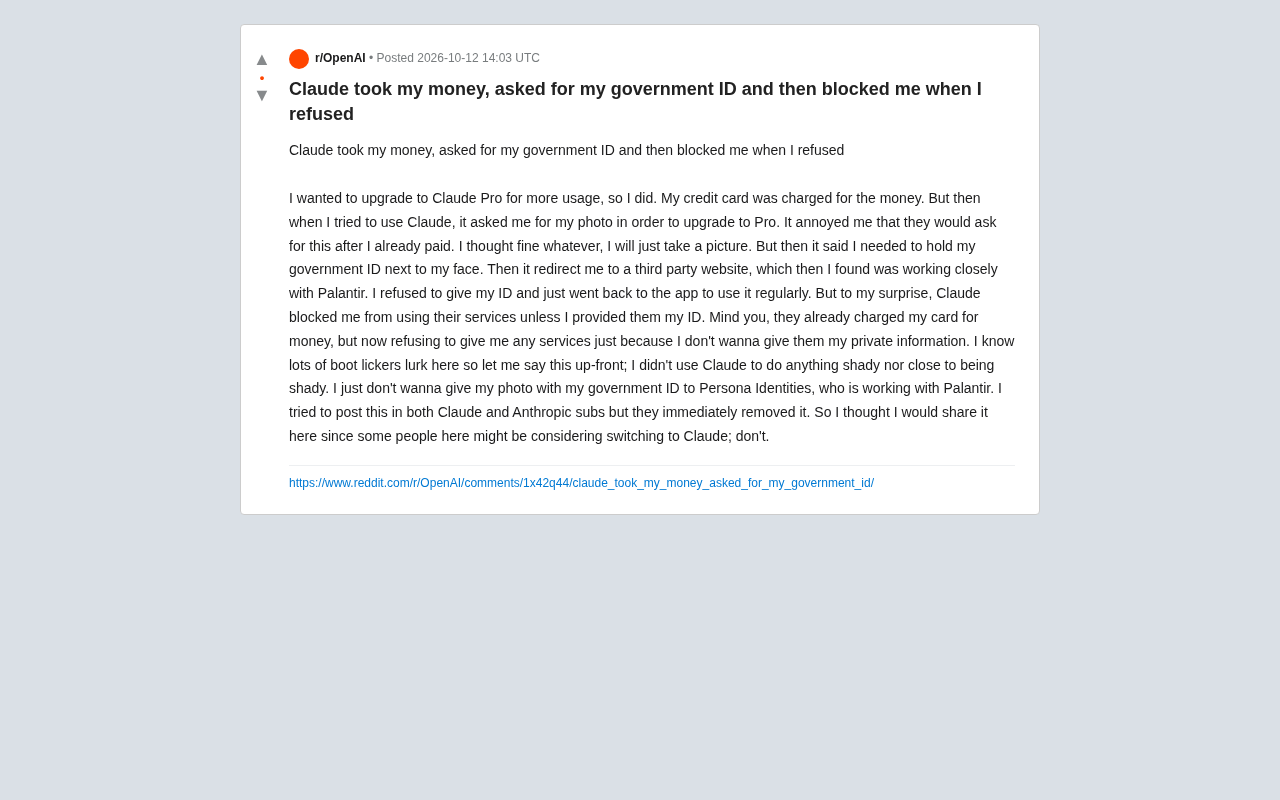
A Reddit user recently shared a frustrating experience upgrading to Claude Pro: their credit card was charged, yet when they tried to use the service, they were asked to submit a selfie holding a government-issued ID. After refusing, their account was immediately banned. The user emphasized that they had done nothing wrong — they simply didn't want to hand over sensitive information, including their face and ID, to a third-party identity verification company called Persona Identities.
Paid Successfully but Unable to Use: An Identity Verification Ordeal
According to the user, they decided to upgrade to Claude Pro to get more usage quota. The payment process went smoothly and their credit card was indeed charged. However, when they returned to the Claude app to start using it, the system popped up an identity verification request.
At first, they thought it was just a selfie, and although they were unhappy about the "pay first, verify later" order, they went along with it. But the verification process then escalated — requiring them to take a photo holding a government ID next to their face, and redirecting them to a third-party website. After investigating, the user found that this verification provider, Persona Identities, has a close working relationship with data analytics company Palantir.
This discovery was what ultimately led them to refuse to provide their ID.
Refusing Verification Means Getting Banned, Refund Status Unclear
What the user didn't expect was that after refusing to submit their ID, not only could they not use Claude Pro features — even basic services were blocked. In the post, they wrote: "They already took money from my card, but because I didn't want to hand over private information, they refused to provide any service."
The post didn't mention whether a refund was received, but based on the phrase "took my money," the user believes the fee has effectively been withheld. This approach of "cutting off service unilaterally after payment" is quite rare among subscription-based AI products.
KYC (Know Your Customer) is an identity verification system commonly used in finance and regulated industries to prevent money laundering, fraud, and sanctions evasion. In recent years, as countries tighten regulations on AI service exports, content compliance, and minor protection, some AI companies have begun introducing KYC into account registration or premium subscription processes.
But KYC typically occurs before service activation: verify identity first, then collect payment and provide service. In this case, however, the sequence of "charge first, then require verification, then ban upon refusal" is clearly anomalous — from a contract law perspective, the user paid consideration but did not receive corresponding service. If the platform unilaterally terminates service without a refund, it could constitute breach of contract or unjust enrichment. This is also why the incident stands out among AI subscription products: the vast majority of platforms, even if their ban-and-refund processes are slow, provide a clear path — rather than cutting off service directly when no violation has occurred.
Third-Party Verification Raises Privacy Concerns
The core controversy in this incident lies in the third-party partner involved in the identity verification step. Persona Identities is a platform providing identity verification services, while Palantir is known for its government and large-enterprise data analytics business. For privacy-conscious users, handing over their facial biometrics and government ID to a company associated with Palantir constitutes a significant psychological barrier.
The user particularly emphasized that they had not used Claude for any suspicious activity — "I haven't done anything shady with Claude, I just don't want to hand over a photo with my government ID to Persona Identities, which works with Palantir."
Persona Identities is a San Francisco-based identity verification provider founded in 2018, primarily offering remote KYC (Know Your Customer) and identity verification capabilities for fintech, the sharing economy, and AI platforms. Its core technology involves collecting user selfies and government ID photos and performing liveness detection and facial matching to confirm that "the person on the other end of the screen is indeed the document holder."
Palantir, meanwhile, is a data analytics company known for its government and defense contracts, long providing data integration and mining platforms to intelligence agencies, law enforcement, and large enterprises. The connection between Persona and Palantir (including ties at the investment, personnel, or data cooperation level) raises concerns because it means user-submitted biometric and ID information could enter a data chain that heavily overlaps with the government surveillance ecosystem.
For privacy-sensitive users, this isn't just a matter of "handing photos to a startup" — it's a matter of "whose hands the photos might end up in next." This also explains why the user chose to give up the service they had already paid for rather than complete verification.
Community Post Deletion Deepens User Frustration
What frustrated the user even more was that when they tried to post about this experience in the official Claude and Anthropic subreddits, the post was immediately deleted. They ultimately chose to share it in other Reddit communities and issued a direct warning to users considering switching to Claude: "Don't use it."
This deletion itself sparked discussion — if users' genuine paid experiences cannot be expressed in the official community, potential consumers lose an important reference for decision-making. As of now, Anthropic has not made a public response to this incident. Whether identity verification has become a mandatory process for Claude Pro and what the refund policy is after refusing verification both remain to be confirmed.
The post deletion mechanisms in Reddit subreddits are typically enforced through a combination of subreddit rules, AutoModerator, and human moderators. Official subreddits for tech companies are often managed by company employees or moderators close to them, so it's not uncommon for posts involving refund disputes, ban complaints, and privacy controversies to be quickly removed.
From a consumer protection perspective, this phenomenon of "official communities only keeping positive feedback" weakens the public information ecosystem: new users often see curated reviews before making decisions, while the real payment risks are pushed to third-party forums or review sites. For a company like Anthropic, which brands itself around "responsible AI," how the official community handles negative experiences is itself part of its credibility.
One-line Summary
A user paid to upgrade to Claude Pro, was asked to submit a selfie with a government ID for verification, and upon refusal was banned with the money unaccounted for.
Paragraph Summary
A Reddit user reported that they paid to upgrade to Claude Pro for increased usage, had their credit card charged, but upon logging in was asked to complete identity verification through third-party provider Persona Identities, with the process escalating to a selfie holding a government ID. The user refused to submit their documents upon discovering Persona's close partnership with data analytics company Palantir, and their account was subsequently fully banned, with even basic services inaccessible and refund status unclear. Their post in the official Claude and Anthropic subreddits was immediately deleted, prompting them to warn potential users in other communities. The incident has sparked discussion about identity verification processes in AI subscription products, third-party privacy risks, and consumer rights protection. Anthropic has not yet responded.
Related articles

5 Practical Ways Real Estate Agents Can Use AI to Boost Efficiency (2026 Edition)
How can real estate agents use AI to boost efficiency? Based on a YouTube walkthrough, this breaks down five methods — ChatGPT for listing descriptions, Canva for marketing materials, forms for open house leads, Zapier for automated follow-up, and seller meeting prep — and flags risk boundaries like fair housing laws, photo authenticity, and price verification.

Grok Bot vs ChatGPT Agent: Which AI Agent Is More Powerful?
How does Grok Bot differ from ChatGPT Agent? This comparison examines how they work: Grok Bot has a cloud computer and runs persistently inside tools to execute multi-step tasks automatically; ChatGPT Agent operates web pages in a browser and is more mature at general tasks. Includes selection advice.

Walmart Agent Gateway: AI Shops for You Automatically—Why Is Amazon Going the Opposite Way?
Walmart's Agent Gateway lets ChatGPT, Gemini and other AI assistants access its product catalog to search, compare and add to cart, with spending limits and per-purchase approval. Amazon blocks external AI agents—two retail giants, opposite paths. Currently US-only, India may follow.