Palantir CEO Warns: AI Development Needs a Reasonable Regulatory Framework
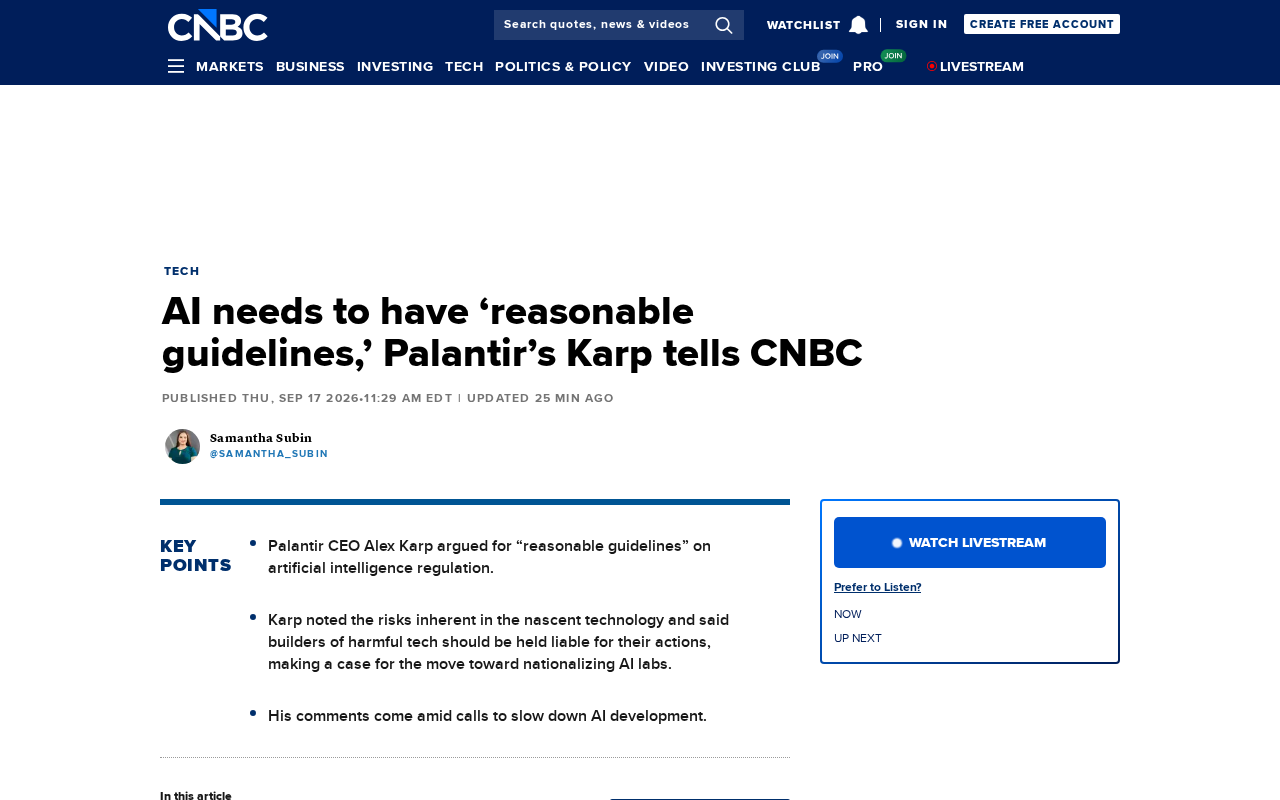
Palantir CEO Karp calls for "reasonable guidelines" for AI, urging a pragmatic balance between innovation and oversight.
Palantir co-founder and CEO Alex Karp has publicly stated that AI development requires "reasonable guidelines" — a position that acknowledges the need for regulation while warning against stifling innovation. As a data analytics firm deeply embedded in government, military, and intelligence operations, Palantir carries unique weight in AI ethics debates. A company so involved in sensitive applications proactively calling for regulatory frameworks signals awareness that unconstrained AI could trigger a crisis of trust. Karp's remarks also reflect a broader industry shift: tech leaders are moving from resisting government intervention to actively shaping global AI governance frameworks in order to have a voice in how the rules are written.
Introduction: The AI Regulation Debate Resurfaces
Palantir co-founder and CEO Alex Karp recently shared his views on the direction of AI development, emphasizing that artificial intelligence needs "reasonable guidelines." Against the backdrop of rapid AI iteration and an still-evolving regulatory landscape, his remarks have once again drawn industry attention to the central question of balancing technological innovation with governance.
As a company deeply involved in data analytics for government and defense, Palantir has long been at the center of debates around AI ethics and regulation. Karp's comments carry particular weight — they come not only from a practitioner at the technological frontier, but from a business leader who has thought deeply about AI's social implications.
The Core of Karp's Argument: Not Whether to Regulate, But How
Karp's advocacy for "reasonable guidelines" reflects an important position: AI regulation should neither be absent nor stifle innovation. The word "reasonable" itself signals a search for balance between two extremes.
AI governance discussions have long been defined by two opposing camps. One side fears that regulatory lag will create uncontrollable technological risks and calls for strict constraints as soon as possible. The other worries that premature or excessive regulation will kill innovation and subject technological progress to bureaucratic processes. Karp's stance leans toward a pragmatic middle ground — acknowledging the necessity of regulation while emphasizing that it must be "reasonable."
For a company like Palantir, whose business is heavily dependent on data analytics and AI capabilities, this position also aligns with its commercial interests: a clear, predictable regulatory environment that doesn't choke innovation is exactly what companies need when planning long-term technology investments.
Why Palantir's Voice Matters
Palantir is no ordinary tech company. It has long provided data integration and analytics services to government agencies, the military, and large enterprises — technologies that directly touch sensitive domains such as national security and public safety. For this reason, Palantir's stance on AI regulation is often seen as an important bellwether for the industry.
When a company so deeply embedded in sensitive applications proactively calls for a regulatory framework, it sends a signal: even technology leaders recognize that unconstrained AI development can trigger a crisis of trust and social backlash. Establishing reasonable rules is, in some sense, laying the groundwork for the entire industry's sustainable development.
Palantir was founded in 2003 by Peter Thiel, Alex Karp, and others. Its name is drawn from the "palantíri" — the seeing stones in The Lord of the Rings. The company's core products include the Gotham platform for government clients and the Foundry platform for enterprises. Gotham has reportedly been used by the CIA, FBI, and military agencies in multiple countries for intelligence analysis and counter-terrorism operations; during the 2011 operation that killed Osama bin Laden, Palantir's data analysis tools were reportedly used for intelligence integration. This deep entanglement with state machinery means that any position Palantir takes in AI ethics discussions carries strong real-world political implications — its calls for "reasonable regulation" inevitably encompass the most contentious application areas: military AI, surveillance technology, and predictive policing.
The Global Context of AI Regulation
Karp's remarks are not an isolated event — they are a microcosm of a global wave of AI governance activity. In recent years, governments and international organizations around the world have accelerated their efforts to legislate and establish norms around AI. From the EU AI Act to various industry self-regulatory frameworks, drawing boundaries around powerful AI capabilities has become a global issue.
Against this backdrop, attitudes toward regulation within the tech industry have been quietly shifting. In the past, many tech leaders resisted government intervention; today, a growing number of industry voices are actively engaging in discussions about regulatory frameworks, seeking a seat at the table rather than passively accepting rules handed down to them. Karp's remarks reflect this broader shift.
The EU Artificial Intelligence Act (EU AI Act) officially came into force in 2024, making it the world's first comprehensive AI regulatory legislation. The Act uses a risk-tiered framework, classifying AI applications into four categories: unacceptable risk (e.g., social credit scoring systems — outright banned), high risk (e.g., medical diagnostics and law enforcement tools — subject to strict compliance review), limited risk, and minimal risk. For companies like Palantir that provide AI tools to law enforcement and defense agencies, a large portion of their products fall squarely into the "high risk" category, meaning they must meet a range of mandatory requirements around data governance, transparency, and human oversight. This helps explain why industry leaders are now proactively engaging in rule-making — better to shape a favorable framework during the legislative process than to scramble for compliance after the fact.
Conclusion: The Difficulty of Balance
"Reasonable guidelines" sounds simple, but implementing them is extraordinarily challenging. How "reasonable" is defined, who gets to define it, and how rules can remain flexible in the face of rapidly changing technology are all questions without easy answers.
Karp's call offers a framework worth reflecting on, but the real test lies in translating these principles into enforceable policy. For practitioners, regulators, and the public navigating the AI wave, this debate over the boundaries of technology is only just beginning.
Note: This article is based on a brief report from Hacker News. The full context of Karp's remarks awaits additional sourcing.
Related articles

Using Claude Code for Free in China: A Complete Guide to Connecting Free Domestic Models
A step-by-step guide for China-based users to run Claude Code for free by connecting Meituan's open-source LongCat model API — no paid subscription needed.

Getting Started with Claude Code: A Beginner's Guide to AI-Powered Coding
Claude Code is a locally-run AI coding agent that reads your entire project and auto-debugs code. Compare it with Copilot, Cursor, TRAE, and Codex to see why it leads the pack.

14K Stars Open-Source Desktop App cc-haha: 5 AI Agents That Divide and Conquer on Their Own
cc-haha, the open-source Claude Code desktop app with 14K Stars, adds Agent Teams: 5 AI agents autonomously divide tasks, with a 99% cache hit rate on 40M tokens.