Palo Alto Networks in Talks to Acquire AI Agent Security Startup Clutch for $500M
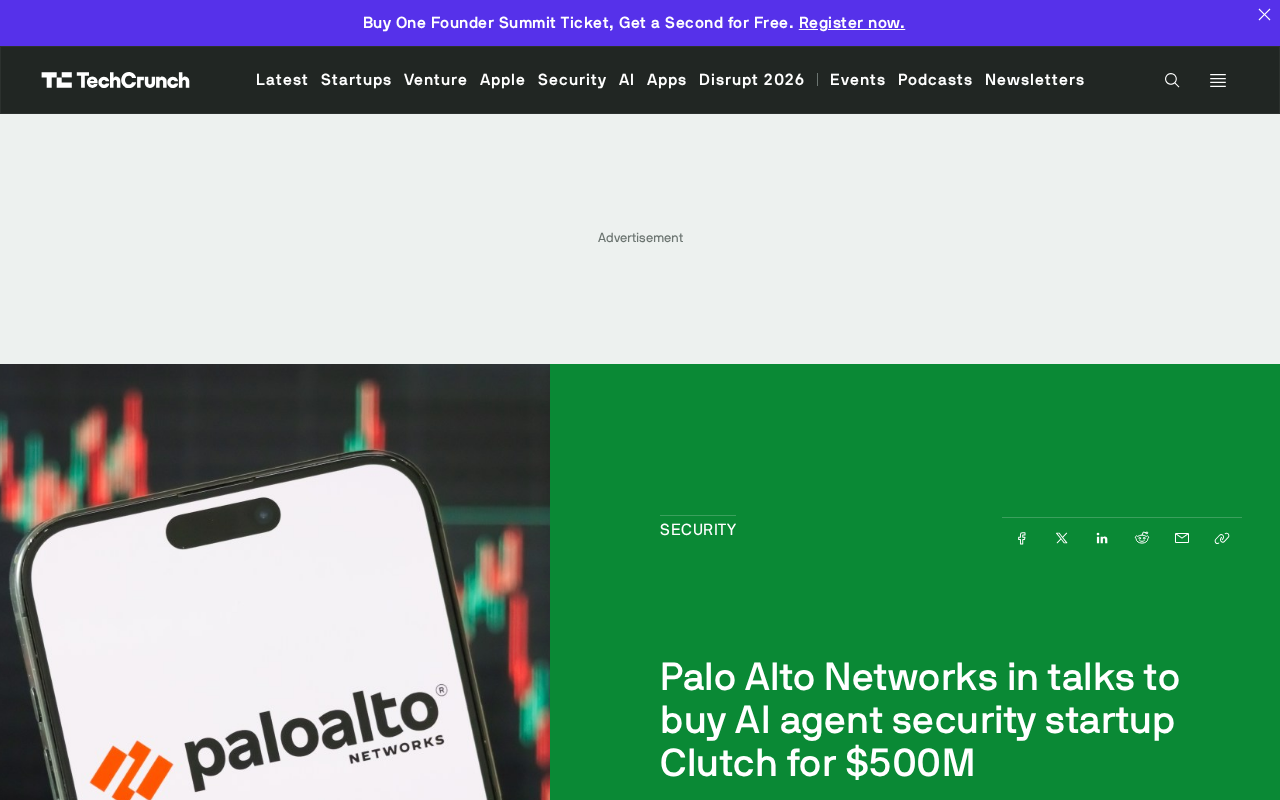
Palo Alto Networks may acquire AI agent security firm Clutch for $500M, a near-5x premium.
Palo Alto Networks is negotiating to acquire AI agent security startup Clutch for up to $500 million. Clutch, backed by Lightspeed and SignalFire, was last valued at about $85 million — a deal would imply a nearly 5x premium. The article examines the strategic rationale: as LLM-powered agents handle more automated tasks, their ability to invoke tools, access sensitive data, and perform multi-step operations creates new attack surfaces like prompt injection and permission abuse that traditional security tools can't cover. A completed deal would bring this capability into Palo Alto's platform, closing the loop from network perimeter to AI runtime, and could trigger a wave of similar acquisitions. Talks are ongoing and terms may change.
Palo Alto Networks is in negotiations to acquire AI agent security startup Clutch, with the deal potentially reaching $500 million. The news, disclosed via an RSS feed, has drawn widespread industry attention to the AI agent security space.
Deal Overview: Strategic Intent Behind the High Premium
According to the RSS source, Clutch was previously backed by Lightspeed and SignalFire, with its most recent round valuing the company at approximately $85 million. A $500 million deal would imply a premium of nearly 5x — particularly striking against the backdrop of a cooling primary funding market.
As a leading player in cybersecurity, Palo Alto Networks has been steadily filling out its capability portfolio through acquisitions in recent years. Its focus on AI agent security reflects growing corporate vigilance over the new attack surface created by autonomous AI systems. Clutch's specific product details have not been made public, but given its positioning, it likely focuses on behavior monitoring, permission controls, or runtime protection for AI agents.
Why AI Agent Security Is Becoming a New Battleground
As LLM-powered agents take on more automated tasks in enterprise settings, their security risks have shifted from theoretical to real. Agents can invoke tools, access sensitive data, and execute multi-step operations — and once compromised by prompt injection or permission abuse, the damage far exceeds that of traditional chatbots.
Traditional security products struggle to cover the dynamic behavior of agents, creating opportunities for startups focused on this area. The backing of Lightspeed and SignalFire shows that capital had already spotted this gap. If Palo Alto Networks completes the acquisition, it will fold this capability directly into its platform, forming a closed protection loop from network perimeter to AI runtime.
Prompt Injection is a key concept for understanding agent security risks. It refers to attackers crafting inputs that trick large models into deviating from their original instructions and executing the attacker's intent. Unlike traditional software vulnerabilities, prompt injection exploits the model's tendency to follow natural language instructions, making it difficult to fully remediate with patch-style fixes. In agent scenarios, the risk is further amplified: agents typically have permission to invoke external tools, read and write data, and make network requests, so a single successful injection can trigger a chain of unauthorized operations. The industry currently builds defenses primarily through input filtering, least-privilege controls, human approval of critical actions, and runtime behavior monitoring — but these approaches have yet to form mature standards, which is precisely why startups focused on this area are valued by strategic buyers.
AI Runtime Protection contrasts with the traditional perimeter defense approach. Firewalls, intrusion detection, and similar products focus mainly on network perimeters and known attack signatures, whereas AI agents generate behavior dynamically and in context when executing tasks — there are no fixed signatures to match. Runtime protection therefore shifts to real-time observation and policy constraints on an agent's actual actions, such as limiting the set of tools it can invoke, monitoring anomalous data access patterns, and inserting interception or approval steps before sensitive operations. This approach is closer to a combination of RASP (Runtime Application Self-Protection) and behavior analytics products, requiring deep integration into the agent's execution chain. The high engineering barrier also constitutes the technical moat for relevant startups.
Potential Impact on the Industry Landscape
If the deal goes through, it could trigger a chain reaction. On one hand, top security vendors will accelerate acquisitions of AI security startups, driving up valuations for quality targets; on the other hand, AI agent security will move from a niche segment into mainstream procurement checklists, with enterprise customers demanding agent-specific protection from suppliers earlier.
Note that the deal is still in the negotiation stage, and the final amount and terms remain subject to change. The gap between Clutch's $85 million valuation and the $500 million offer also hints at strategic buyers' willingness to pay a premium for scarce capabilities.
FAQ
What kind of company is Clutch?
Clutch is a startup focused on AI agent security, backed by Lightspeed and SignalFire, with a most recent valuation of approximately $85 million.
What does this acquisition mean for Palo Alto Networks?
If completed, Palo Alto Networks would gain AI agent security capabilities, strengthening its position in AI runtime protection.
Is the deal finalized?
It is currently only in the negotiation stage and has not been officially announced; the final outcome remains uncertain.
One-line Summary
Palo Alto Networks may acquire AI agent security company Clutch for $500 million, a premium of nearly 5x.
Paragraph Summary
Palo Alto Networks is in talks to acquire AI agent security startup Clutch for up to $500 million. Clutch was previously backed by Lightspeed and SignalFire at a most recent valuation of about $85 million — a deal would imply a premium of nearly 5x. The article analyzes the strategic intent behind this high premium: as LLM-powered agents take on more automated tasks in enterprises, their ability to invoke tools, access sensitive data, and execute multi-step operations introduces new attack surfaces such as prompt injection and permission abuse, and traditional security products struggle to cover agents' dynamic behavior. If completed, Palo Alto Networks would fold this capability into its platform, forming a closed protection loop from network perimeter to AI runtime, and potentially triggering a wave of acquisitions of AI security startups by leading security vendors. The deal is still in negotiation and terms remain subject to change.
Related articles

Agent Clan: Command Multiple AI Coding Assistants Simultaneously with Mid-Air Gestures
Agent Clan turns Claude Code and Codex agents into a 3D team on screen, supporting fist summoning, pinch selection, drag-to-approve permissions, and local gesture and voice processing, free on Mac and Windows.

Inkling 2 Small: A 594B MoE Model That Can "See" and Revise
Thinking Machines Lab releases Inkling 2 Small, a 594B-parameter MoE model activating only 17B, focused on long-horizon coding and visual tasks where it can see and refine its own output, with inference and fine-tuning via the Tinker platform.

Deduplication: How Tech 'Steals' Everyday Words
Deduplication uses Wikipedia pageview data to quantify 719 words redefined by tech across 14 domains, revealing which meaning wins. Free and open by HackerNoon.