Paper Accepted but Model Weights Lost — Can Retraining Work?

After paper acceptance, weights were found unsaved; the community consensus is that retraining is acceptable, with transparency and reproducibility as the bottom line.
The article discusses a real question from the Reddit machine learning community: after a paper was accepted, the trained model weights were found not to have been saved, so retraining was the only option — is this academically acceptable? The consensus is that as long as the model architecture, hyperparameters, data splits, and random seeds match the paper's description, retraining itself is not academic misconduct, because the paper promises reproducibility of the method and experimental design, not a specific weight file. The real risk lies in review and reproduction: if retraining results differ noticeably from the reported values without explanation, that crosses the integrity boundary. Mainstream conferences usually require reproducible code or supplementary materials and rarely mandate weight submission. The article concludes with engineering advice such as saving experimental snapshots before submission, versioning configurations, and honestly explaining randomness.
A Common Accident That Keeps Researchers Up at Night
In the Reddit machine learning community, a researcher raised a very practical question: after their paper was accepted by a conference, they discovered that the trained model weights had not been saved, and now they could only retrain from scratch. They wanted to know whether this was acceptable from an academic integrity standpoint.
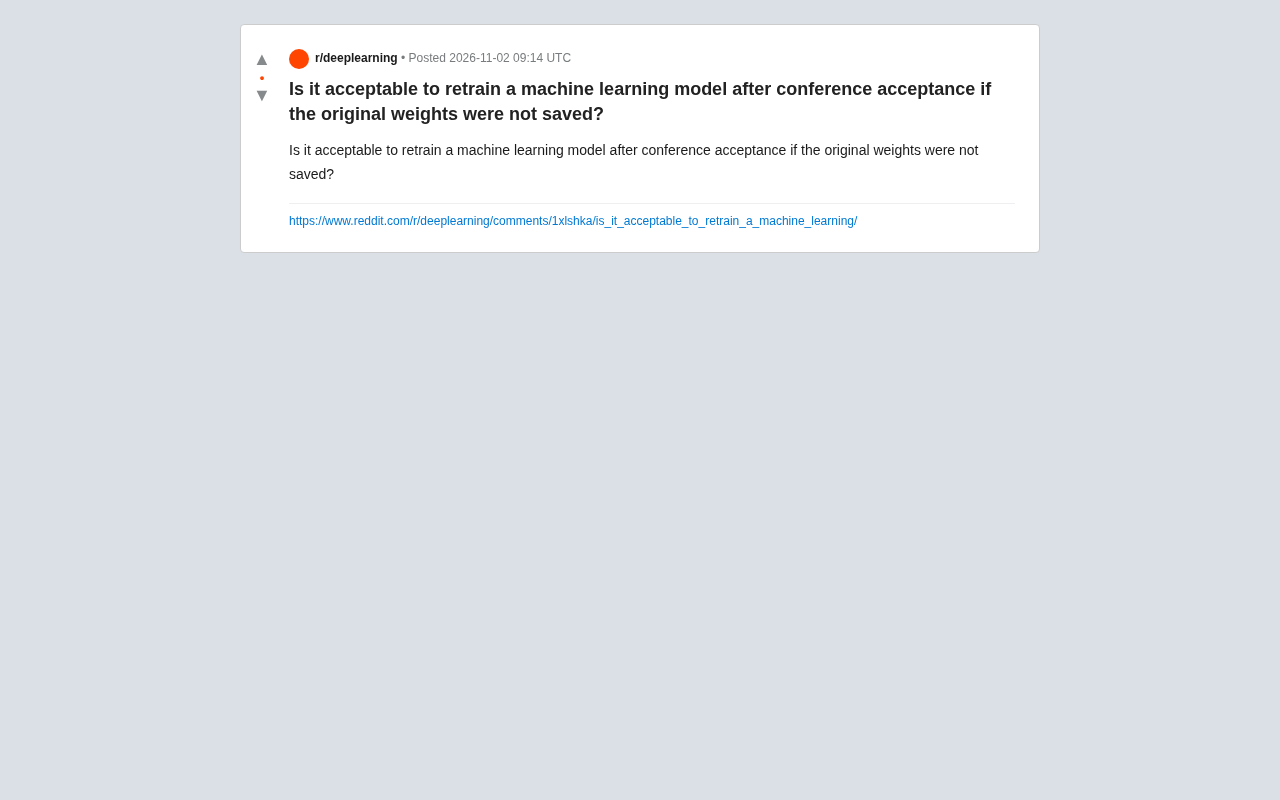
This seemingly simple question actually touches on three layers of issues: reproducibility, reviewer trust, and research engineering practice. The discussion included both researchers sharing personal experiences and a review of conference policies, forming a consensus that is quite valuable as a reference.
Retraining Itself Is Not Academic Misconduct
Many community members were highly consistent in their views: as long as the model architecture, hyperparameters, data splits, and random seed settings match what is described in the paper, retraining itself does not constitute academic misconduct. What a paper truly promises is the reproducibility of the method and experimental design, not a specific weight file.
One reply pointed out that reviewers care about whether the conclusions are produced by the described method, not whether you happen to have kept that particular set of parameters on your hard drive. If the results after retraining match the numbers reported in the paper within a reasonable margin of error, then there is no issue with academic integrity.
However, some users also cautioned that if the metrics drop noticeably after retraining, you cannot quietly replace the results without explanation — that is where the boundary of integrity is crossed.
Random seed is a value that controls the initial state of a pseudorandom number generator. In deep learning training, parameter initialization, data shuffling order, Dropout masks, and more all depend on random numbers. After fixing the seed, the same code in the same environment should theoretically produce the same training trajectory. But even with a fixed seed, non-deterministic operators on the GPU (such as certain cuDNN convolution algorithms and atomic additions) may still introduce tiny differences, making bit-for-bit reproducibility impossible. Therefore, when discussing "whether retraining results are consistent," what is usually meant is closeness in a statistical sense (such as the mean and variance across multiple runs), rather than strict numerical equality. This is also why the community emphasizes that papers should explain the sources of randomness and the number of runs.
Review and Reproduction Are Where the Real Risks Lie
Disagreements mainly centered on risk management. Some argued that if the paper comes with open-source code or supplementary materials, and reviewers or readers find that the results do not match when reproducing, retraining can turn into a trust crisis. Others emphasized that deep learning training itself involves randomness, and as long as the paper honestly explains the sources of randomness and the statistical approach across multiple runs, small fluctuations are explainable.
The more pragmatic advice in the community is: after retraining, proactively record the results corresponding to the new weights. If the difference from the values reported in the paper is within normal fluctuation, no special statement is needed; if the difference is large, it should be honestly explained in the code repository or in a paper erratum.
Artifact evaluation is an optional or additional review process established by some conferences (such as NeurIPS, MLSys, EuroSys, etc.), in which an independent review committee checks whether the code, data, and scripts submitted by the authors can be run as documented and reproduce the paper's results. It is usually divided into progressive levels such as "available," "functional," and "reproduced." Artifact evaluation generally does not mandate submission of trained weights; instead, it examines whether others can run the process themselves based on the provided materials. Therefore, for authors, a clear README, environment dependency lock files, and a one-click run script are often more important than attaching several GB of weight files.
Engineering Habits Matter More Than Remediation After the Fact
Another main thread of the discussion was prevention. Many practitioners mentioned that weight files are large and easily deleted or overwritten by mistake, so mechanisms for automatically saving checkpoints, versioning datasets, and versioning configuration files should be deliberately added to training scripts.
One user suggested archiving model weights, random seeds, and the full configuration together, and locking in a traceable experimental snapshot before paper submission. That way, even if materials need to be repackaged after acceptance, they can be used directly without retraining.
A checkpoint is a snapshot of the model state saved periodically during training. In addition to weights, it usually includes optimizer state, learning rate scheduler state, and the current epoch number, so training can be resumed from a breakpoint. Compared with saving only the final weights, a checkpoint mechanism allows quick recovery when training is interrupted or accidentally overwritten, and makes it easier to later select the epoch with the best validation performance. In practice, versioned storage (such as DVC, Git LFS, or uploading weights to object storage and recording hashes) can be combined to manage large files and avoid binary files becoming disconnected from code versions. At the configuration level, tools such as YAML/Hydra are commonly used to record hyperparameters, ensuring that the full configuration of each experiment is traceable.
What Conference Policies Say
Regarding conference-level rules, the consensus in the discussion was: mainstream conferences usually require reproducible code or supplementary materials, but rarely mandate submission of the weight files themselves. Therefore, whether retraining is "compliant" depends more on whether the authors honestly describe the method and results than on whether the original binary files were retained.
If the paper involves a reproducibility statement or artifact evaluation, authors should ensure that the retraining process can be executed by others according to the documentation — this is more practically meaningful than keeping a copy of the weights.
Practical Recommendations
Taken together, the discussion can be summarized into several actionable practices: save a complete experimental snapshot before submission; clearly state randomness and the statistical basis for multiple runs in the paper; compare results after retraining and proactively explain significant differences; and bring weights and configurations under version control to avoid falling into the same trap again.
The answer to this question is not complicated — retraining is acceptable, but transparency and reproducibility are the bottom line.
One-line Summary
After discovering weights were not saved following paper acceptance, the community consensus is that retraining is acceptable, and transparency and reproducibility are the bottom line.
Paragraph Summary
The article centers on a real question from the Reddit machine learning community: after a paper was accepted by a conference, the authors discovered that the trained model weights had not been saved and could only retrain — is this academically acceptable? The consensus formed in the discussion is that as long as the model architecture, hyperparameters, data splits, and random seeds match the paper's description, retraining itself does not constitute academic misconduct, because what the paper promises is reproducibility of the method and experimental design, not a particular weight file. The real risk lies in review and reproduction: if retraining results differ noticeably from the reported values without explanation, that is where the integrity boundary is crossed. Mainstream conferences usually require reproducible code or supplementary materials and rarely mandate weight submission. The article concludes with engineering suggestions such as saving experimental snapshots before submission, versioning configurations, and honestly explaining randomness.
Related articles

AI SDK Workflow 2.0.95 Update: Stream Transform API Removed
AI SDK Workflow 2.0.95 removes the experimental_transform option from WorkflowAgent.stream() and the StreamTextTransform type export, as stream transforms cannot reliably cross workflow step boundaries. This article covers the reasons, migration points, and upgrade advice.

AI SDK Vue 4.0.163 Patch Released: Full Dependency Chain Update
AI SDK Vue releases patch 4.0.163, synchronously upgrading dependencies including ai@7.0.163 and @ai-sdk/provider-utils@5.0.75. This article analyzes the practical impact of this dependency chain update.

AI SDK Voyage 2.0.75 Patch Release: What the Dependency Chain Update Means
AI SDK's Voyage Provider releases patch version 2.0.75, syncing only @ai-sdk/provider and provider-utils deps. We analyze the impact and upgrade guidance.