ParakeetAI 2.0: Reimagining the Entire Job Interview Prep Journey with AI

ParakeetAI 2.0 covers the full interview journey with a question bank, AI mock interviews, and real-time answer drafts.
ParakeetAI 2.0 is an AI-powered interview prep tool that breaks the process into three stages: a company-grouped, frequency-ranked question bank; an AI interviewer that asks dynamic follow-ups and provides full transcripts; and a real-time feature that listens during live interviews and instantly drafts answers. Together, they form a closed loop from preparation to performance. The real-time assistance is the most controversial element — extending AI's role from pre-interview coach to in-the-moment aid — but raises fairness questions. The first mock interview is free, and the product has earned 76 upvotes on Product Hunt, making it worth a try for time-pressed candidates targeting specific companies.
ParakeetAI 2.0: Reimagining the Entire Job Interview Prep Journey with AI
The biggest anxiety job seekers face before an interview often comes from one unpredictable question: "What are they actually going to ask me?" ParakeetAI 2.0 attempts to answer that with a comprehensive AI toolkit — guiding candidates from the fog of "I have no idea what to expect" to the confidence of "I've got this." The product earned 76 upvotes and ranked #14 on Product Hunt, spanning three categories: Recruiting, Artificial Intelligence, and Career Development.
A Three-Stage Design: From Question Bank to Real Interview
ParakeetAI's core philosophy is to break interview preparation into an actionable pipeline — not vague advice to "practice more."
The journey begins with the Question Bank. Unlike scattered lists of interview questions found online, ParakeetAI groups real interview questions by company and ranks them by frequency. This means candidates can focus on the most commonly asked questions at their target company, rather than spreading their time thin across every possible topic. For time-pressed candidates, this data-driven prioritization is itself a productivity upgrade.
The question bank answers "what to prepare," but the real challenge is "how to practice." Many people who have memorized answers still freeze under the pressure of a live conversation. ParakeetAI fills this gap with an AI Interviewer.
AI Interviewer: A Mock Conversation That Asks Follow-Ups
The standout feature of ParakeetAI 2.0 is its AI interviewer, capable of genuine back-and-forth dialogue. It doesn't just mechanically fire off questions — it "asks, listens, and follows up based on your answers."
This follow-up mechanism is what sets this mock interview experience apart. In real interviews, interviewers rarely accept a textbook answer at face value — they dig deeper based on what you say: "You mentioned that project — what specific challenges did you run into?" ParakeetAI's AI interviewer attempts to replicate this dynamic interaction, making practice feel closer to the unpredictability of a real interview.
After each session, users can review the full conversation transcript. This gives candidates a concrete basis for self-reflection: where did their logic fall apart, where were they too long-winded, which questions kept tripping them up? It's all visible in black and white. Compared to vaguely remembering that you "probably answered okay," a written record provides a far more objective starting point for improvement.
This follow-up capability relies on the contextual understanding of large language models (LLMs). Traditional chatbots follow preset scripts and can't process the specific content of a candidate's answers. AI interviewers built on models like GPT-4, however, can feed a candidate's response directly into the next prompt — dynamically generating targeted follow-up questions. This "conversational memory" makes each practice session impossible to fully anticipate, partially simulating the person-specific pressure of a real interview. Similar products on the market (such as Interview Warmup and Final Round AI) use comparable technical approaches, though the depth and coherence of follow-up questions varies significantly depending on how each company has fine-tuned its models.
Real-Time Assistance: Live Answer Drafts on Interview Day
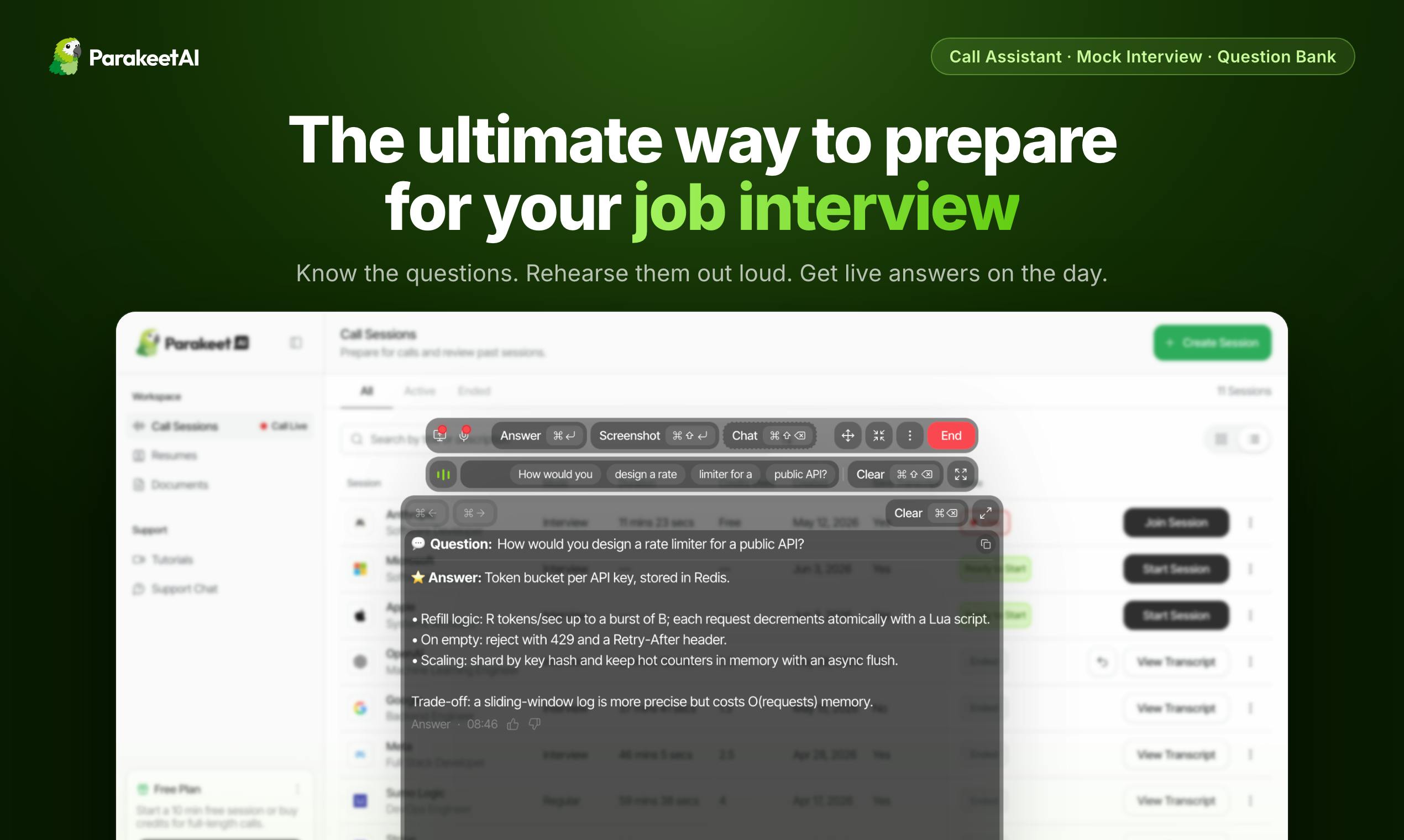
Where ParakeetAI truly pushes beyond being a "preparation tool" is in what it offers on the day of the actual interview. The product claims to listen in real time during a live interview and instantly draft answers for the user.
This is a design choice that's both compelling and controversial. For remote video or phone interviews, real-time answer prompts can be a lifeline when a candidate's mind goes blank. It elevates AI from "pre-game training partner" to "in-game coach," covering the full span of the interview experience.
Of course, this kind of real-time assistance raises legitimate questions about fairness and authenticity. Whether a candidate relying on live answer drafts truly reflects their own capabilities is something both employers and job seekers will need to weigh. But from a product positioning standpoint, ParakeetAI has clearly prioritized "helping candidates land the offer" — leaving that judgment call to each individual user.
The technical foundation of this feature is a combination of real-time speech-to-text (STT) and instant text generation. The system captures the interviewer's voice via microphone, converts it to text through speech recognition, and then generates a suggested answer within seconds using a language model. To be practically useful, the total latency across this pipeline typically needs to stay within 2–5 seconds. This technical approach closely mirrors that of AI real-time captioning and simultaneous interpretation products. It's worth noting that some video interview platforms (such as HireVue) have begun detecting anomalous eye movement patterns or screen-switching behavior. As a result, the discretion and usability of real-time assistance tools face platform-level constraints and may not work smoothly across all interview environments.
Product Positioning and Market Context
ParakeetAI was built by Jure Sotosek and others, with the first mock interview offered for free — lowering the barrier to entry. This "first session free" strategy is common among tool-based products: let users experience core value first, then decide whether to pay.
Zooming out, AI interview assistance is becoming a fast-growing niche. As large language models improve in conversational understanding and real-time generation, the combination of "AI practice partner + live assistance" has become technically viable. ParakeetAI 2.0 integrates a question bank, simulated conversation, and real-time assistance into a single product, forming a relatively complete closed loop — and that's what differentiates it from single-feature tools.
That said, the product has only 2 comments on Product Hunt, suggesting limited community discussion so far, and real-world user feedback remains to be seen. For job seekers considering giving it a try, it's worth starting with the free first mock interview to evaluate the quality of the AI interviewer's follow-up questions and the usefulness of the answer drafts before committing further.
The AI interview assistance space expanded rapidly over the past two years following the commercialization of GPT-4. Key players include Final Round AI (focused on real-time prompting), Yoodli (focused on behavioral interviews, analyzing speech pace and filler words), and Google's free practice tool Interview Warmup. Differentiation across these products mainly comes down to: whether real-time assistance is supported, how many companies the question bank covers, and the granularity of feedback. ParakeetAI's three-stage integrated approach takes a "full coverage" rather than "single-feature depth" route — which means lower switching costs in tool selection, but potentially less depth in any individual feature compared to more narrowly focused competitors.
Final Thoughts
ParakeetAI 2.0 represents one model of how job preparation tools are evolving toward end-to-end AI integration. Its value lies not in any single dazzling feature, but in connecting preparation, practice, and live performance into a coherent, continuous path. For candidates who interview frequently — especially those targeting specific companies — this toolkit can save a significant amount of trial-and-error. As for where to draw the line on real-time assistance, that's a question each user will need to answer based on their own professional ethics.
Related articles

When Did Paid Childcare Become the Norm? Working Mothers and the Evolution of Childcare
When did paid childcare become the norm? This article traces the evolution from the rise of childcare centers in the 1970s–80s and the 1990s linking of federal subsidies to work requirements, to declining stigma and rising costs, and explores advocates' 25-year effort to catch up with other countries on childcare and paid parental leave.

Red Flags for Product-Market Fit: A Practical Guide from Top VCs and the Superhuman Founder
Investors from Iconiq and Sapphire Ventures and Superhuman founder Rahul Vohra share PMF red flags and practical methods, including the 40% disappointment rule, retention curves, and acquisition costs.

What Task Should AI Agents Take Over Most? Heated Reddit Discussion
Reddit discussion: Which task do you most want AI agents to take over completely? Cross-app data migration, CRM updates, and report generation top the list, but insufficient reliability and the trust gap are the biggest obstacles to automation adoption.