Parsec: An Open-Source Tool for Slimming AI Agent Contexts with Small Models
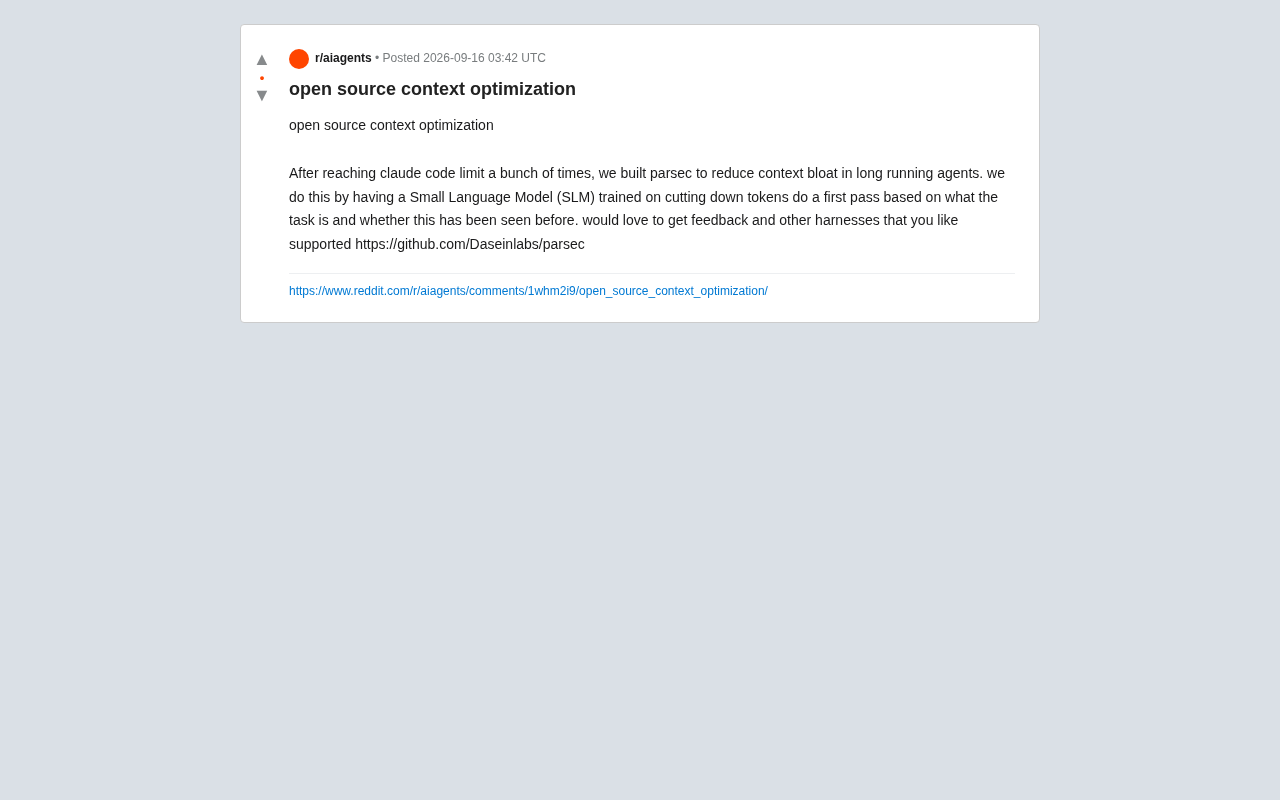
Developer open-sources Parsec, a context compression tool that uses a small model to pre-filter AI agent context and reduce token costs.
Long-running AI agents accumulate tool call records and intermediate results that bloat context windows, driving up costs and hurting response quality. After repeatedly hitting Claude Code's usage limits, a developer open-sourced Parsec — a context compression tool that uses a trained SLM to filter content before it reaches the main model, trimming redundancy based on task type and content repetition. This layered "small model first, large model decides" architecture is emerging as a practical approach to agent cost optimization, though questions around information loss, SLM overhead, and framework compatibility still await community validation.
Why Long-Running AI Agents Keep Getting Dragged Down by Context
Anyone who has used Claude Code or similar coding assistants has probably run into the same problem: midway through a task, the context window fills up, the model slows down, costs spike, and you eventually hit a usage limit. One developer shared his solution on Reddit — after repeatedly bumping into Claude Code's usage caps, he and his team built an open-source tool called Parsec, designed specifically to cut down on context bloat in long-running agents.
Context bloat is an unavoidable pain point in autonomous agent architectures. As an agent works through a multi-step task, it continuously accumulates tool call records, intermediate results, and conversation history. Most of this content is irrelevant to the current step, yet it still consumes precious token budget. As the task chain grows longer, the useless context snowballs — driving up costs and degrading response quality.
Parsec's Core Idea: Let a Small Model Do the Filtering First
Parsec works a bit like giving a large model a "pre-screening gatekeeper." It introduces a Small Language Model (SLM) specifically trained for token compression, which preprocesses content before it ever reaches the main model.
The SLM makes decisions based on two key factors: what the current task actually is, and whether the relevant content has already appeared earlier in the context. Using these two dimensions, the small model decides what information is worth keeping and what can be trimmed. In other words, the relatively lightweight, pattern-based job of "identifying redundancy" is handed off to a cheaper model, freeing up valuable context space for the main model behind it.
This layered architecture — where a small model handles the groundwork and a large model makes the final decisions — is becoming increasingly common in agent optimization. Using a cheaper model to handle auxiliary tasks like filtering, routing, and summarization, then passing the refined information to the expensive primary model, is a practical path to controlling both cost and latency. Parsec applies this idea concretely to the context compression problem.
Small Language Models (SLMs) typically refer to lightweight language models in the 1B–13B parameter range. Notable examples include Microsoft's Phi series, Google's Gemma, and Meta's smaller Llama variants. Compared to mainstream large models with tens or hundreds of billions of parameters, SLMs can be 1–2 orders of magnitude cheaper to run and are capable of operating locally or on edge devices — making them well-suited for structured auxiliary tasks like classification, filtering, and summarization. In the context compression scenario, an SLM doesn't need complex reasoning ability; it simply needs to judge whether a piece of content is relevant to the current task and whether it has already appeared. This kind of pattern recognition sits squarely within a small model's capability range. This is the core economic logic behind Parsec's choice to use an SLM rather than having the main model summarize itself: replacing the least cost-effective token consumption in the main model with cheaper computation.
Why Tools Like This Are Becoming Important
As long-running applications like coding agents and research agents become more widespread, token economics is becoming an unavoidable constraint for developers. Major models charge by the token, so the longer the context, the higher the cost per call. On top of that, excessively long contexts introduce attention degradation issues like "lost in the middle," which can actually hurt output quality.
In this environment, context engineering is gradually evolving from a niche technique into a core skill. Whoever can feed a model the same — or better — information using fewer tokens wins on cost, speed, and quality simultaneously. Parsec's decision to go open-source also means developers can directly inspect its compression strategy, adjust it for their own needs, or contribute improvements — which helps with community validation and rapid iteration.
"Lost in the Middle" is a phenomenon formally named in a 2023 Stanford University study: when key information is placed in the middle of a very long context, large language models' retrieval accuracy drops significantly, while information at the beginning or end is much more likely to be "noticed" by the model. This finding reveals a counterintuitive reality — a longer context window doesn't always lead to better performance. In some tasks, a trimmed-down context actually produces more accurate answers. For multi-step agents, historical tool call results and intermediate outputs tend to pile up in the middle of the context, landing squarely in the zone where the model's attention is weakest. This further reinforces the case for proactive context compression. Context engineering is therefore not just a cost-saving measure — it's also a technical safeguard for maintaining output quality.
Questions That Still Need Answering
As an early-stage open-source project, Parsec is primarily putting forward an idea and soliciting feedback. The author explicitly stated in the post that they want to hear opinions and learn which agent frameworks (harnesses) people want it to support. This also exposes several key questions that don't yet have public answers:
- How to balance information loss from compression: When the SLM trims tokens, how does it ensure it doesn't accidentally discard information that's critical for later steps? There's currently no publicly available benchmark data on this.
- The overhead of the small model itself: Adding another model means additional inference cost and latency. The net benefit needs to be validated under real-world workloads.
- Framework compatibility: The author's proactive outreach to the community about which harnesses to support suggests the current integration scope may be limited.
For teams struggling with context costs, Parsec offers a worthwhile open-source reference implementation. The project is publicly available on Reddit (github.com/Daseinlabs/parsec), and interested developers can evaluate its real-world performance in their own workflows.
Note: This article is based on a single source — a developer's Reddit post. Parsec's actual compression effectiveness and stability still await more independent testing and validation.
Related articles

AI Agent Earns $10K in One Week: 3 Key Upgrades Explained
A blogger shares how he earned $10K in a week with an AI Agent — not by adding more skills, but through verification, approval gates, and subagents to raise trust and enable true automation.
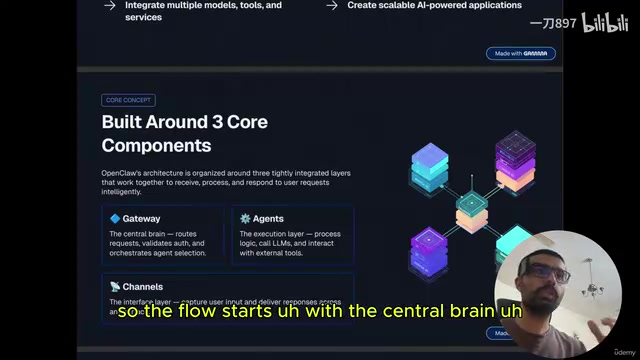
Getting Started with OpenClaw: Multi-Channel AI Agent Gateway and Automated Workflow Guide
OpenClaw is an open-source multi-channel AI agent gateway. This guide covers its three core components — gateway, agents, and channels — plus tool integration and memory mechanisms.
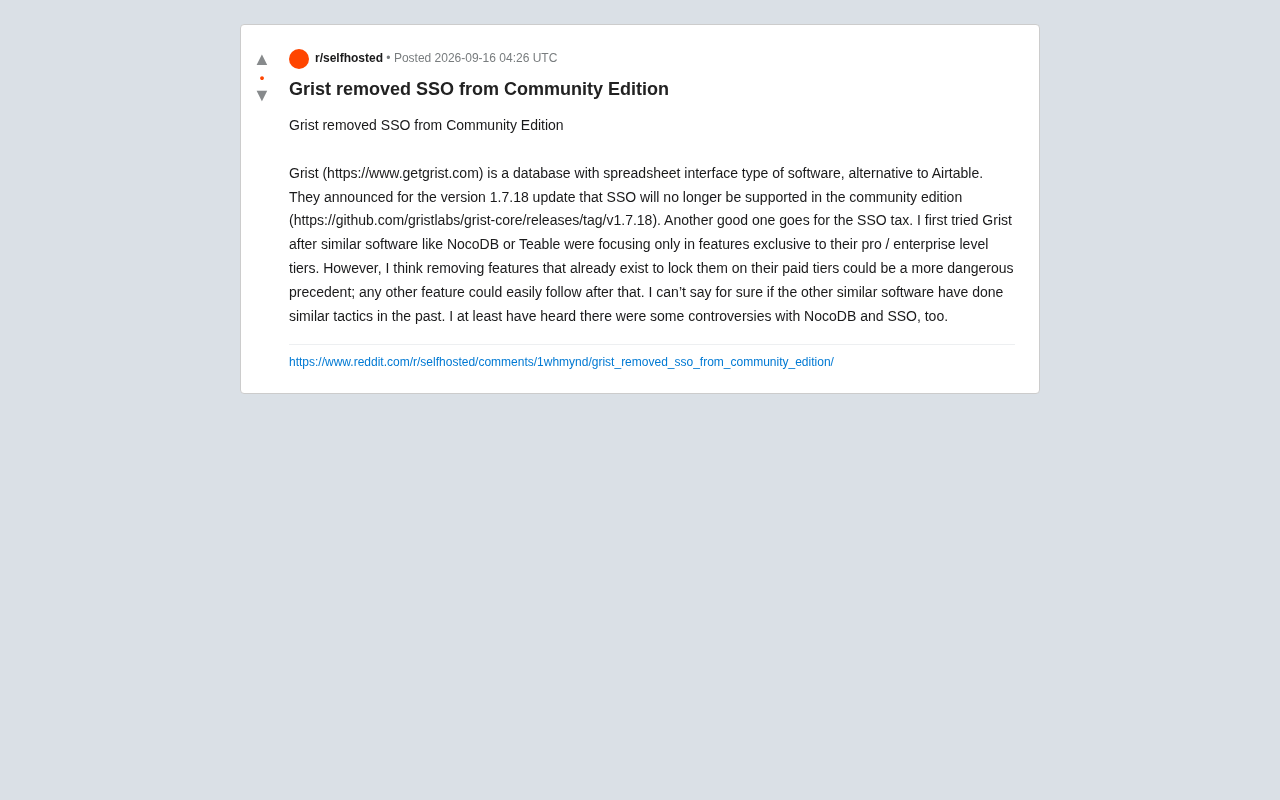
Grist Removes SSO from Community Edition: The 'SSO Tax' Debate Resurfaces
Grist v1.7.18 removed SSO from its Community Edition, locking it behind a paid tier and reigniting the 'SSO Tax' debate. We analyze the incident, open-source monetization tensions, and what it means for self-hosted users.