Passing Load Tests ≠ Meeting Service SLOs: The Two Acceptance Gates of LLM Deployment

LLM deployment requires two independent gates: artifact correctness and service health under real traffic.
Production LLM deployment requires passing two distinct acceptance gates: artifact validation (can the model serve correctly?) and service health (does it stay healthy under real traffic?). Using OrcaRouter's case as example, this article demonstrates why passing load tests with good artifact metrics doesn't guarantee meeting service SLOs, and proposes splitting releases into artifact canary and service canary for independent monitoring.
A Widely Misunderstood Problem: Two Acceptance Gates for Model Deployment
Whenever a new model is released, the community often focuses on one question: Can this model run? But true production-grade deployment requires passing two independent acceptance gates:
- Can the artifact serve correctly?
- Does the service stay healthy under real traffic?
These two sound similar but belong to entirely different engineering domains. The recent OrcaRouter uncensored model release case that sparked discussion on Reddit clearly exposed the gap between these two gates.
Artifact-Side Validation: Valuable but with Clear Boundaries
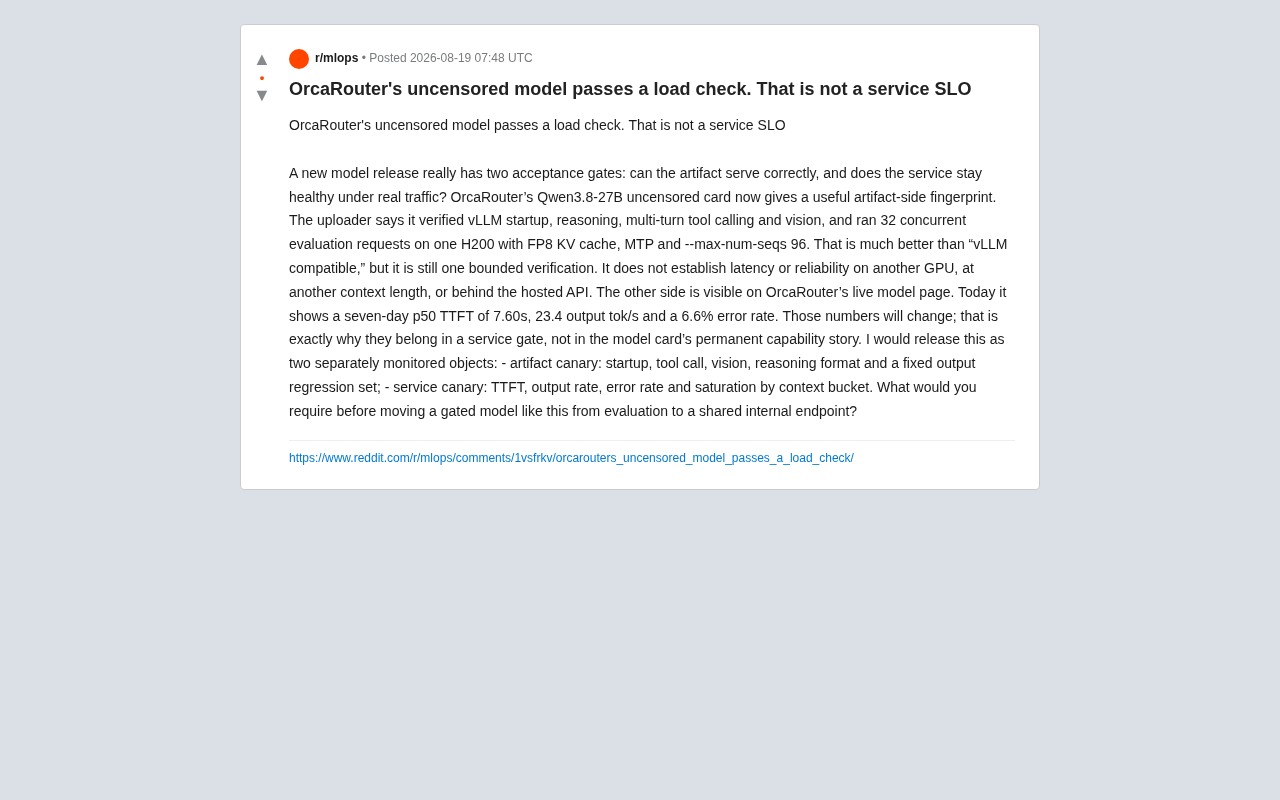
According to the Reddit post, the model card for OrcaRouter's released Qwen3.8-27B uncensored model provided solid artifact-side validation information. The uploader claimed to have verified the following capabilities:
- vLLM starts normally
- Reasoning capability available
- Multi-turn tool calling
- Vision capability
vLLM here refers to the high-performance large language model inference and serving framework developed by the UC Berkeley team. Its core innovation is the PagedAttention mechanism—borrowing the paging concept from virtual memory management in operating systems, it allocates KV cache on-demand into non-contiguous memory blocks, thereby greatly reducing GPU memory waste. Before vLLM emerged, memory management for large model inference generally adopted pre-allocation strategies, leading to significant memory fragmentation and severely limiting concurrent throughput. vLLM's emergence enabled inference throughput to increase several to dozens of times compared to native HuggingFace Transformers implementation under the same hardware conditions, quickly becoming one of the de facto standard engines for community and enterprise LLM service deployment.
Going further, the uploader also ran 32 concurrent evaluation requests on a single H200, with configurations including FP8 KV cache, MTP (Multi-Token Prediction), and --max-num-seqs 96.
The NVIDIA H200 is a data center GPU based on the Hopper architecture. Compared to the H100, the biggest upgrade is in memory capacity and bandwidth: equipped with 141GB HBM3e memory with 4.8TB/s bandwidth, specifically optimized for memory bottlenecks in large model inference. FP8 (8-bit floating point) KV cache is a quantization technique that compresses the Key-Value cache in the attention mechanism from FP16 or BF16 to 8 bits, reducing KV cache memory usage by half, thereby supporting longer context windows or higher concurrency on the same hardware. The Hopper architecture natively supports FP8 Tensor Core operations, allowing this quantization to achieve significant efficiency gains with minimal accuracy loss.
MTP (Multi-Token Prediction) is a technique to accelerate autoregressive language model inference. The core idea is to have the model predict multiple subsequent tokens in a single forward pass, rather than traditional token-by-token generation. In inference services, MTP is typically used with Speculative Decoding: the model quickly drafts multiple tokens, then confirms whether to accept them through a verification step, significantly reducing generation latency without compromising output quality. Qwen3 series models natively support MTP capability, which is why OrcaRouter enabled this feature in validation.
Stronger than "vLLM Compatible," but Still a Bounded Verification
This validation is clearly more valuable than the common "vLLM compatible" one-liner on model cards—it provides a specific artifact-side fingerprint, letting users know the model can indeed start, reason, call tools, and handle vision inputs under specific conditions.
Regarding model cards themselves, this concept was introduced by the Google research team in their 2019 paper "Model Cards for Model Reporting," aimed at establishing a standardized documentation framework for machine learning models, covering intended use, training data, evaluation metrics, ethical considerations, and known limitations. The HuggingFace platform made model cards standard documentation for every model repository, greatly promoting their adoption in the open-source community. However, model cards were originally designed to describe the "static properties" of model artifacts—they excel at answering "what this model is and what it can do," but are inherently unsuited for carrying dynamic information like "how this model performs in production."
But as the original poster astutely pointed out: this is still one bounded verification. It cannot prove:
- Performance on another GPU
- Latency under another context length
- Reliability behind a hosted API
In other words, passing a load check does not equal meeting Service Level Objectives (SLO). This is the core argument of this article.
Service-Side Truth: The Other Half of the Story Revealed by Real-Time Monitoring
In stark contrast to the artifact-side "green light," the service-side data exposed on OrcaRouter's real-time model page tells a different story. The original post cited that day's observations:
| Metric | Value (7 days) |
|---|---|
| p50 TTFT (Time to First Token) | 7.60s |
| Output Rate | 23.4 tok/s |
| Error Rate | 6.6% |
TTFT (Time To First Token) is one of the most critical metrics for measuring LLM service user experience. It measures the time between a request arriving at the server and the user receiving the first generated token. This metric is important because the streaming output nature of large models means users can start reading once they see the first token—TTFT directly determines the perceived "response speed." TTFT is primarily affected by three factors: prefill computation time for the input sequence (proportional to input length), queuing wait time (related to service concurrency and scheduling strategy), and KV cache allocation overhead. A p50 TTFT of 7.6 seconds means half of requests need to wait over 7 seconds to see the first character, which is nearly unacceptable in interactive application scenarios—the industry generally believes good chat experiences require TTFT controlled within 1-2 seconds.
The 6.6% error rate is equally concerning. This means nearly 7 out of every 100 requests will fail—clearly not healthy for a formal outward-facing service.
Why These Numbers Belong to the Service Gate, Not the Model Card
The original poster made a key judgment: those numbers will change. Precisely because they are dynamic and fluctuate with traffic and infrastructure, they should belong to the service gate, not be written into the model card as static labels.
This distinction is crucial:
- Model cards describe the artifact's inherent capabilities—what modalities are supported, output formats
- Service metrics describe operational status—actual experience under current deployment, current traffic, current hardware
Mixing operational status into capability narratives misleads downstream users into making incorrect judgments about the model itself. When community members conflate real-time service-side metrics (like TTFT, error rate) with capability claims in model cards, cognitive confusion arises—people may mistakenly believe high latency or high error rates are problems with the model itself, when they may actually be temporary conditions caused by current deployment configuration or traffic spikes.
Engineering Practice: Split Model Release into Two Independent Monitoring Objects
Addressing the above issues, the original poster proposed a clear and actionable engineering paradigm: split gated model releases into two independent monitoring objects, each with canary validation.
Canary Release gets its name from the practice of using canaries to detect toxic gases in coal mines. In software engineering, it refers to deploying a new version to a small portion of traffic for validation, then gradually expanding to full traffic after confirming no anomalies. This progressive delivery strategy is already standard practice in traditional microservices, but faces special challenges in LLM services: model switching costs are extremely high (loading a 27B parameter model to GPU may take several minutes), quality degradation is often not binary crashes but gradual drift (like subtle declines in answer quality), and evaluation itself has randomness. Therefore, canaries in LLM scenarios need to monitor not only traditional latency and error rates but also include semantic-level regression detection.
Artifact Canary
Focuses on the correctness and stability of the model artifact itself. Validation items include:
- Startup
- Tool call
- Vision
- Reasoning format
- Fixed output regression set
This layer ensures: the model artifact has not degraded, capabilities match claims.
Service Canary
Focuses on service health under real traffic. Monitors by context bucket:
- TTFT (Time to First Token)
- Output rate
- Error rate
- Saturation
This layer ensures: service experience is acceptable under real load, reliability meets standards.
Monitoring by context buckets is especially important. In LLM inference, processing a 512-token short conversation versus a 32K-token long document can differ in computation and memory requirements by tens of times. Without bucketing, good performance on short requests masks severe degradation on long requests, leading to SLOs appearing met while some user experiences are extremely poor.
Through this split, teams can clearly answer two different questions: Is the model correct? Is the service good? The two signals don't pollute each other.
From Evaluation to Shared Endpoint: LLM Service Admission Checklist
The original post concluded with an open question: What conditions need to be met before migrating a gated model from evaluation phase to a shared internal endpoint?
This question touches the core pain point of LLM engineering. Gated Models refer to models requiring users to agree to specific license terms before access, such as Meta's Llama series and some Qwen models. When enterprises deploy gated models as internal shared endpoints, they face a series of unique governance challenges: license compliance (whether specific uses are allowed), version management (whether to follow when upstream models update), quality assurance (who is responsible for service quality), and cost allocation (how to bill GPU compute). The migration from "evaluation phase" to "shared endpoint" is essentially crossing a trust boundary—in the evaluation phase, users bear risks themselves; once it becomes a shared endpoint, the service provider implicitly commits to reliability.
As open and semi-open source models iterate rapidly, teams face not "can it run," but "dare we let others depend on it." A reasonable admission checklist should include:
- Regression tests passed: Artifact canary shows no degradation on fixed test set
- Latency budget met: p50/p95 TTFT within business-acceptable range
- Error rate threshold: Error rate below explicit SLO (e.g., <1%)
- Multi-hardware validation: Performance reproduced on at least target deployment hardware
- Context length coverage: Data available across all context buckets that will actually be used
SLO (Service Level Objective) originates from Google's SRE system and is a core concept in reliability engineering. It differs from SLA (Service Level Agreement) in that: SLO is an internal engineering target, SLA is an outward contractual commitment—typically SLOs are set stricter than SLAs to leave safety margin. In LLM service scenarios, SLO formulation is especially complex because different context lengths, different model sizes, and different inference modes (streaming vs batch) correspond to vastly different reasonable thresholds. A mature LLM platform typically sets different SLOs by context length bucket—short conversations and 128K long document summaries should not share the same latency standards.
For the current state with 6.6% error rate and 7.6s TTFT, it's clearly not ready to become a widely depended-upon shared endpoint.
Conclusion
The value of the OrcaRouter case is not in criticizing the quality of a specific model, but in clearly demonstrating an often-overlooked engineering principle: capability narratives in model cards and operational metrics of services are two completely different types of information that must be measured, monitored, and gated separately.
For any team building LLM platforms or internal inference services, treating "artifact canary" and "service canary" as two independent objects for governance is the key step from "can run" to "reliable and dependable." This is not merely an engineering best practice, but a shift in mindset: model release should not equal service launch—the two need to be bridged by rigorous gating processes, ensuring every shared endpoint has undergone sufficient, multi-dimensional validation.
Related articles

Cross-App Access for AI Agents: Three Identity Vendors Converge on the Same Architecture Pattern in 8 Days
Okta, Auth0, and Descope all shipped Cross App Access within 8 days. This article breaks down the two-layer access pattern behind AI Agent identity management.

Dense Models Too Slow to Run Locally? How MoE Architecture Breaks Through the Performance Bottleneck
Dense models are slow on local hardware due to memory bandwidth limits. Learn how MoE sparse activation architecture dramatically boosts local inference speed and the future of local AI deployment.

Storm Summoner: A MIDI Controller Built Specifically for Guitar Effects Pedals
A deep dive into the Storm Summoner open-source MIDI controller for guitar effects pedals—covering design philosophy, technical architecture, and how it compares to commercial solutions.