Pay to Kick Someone Off a Website? This Experimental Project Ignites a Battle Over Ownership

hijackthis.lol lets users pay to kick off the current occupier, exploring digital ownership through a one-hour protection period and incremental pricing.
hijackthis.lol is a newly launched experimental website where paying lets you kick off the current page occupier and become the new owner with a one-hour protection period. Occupiers can allow takeover for a partial refund or disallow it to keep the full hour. The price starts at $1 and rises with each change of hands. The developer personally did the first hijack. The article analyzes its mechanism as similar to the Million Dollar Homepage but with time protection and refund options, creating a psychological game between speculation and stability, while noting risks like payment/refund complexity, missing content moderation, and rising prices deterring players. The core is exploring whether people will pay for fleeting digital possession and whether this low-barrier, high-topic model can go viral.
A website called hijackthis.lol has just launched, and its rules are brutally simple: pay money to kick the current person off the page and become the new owner of the site. It sounds like an absurd internet game, but behind it lies a clever experiment about digital ownership, human psychology, and viral spread.
Rule Design: From Protection Period to the Takeover Curve
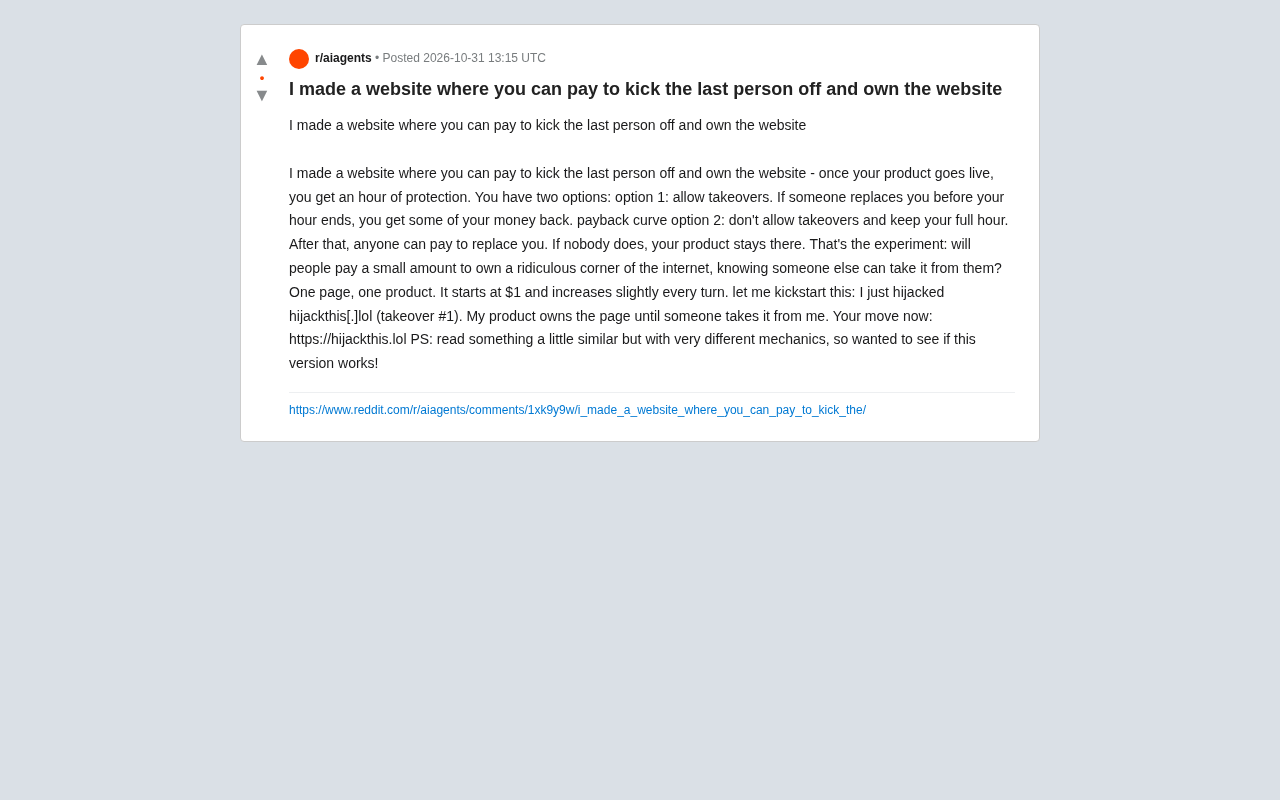
According to the developer's own post on Reddit, the site uses a "one page, one product" model. When you pay to successfully "claim" the page, you get a one-hour protection period. During this time, you can choose between two strategies:
- Allow takeover: If someone kicks you off during the protection period, you receive a partial refund calculated according to a "return curve."
- Disallow takeover: You give up any possible refund but fully own the page for that hour.
Once the protection period ends, anyone can pay to replace you. If no one does, your product stays on the page indefinitely. The starting price is $1, and the price rises slightly with each change of hands.
This mechanism creates a subtle psychological game: what you buy isn't permanent ownership, but a "throne" that can be snatched away at any moment. The developer says outright that this is the core of the experiment—are people willing to spend a little money to own an absurd corner of the internet, even knowing someone else can take it away at any time?
In this context, the "return curve" doesn't refer to the yield curve common in finance, but to a formula that dynamically calculates the refund ratio based on time or rounds. Simply put: if the occupier is kicked off during the protection period, they don't get all their money back—the amount is prorated based on how much time remains before the protection period ends, or on the current price increase. Generally, the earlier you're kicked off, the lower the refund ratio; the closer to the end of the protection period, the higher the refund ratio. This design both reduces the risk for early participants and encourages them to hold on longer. The developer hasn't disclosed the exact formula, but the core intent is to ensure that "being kicked" doesn't necessarily mean "losing money," thereby sustaining willingness to participate.
Dynamic pricing (or incremental pricing) is another key mechanism. After each change of hands, the price rises slightly, similar to the "ascending price" strategy in auctions. This produces two effects: first, early entrants have lower costs and relatively higher potential resale gains (if they allow takeover and receive a refund); second, as time passes, the price slowly rises, which both prevents frequent low-price spam and preserves the "maybe it'll be more worth it if I wait" mentality. This pricing approach has precedents in online ad slots, domain squatting, and some NFT projects, but hijackthis.lol compresses it into a one-hour timeframe, making the game faster-paced and more exciting.
The Developer Steps In: The First "Hijack" Has Already Happened
To kick off the experiment, the developer played first. He "hijacked" the first slot on hijackthis.lol (takeover #1) and publicly declared: "My product now owns this page until someone takes it from me. Your turn."
From a technical standpoint, the project isn't complex—a single-page app plus payment and timing logic is enough to run it. But its cleverness lies in turning "ownership" into a dynamic, tradeable experience rather than a static asset. Every change of hands is a micro-event that can trigger social sharing and chain reactions.
The Thinking Behind the Experiment: The Illusion of Digital Ownership
The project brings to mind some early internet experiments, such as the "Million Dollar Homepage," or various bidding-based ad-slot games. But what sets hijackthis.lol apart is that it explicitly introduces time protection and refund options, forcing participants to decide between "speculation" and "stability."
The developer mentions being inspired by a project with a similar mechanism but different details, and wanting to test whether this version is viable. Based on the information publicly available so far, there's no data yet to show whether people will keep participating. But what's certain is that this low-barrier, high-topic approach is naturally suited to spreading on social media—after all, who wouldn't want to spend a dollar to kick someone off and leave their own mark on the page?
The "Million Dollar Homepage" is a famous experiment created in 2005 by British student Alex Tew: he divided a webpage into a grid of one million pixels, each priced at $1, where buyers could place small ads or links. The project ultimately raised over $1 million and became a classic case of internet viral marketing and the concept of "digital real estate." Its core logic was to artificially divide virtual space and give it scarcity, then drive sales through media attention and herd mentality. hijackthis.lol inherits this "treat the page as a commodity" idea but introduces dynamic changes of hands and time protection, turning ownership from a "one-time buyout" into a "continuous contest"—more like a real-time game of musical chairs.
In the internet context, digital ownership usually refers to control over an account, domain name, virtual item, or page slot. Unlike traditional property rights, digital ownership often depends on platform rules and technical architecture, and is essentially a "license" rather than "absolute ownership." hijackthis.lol dramatizes this fragility: what you pay for is only the temporary right to exclude others, and it can be overridden at any time by a higher bidder. This precisely reveals a common feature of digital assets—ownership is defined by code and protocols, not by physical possession. That participants are willing to pay for this fleeting sense of control is exactly the human nature the experiment aims to observe.
Potential Risks and Sustainability
Of course, this model also faces obvious challenges. First is the complexity of the payment and refund process; if handled poorly, it could lead to disputes. Second is the content management problem: if anyone who pays can put any product on the page, how do you avoid inappropriate or spam content? The developer didn't detail these rules in the original post, which may be a gap that needs to be filled later.
Additionally, as the price gradually rises with each change of hands, the barrier to entry will slowly increase, potentially deterring ordinary players. But conversely, this could also create "scarcity," making the last few slots more valuable. Whether this dynamic pricing strategy can sustain long-term interest remains to be seen.
Conclusion: A Micro-Experiment About Human Nature
hijackthis.lol is currently just an experiment, but it touches on several interesting topics: what does digital ownership really mean? How much are people willing to pay for a fleeting sense of "having"? Whether it ultimately succeeds or not, this approach of embedding game mechanics into website ownership offers independent developers a new way of thinking—sometimes, a simple rule design can turn an ordinary page into something full of tension.
If you're curious, you can go to hijackthis.lol to see who currently occupies the page—or spend a dollar to kick them off.
One-line Summary
hijackthis.lol lets users pay to kick off the current occupier, exploring the game theory of digital ownership through a one-hour protection period and incremental pricing.
Paragraph Summary
hijackthis.lol is a newly launched experimental website with a simple rule: pay to kick off the current page occupier and become the new owner with a one-hour protection period. The occupier can choose to allow takeover (receiving a partial refund) or disallow takeover (keeping the full hour). The starting price is $1, rising slightly with each change of hands. The developer personally completed the first hijack to kick off the experiment. The article analyzes how its mechanism resembles the "Million Dollar Homepage" but introduces time protection and refund options, creating a psychological game between speculation and stability, while pointing out risks such as payment/refund complexity, lack of content management, and rising prices potentially deterring ordinary players. The core of the experiment is exploring whether people are willing to pay for a fleeting sense of digital possession, and whether this low-barrier, high-topic approach can trigger viral spread.
Related articles

AI Can Read Neural Network Weights Directly: Do Models Already Exceed Expectations?
A Reddit developer experiment shows language models can directly read neural network weights and infer their function. Astra, Opus 5.5, and Muse Spark 1.3 all passed the test, sparking discussion on model generalization and training sources.

India's Microdrama Market Explodes: EloElo Secures $80M Investment from NBCUniversal
EloElo secures $80M from NBCUniversal to boost StoryTV, its microdrama platform with over 33M monthly active users, as India's microdrama market draws global capital.

Acoustic Detection of Multi-Rotor UAVs: Fusing Handcrafted Features with Pre-Trained Embeddings
Study reveals data leakage from random splits in UAV acoustic detection, proposes source-disjoint protocol with stacked ensemble of handcrafted features and YAMNet embeddings, achieving 95.29% accuracy for low-cost drone detection.