Paying $20 to Watch Others Have Double the Fun: Plus Users' AI Experience Dilemma
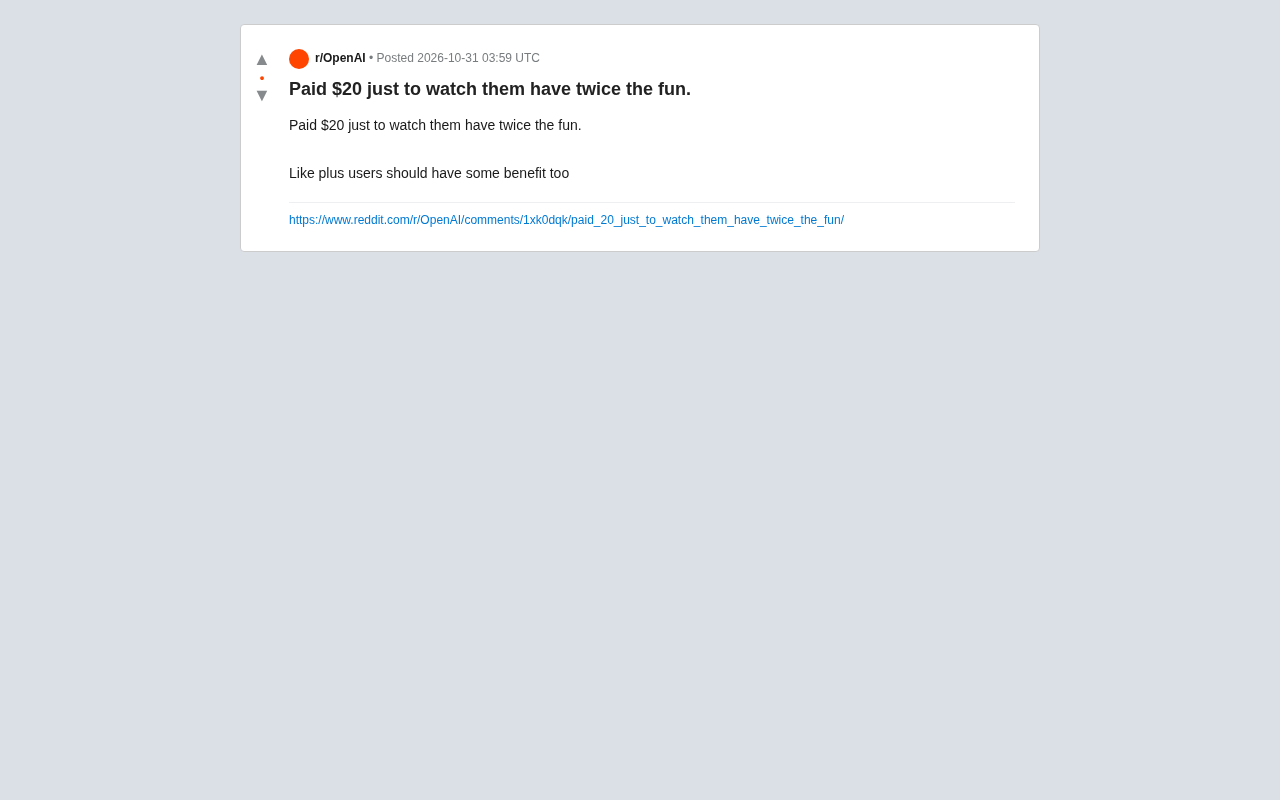
Reddit user complains about paying $20 for Plus while watching others enjoy more benefits, reflecting the fairness crisis of AI subscriptions.
Starting from a Reddit complaint by a Plus user, the article points out that paying users feel "betrayed" because non-paying or specific groups receive more features and quotas. The disappointment stems from comparison rather than absolute price, driven by subscription fatigue and the conflict between acquisition incentives and retention benefits. Drawing on fairness preference theory, it emphasizes that paying users care about relative advantage, so product teams should establish clear benefit tiers and transparent communication to maintain paid superiority and prevent core user loss.
The Awkwardness of Paid Subscriptions: Why Plus Users Feel Left Out
In the Reddit community, a user posted a complaint: "Spent $20, only to watch others enjoy double the fun." This brief statement quickly struck a chord. According to the post, the user had paid for the Plus version of an AI service, but in actual use discovered that non-paying users or certain specific groups were instead getting more features or higher usage privileges, leaving paying users with a strong sense of "betrayal." The post included a Reddit screenshot, with the title clearly expressing this sense of imbalance: "Plus users should get some benefits too."
This is not an isolated case. In today's rapidly evolving AI tool landscape, subscription models have become the mainstream business model, but how to balance the rights of paying users versus free users, and early users versus new users, is becoming a thorny problem for product teams. The core demand from users is simple: if I've paid $20, I should get clear, perceivable extra value—not watch others enjoy "double the fun" that I can't access.
The Value Perception Crisis Under Subscription Fatigue
Judging from the tone of the post, the user's disappointment stems more from "comparison" than from the absolute price. $20 is mid-to-upper range in the AI subscription market, and the user's willingness to pay shows they had expectations for the product. But when they discovered that certain users (possibly new users, users in specific regions, or activity participants) received more generous quotas or more advanced features, the psychological gap was magnified.
Behind this emotion is the spread of subscription fatigue. When every AI product rolls out Plus, Pro, Max and other tiers, users' expectations of "paying means enjoying privileges" keep rising. Once there are gray areas in benefit design—such as free users obtaining temporary high privileges through activities, or new users receiving large quotas upon registration—long-term paying users easily feel neglected. The phrase "watching others enjoy double the fun" in the post is precisely the concrete expression of this perception.
Subscription Fatigue refers to the psychological weariness and decision fatigue consumers experience when facing an increasing number of subscription services and layered payment tiers. As AI products widely adopt multi-tier subscription models like Plus, Pro, and Max, users not only need to continuously pay for multiple services but also constantly evaluate the cost-effectiveness of each tier. In this state, users' sensitivity to paid benefits rises significantly, and any signal of "paying but getting less than free" gets amplified. Subscription fatigue also lowers users' tolerance for products: once they feel benefits are ambiguous or shrinking, users are more likely to cancel their subscriptions rather than patiently wait for improvements. For product teams, this means subscription tier design must be more restrained and transparent, avoiding excessive tiers that aggravate users' cognitive burden.
The Dilemma of Product Operations: How to Balance Acquisition and Retention
From a product operations perspective, giving new users or free users more benefits is a common acquisition tactic. Limited-time activities, registration rewards, referral rebates and other strategies can rapidly expand the user base, but if handled poorly, they can hurt the feelings of core paying users. The Reddit user's complaint reveals a key contradiction: the conflict between acquisition incentives and retention benefits.
The ideal approach is to establish clear benefit tiers and transparent communication mechanisms. For example, new user benefits should be explicitly labeled as "limited-time trials" rather than permanent privileges; paying users' exclusive features or quotas should remain stable and not be relatively diluted by operational activities. Additionally, product teams can proactively collect feedback from paying users through user feedback channels and adjust strategies in a timely manner. The call in the post that "Plus users should get some benefits too" is essentially a demand that product teams acknowledge the presence of paying users.
Acquisition and Retention are two key stages in the growth model of subscription products. Acquisition focuses on how to attract new users, commonly through registration rewards, limited-time free access, referral rebates, etc.; retention focuses on how to keep existing users paying, relying on stable benefit guarantees and good user experience. When resources are limited, the two often compete: over-subsidizing new users dilutes the relative benefits of paying users, while over-protecting paying users may weaken acquisition appeal. A healthy approach is to confine acquisition incentives within a "limited-time trial" framework with clear expiration mechanisms, while preserving core benefits for paying users that cannot be overridden by activities, so that the two sets of incentives do not conflict in terms of time and benefits.
Insights for User Experience Design: Fairness Matters More Than Absolute Value
The "fairness preference" theory in behavioral economics points out that people care not only about their own absolute gains but also about relative gains when compared with others. In AI products, this means paying users care not only about how much they get but also about how much free users get. If free users obtain an experience close to or even exceeding that of paying users through certain channels, paying users' satisfaction will drop sharply.
Therefore, product design needs to deliberately maintain a "paid superiority." This is not about mistreating free users but about ensuring that paid benefits always have a clear advantage in comparable dimensions. For example, paying users should enjoy higher usage quotas, faster response speeds, and priority model access, and these advantages should not be easily erased by short-term operational activities. At the same time, product teams should avoid over-promoting free user benefits on public channels, to prevent psychological imbalance among paying users.
Fairness Preference is a core concept in behavioral economics, proposed by Fehr, Schmidt and others, referring to the fact that in economic decisions people care not only about the absolute level of their own gains but also compare their gains with those of others; when the comparison result is perceived as unfair, people are willing to sacrifice their own interests to punish unfair behavior. In subscription products, this theory explains why paying users are particularly sensitive to "extra benefits" obtained by free users—even if their own absolute benefits have not decreased, a decline in relative status is enough to trigger dissatisfaction. Product designers can use this to establish "stable advantages in comparable dimensions," for example always keeping paying users ahead in explicit indicators such as quotas, speed, and model access, thereby maintaining their perception of fairness.
User Voices: The Value of Community Feedback
Although the Reddit post is brief, it is a typical sample of product feedback. It reminds AI product teams that the success of a subscription model depends not only on feature strength but also on users' perception of fairness. In the highly competitive AI market, user migration costs are not high, and one disappointing subscription experience can lead to long-term customer loss.
For Plus users, what they need may not be more feature stacking but clear respect and continuous benefit guarantees. Product teams should regularly review the competitiveness of subscription benefits, proactively communicate changes with users, and set up exclusive compensation or priority channels for paying users during operational activities. Only in this way can the awkwardness of "paying to watch others enjoy double the fun" be avoided in the future.
One-line Summary
A Reddit user complains about paying $20 for Plus while watching others enjoy more benefits, reflecting the fairness crisis of AI subscription models.
Paragraph Summary
The article starts from a Reddit complaint post by a Plus user, pointing out that paying users feel "betrayed" because non-paying or specific groups receive more features and quotas. The author analyzes that this disappointment stems from comparison rather than absolute price, behind which lies the spread of subscription fatigue and the conflict between acquisition incentives and retention benefits. Drawing on the fairness preference theory of behavioral economics, the article emphasizes that paying users care not only about how much they get but also about whether their relative advantage over others is diluted. Therefore, product teams should establish clear benefit tiers, transparent communication mechanisms, and deliberately maintain paid superiority to avoid short-term operational activities eroding paid value, which could otherwise lead to core user loss.
Related articles

Deleted Reddit Post Sparks Debate Over AI Content Moderation
A Reddit post removed with only a 'Removed by Reddit' notice highlights AI content moderation's transparency gaps, misjudgment risks, and appeal challenges for platforms and creators.

DSH + Ollama Local LLM Deployment in Practice: Free Chat with Da Fei Yu
Bilibili creator tests DSH + Ollama local LLM deployment end to end: Ollama install, Xunlei-accelerated downloads, ModelScope GGUF model import, DSH custom API address setup, and a comparison of Qwen 3.5 4B, 8B, Gemma, and other models on 8GB VRAM, with advice on choosing local deployment vs. API calls.

Tested: A $899 Mac Mini vs. a $200/Month AI Subscription
Real-world test of whether an M4 Mac mini can replace a $200 AI subscription: 16GB can't fit large models, and both speed and quality fall short—but privacy, no caps, and near-zero running costs make it an ideal host for an always-on agent. Includes buying advice per configuration and money-saving strategies.