Paying ChatGPT User Banned for 'Cyber Abuse' — Appeals Rejected Within 60 Seconds by a Bot

A $100/month ChatGPT user was banned for 'cyber abuse' and had every appeal auto-rejected within 60 seconds.
An indie game developer paying $100/month for ChatGPT was banned without warning under the vague label of 'cyber abuse.' Three separate appeals were each rejected within a minute by automated systems — no human ever reviewed the case. The likely cause was a content filter misreading routine developer questions about local builds and API limits. The incident highlights a structural flaw in AI platform governance: false positives are inevitable at scale, but the deeper problem is the absence of transparent violation explanations and accessible human review. The article also offers practical advice for developers on reducing dependency risk.
A self-employed indie game developer paying $100 a month for ChatGPT went public on Reddit to describe being banned without warning under the vague label of "cyber abuse." Every appeal was rejected within a minute by an automated system — no human ever reviewed the case. The incident has once again put the account governance practices of major AI platforms under the microscope.
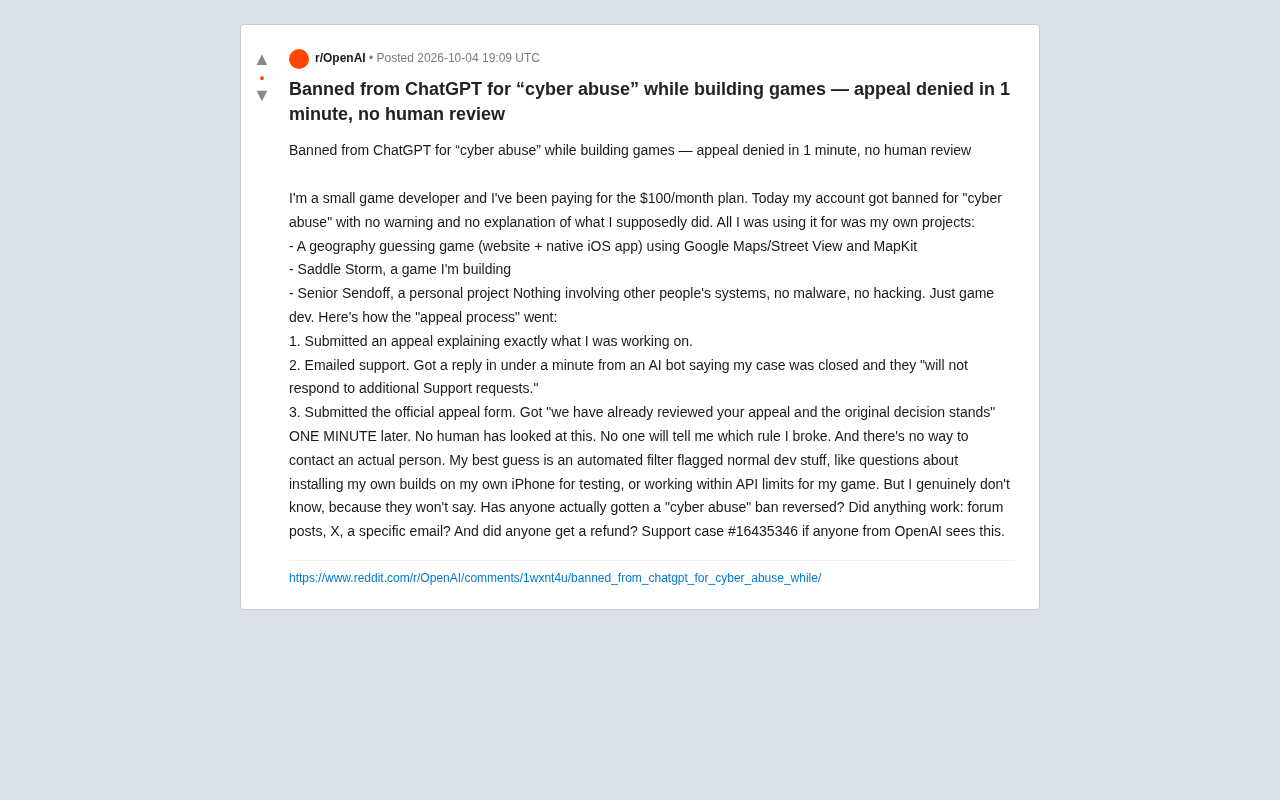
Three Appeals, Three Instant Rejections
The user, who describes himself as a small indie game developer, says he used ChatGPT exclusively for personal projects: a geography guessing game built on Google Maps/Street View and MapKit (with both a website and a native iOS app), a game in development called Saddle Storm, and a personal project called Senior Sendoff.
By his account, none of this involved third-party systems, malware, or anything resembling hacking — just ordinary game development work. Yet his account was suspended without warning and without any explanation of what rule had been violated. The reason listed was simply "cyber abuse."
He then tried three separate appeal paths, all with the same outcome:
- He submitted an appeal with a detailed explanation of what he was working on — and received a bot reply within one minute informing him the case was closed and that "no further support requests would be addressed."
- He emailed customer support — and got an automated response within one minute.
- He submitted the official formal appeal form — and one minute later received a reply stating: "We have reviewed your appeal and are upholding our decision."
The common thread across all three responses was unmistakable: no human being ever looked at his case, no one was willing to tell him which rule he had violated, and there was no way to reach a real person.
What Probably Triggered It: Ordinary Dev Work Misread as Suspicious
The user's own theory is telling. He suspects an automated filter flagged normal development activity as problematic — for example, asking how to install a locally compiled build onto his own iPhone for testing, or asking technical questions about game API rate limits.
These are entirely routine questions in a developer context. But from the perspective of a content safety model, phrases like "install an unsigned build," "bypass limits," or "call an API" can easily be categorized as suspicious behavior when the system lacks the ability to interpret context. In other words, the problem may not be anything the user actually did — it may be that the automated system treated technical phrasing as a potential abuse signal.
The fundamental contradiction is this: the platform doesn't disclose what specifically triggered the ban, so the user has no way to prove his innocence. The entire process becomes a closed loop with no exit.
Content safety filters typically rely on large-scale pretrained classification models that map input text to risk categories such as cyberattacks, malware, or system exploitation. These models make judgments based on word co-occurrence patterns rather than a deep understanding of conversational intent. "Installing a build on your own iPhone" is a standard TestFlight alternative workflow to any developer — but the phrase "install an unsigned app" may be strongly associated in training data with jailbreaking or enterprise certificate abuse. Similarly, "API rate limits" may semantically overlap with rate-limit bypassing or reverse engineering. This kind of surface-feature misclassification — where intent and context are ignored — is known in security as a "false positive" and is a well-documented pain point in large-scale content moderation systems. Because filters typically operate as black boxes, platforms neither disclose specific trigger terms nor provide structured explanations in appeal responses, leaving misidentified users with almost no way to make their case.
The Real Problem: Automated Governance and the "No One to Ask" Trap
Setting aside the specifics of this case, it exposes a governance structural problem that is widespread across AI service providers.
An "appeal review" completed within one minute is almost certainly an algorithm-versus-algorithm process — an automated system makes the ban decision, and another automated system rejects the appeal against that decision. For a paid commercial service, this design — with no human review as a backstop — directly undermines users' trust in the platform's reliability.
For content platforms, automated moderation is an inevitable response to the sheer volume of requests, and some false positives are unavoidable. But the real problem isn't the misclassification itself — it's the absence of an effective correction mechanism after the fact. When a user can't even get an answer to "what rule did I actually break," the appeal process stops being a user right and becomes pure theater.
This also serves as a warning to any developer who relies on a single AI platform for production work: tying your core workflow to a service that can be interrupted without warning and offers no meaningful human recourse is itself a risk exposure.
From a platform governance perspective, ChatGPT now has over 200 million monthly active users. Relying on purely manual review for every violation or appeal is neither economically viable nor operationally practical — which is precisely why mainstream content platforms (YouTube, Meta, Twitter/X) have broadly adopted an "algorithmic first pass + human spot-check" model. Even so, these platforms typically offer dedicated support channels or higher-priority human review queues for paying commercial users. YouTube, for instance, provides a dedicated appeal channel for members of its YouTube Partner Program (YPP), and Meta Business Suite gives advertisers direct access to account representatives when ad accounts are suspended. By contrast, OpenAI's paid subscriptions (ChatGPT Plus/Pro) currently offer no differentiated human support path for account appeals — meaning a user paying $100 a month has no more meaningful appeal rights than a free-tier user. This gap in the design is the institutional root cause of why this story has resonated so widely.
Practical Advice for Developers
A few actionable takeaways from this incident:
- Keep records of your work: Save chat logs, project documentation, and payment receipts. If you ever need to make your case publicly — on social media or in a community — having evidence ready matters.
- Diversify your dependencies: Don't let any single AI service become an irreplaceable link in your development workflow. Have fallback options for critical tasks.
- Use public channels as leverage: The user publicly posted his support ticket number (#16435346) and asked whether anyone had successfully overturned a similar ban through forums, X, or a specific email address. When automated appeals fail, public pressure often becomes the only remaining card to play.
- Add context to technical questions: When asking about installation, bypassing rate limits, API calls, or similar topics, include a brief explanation of your use case. It reduces the chance of the model misreading your intent.
Closing Thoughts
The two questions this developer cared most about — whether anyone has successfully appealed a "cyber abuse" ban, and whether anyone has obtained a refund — remain unanswered. But the value of this incident isn't in the outcome. It clearly illustrates a contradiction that AI services at scale have not yet resolved: when both the original decision and the appeal process are handed off to machines, how are users' rights to be heard actually protected?
For platform operators, establishing a transparent system for explaining violations and creating a reachable human review channel may well be an unavoidable step toward rebuilding trust.
(Note: This article is based solely on the public statements of a single Reddit user. The claims described have not been verified by OpenAI.)
Related articles

WorkBuddy Full Tutorial: Build an AI Office Automation Agent from Scratch
A complete WorkBuddy tutorial: installation, three working modes, multimodal picture book video practice, expert team agent building, and workflow configuration for low-cost AI office automation.

WorkBuddy Agent Complete Guide: From Beginner to Automation in 7 Days
Based on Bilibili's 256-episode WorkBuddy masterclass, this systematically breaks down Tencent's AI office workbench core capabilities: Agent principles, Skill encapsulation, cross-platform connectors, scheduled automation, knowledge bases, and zero-code development, with learning path recommendations.

8 AI Accounts, 7 Failed: An Honest Review of Using AI to Get Work Done
Only 1 of 8 AI-run Bilibili accounts succeeded. We break down the real difference between "performing AI" and "using AI to get work done."