Paying Creators for Training Data May Accelerate AI Displacement

Compensating creators for training data may accelerate AI displacement of low-quality creators and reduce consumer surplus.
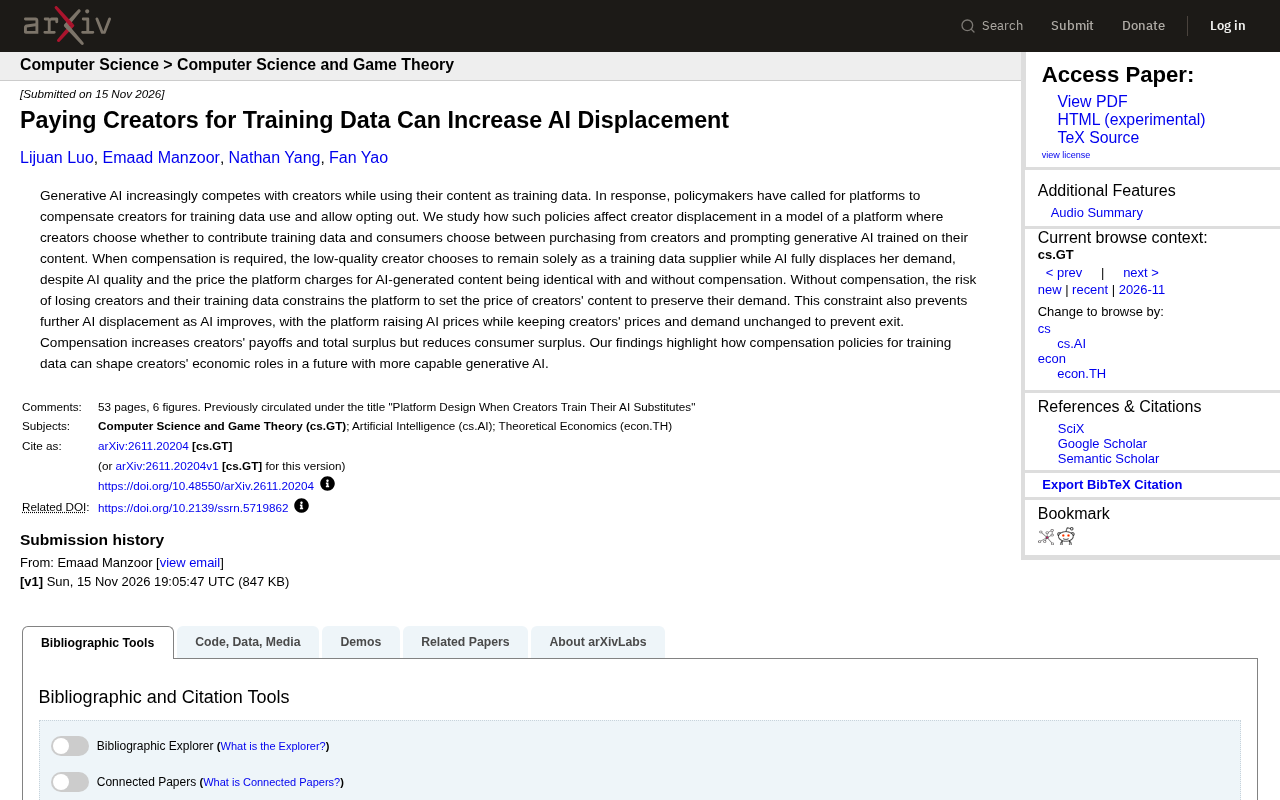
The study builds a platform model to analyze the effects of compensation policies on creators, platforms, and consumers. It finds that compensation leads low-quality creators to supply only training data, with AI fully replacing demand for their content; without compensation, platforms constrain AI displacement to retain data, and compensation removes this constraint. Compensation raises creator income and total surplus but lowers consumer surplus. Policy design needs refinement to avoid unintentionally accelerating creator exit from the content market and to address declining consumer welfare.
Article Content
The rise of generative AI has put creators in a dilemma: their works are used as training data, yet they may be replaced by AI. Policymakers have proposed compensating creators and allowing them to opt out, but a modeling study reveals a counterintuitive conclusion: compensation policies may actually accelerate the displacement of low-quality creators by AI and reshape the distribution of interests among platforms, creators, and consumers.
Creator Divergence Under Compensation Policies
The study constructs a platform model: creators decide whether to contribute training data, and consumers choose between purchasing creator content and using AI-generated content. When the platform is required to compensate creators, low-quality creators will choose to act solely as training data suppliers, while AI completely replaces demand for their content. The key point is that, regardless of whether compensation is provided, the quality of AI and the platform's pricing of AI-generated content remain unchanged. This means that compensation does not enhance AI's competitiveness, but instead causes some creators to voluntarily exit the content market and rely on data compensation income.
This result challenges the intuition that "compensation necessarily protects creators." For low-quality creators, compensation payments may be more attractive than continued competition, thereby accelerating the transformation of their economic role.
Platform model here refers to a theoretical economic framework used to simulate strategic interactions among multiple participants. Research typically assumes that the platform, as an intermediary, sets rules and prices; creators decide whether to contribute training data and whether to produce content; and consumers choose between human-created content and AI-generated content. The model derives how policy interventions (such as mandatory compensation) change market outcomes by solving for the equilibrium strategies of all parties. Such models do not rely on specific data but reveal mechanistic causal relationships through mathematical derivation, so their conclusions are general but need to be calibrated against actual market conditions.
Platform Constraints in the Absence of Compensation
When there is no compensation requirement, the platform faces another constraint: if pricing is too high and causes creators to exit, the platform will lose its source of training data. Therefore, the platform will set the price of creator content to maintain demand and prevent creator attrition. This constraint also prevents AI from further replacing creators: as AI capabilities improve, the platform will raise AI prices while keeping creator prices and demand unchanged to avoid creator exit.
In other words, in the absence of a compensation mechanism, the platform's reliance on training data becomes an invisible shackle that protects creator demand. Compensation policies remove this shackle, and the platform no longer needs to worry about creator exit because data supply is guaranteed through compensation contracts.
Training data dependency is one of the core bottlenecks in the development of generative AI. High-quality AI models require massive, diverse, and continuously updated data, and creator content is often an important source of such data. When a platform cannot forcibly obtain data, its business strategy must balance the sustainability of data supply. This dependency creates an internal constraint for the platform: excessive replacement of creators with AI may lead to data depletion, thereby weakening long-term AI competitiveness. Compensation policies guarantee data supply through contracts, essentially removing this constraint and allowing the platform to optimize AI displacement strategies more freely.
Welfare Effects: Uneven Gains and Losses for Creators and Consumers
Compensation policies increase creator income and total surplus but reduce consumer surplus. Consumers face higher AI prices or fewer choices, while creators' overall income increases. This distributional effect means that policymakers need to weigh creator protection against consumer welfare. The study emphasizes that compensation policies will shape creators' economic role in a future environment with more powerful generative AI.
Consumer surplus refers to the difference between the maximum price consumers are willing to pay for a good and the price they actually pay, and is a commonly used economic indicator for measuring consumer welfare. In this study, compensation policies lead to higher prices for AI-generated content or fewer choices of human-created content, thereby compressing consumer surplus. In contrast, total surplus (the sum of creator income and consumer surplus) may increase due to efficiency gains from compensation contracts, but the distributional effects are significant. Policymakers need to weigh the gains and losses of different groups and avoid overprotecting creators at the expense of consumer welfare.
Implications for Policy Design
The study suggests that simple compensation mechanisms may have unintended consequences. If the policy aims to maintain creators' content production rather than merely compensate for data use, more refined design may be needed, such as linking compensation to content output or including provisions to prevent creators from completely exiting the content market. At the same time, attention must be paid to the decline in consumer surplus to avoid policies that exacerbate inequality in the digital content market.
In the future, as AI capabilities continue to improve, the dynamic relationship among creators, platforms, and consumers will become more complex, and compensation policy is only one part of it. Decision-makers should evaluate the long-term effects of different policy combinations based on empirical models.
One-line Summary
Compensating creators for training data may accelerate the displacement of low-quality creators by AI and reduce consumer surplus.
Paragraph Summary
The study constructs a platform model to analyze the impact of compensation policies on creators, platforms, and consumers. It finds that compensation leads low-quality creators to choose to supply only training data, with AI completely replacing demand for their content; without compensation, platforms constrain AI displacement to retain data, and compensation removes this constraint. Compensation increases creator income and total surplus but reduces consumer surplus. Policy design needs to be more refined to avoid unintentionally accelerating creator exit from the content market and to address the decline in consumer welfare.
Related articles

No OBD2? How Claude Reverse-Engineered a '94 Jeep
A 1994 Jeep failed emissions. With Claude and Codex, the owner bypassed the missing OBD2 port using a $3 chip to read ECU data, control the fuel pump, and write Flash code—passing inspection. Full wiring and AI reverse engineering details.

Claude Meets a 32-Year-Old Jeep: An AI Reverse-Engineering Journey from Reading Codes to Controlling the Car
A 1994 Jeep Cherokee failed California's smog test due to high NOx. Using Claude Code to reverse-engineer the SCI protocol and a $3 Arduino to read the ECU, plus Codex injecting code into EEPROM, it passed.

GTA 6: How Rockstar Is Building Its Most Detailed — and Most Romantic — Open World
GTA 6 is billed by Rockstar as its most detailed and most romantic entry yet, starring a pair of thieves who fall in love while stealing a car. This analysis explores what that premise could mean for open-world narrative and gameplay design — and the risks Rockstar is taking.