Peak Design Roller Lite Review: More Interior Space at a More Affordable Price

Peak Design launches the cheaper Roller Lite carry-on case, which actually offers more interior space.
After the Roller Pro's price rose from a crowdfunding price of $425 to $599.95, Peak Design introduced the more affordable Roller Lite Carry-On. The company claims it actually offers more interior space, suggesting improved space utilization through a redesigned compartment layout or thinner shell materials. The Lite aims to lower the barrier to entry while also handling volume sales, but it faces competition from both high-end photography cases and mainstream premium travel cases. Key details such as price, weight, materials, and warranty remain undisclosed.
Title
Peak Design Roller Lite Review: More Interior Space at a More Affordable Price
Meta Description
Peak Design launches the Roller Lite Carry-On, offering more interior space than the Roller Pro at a lower price. This article analyzes its pricing strategy, space design, and market positioning to explore whether this photography-friendly travel case is worth the wait.
Article Content
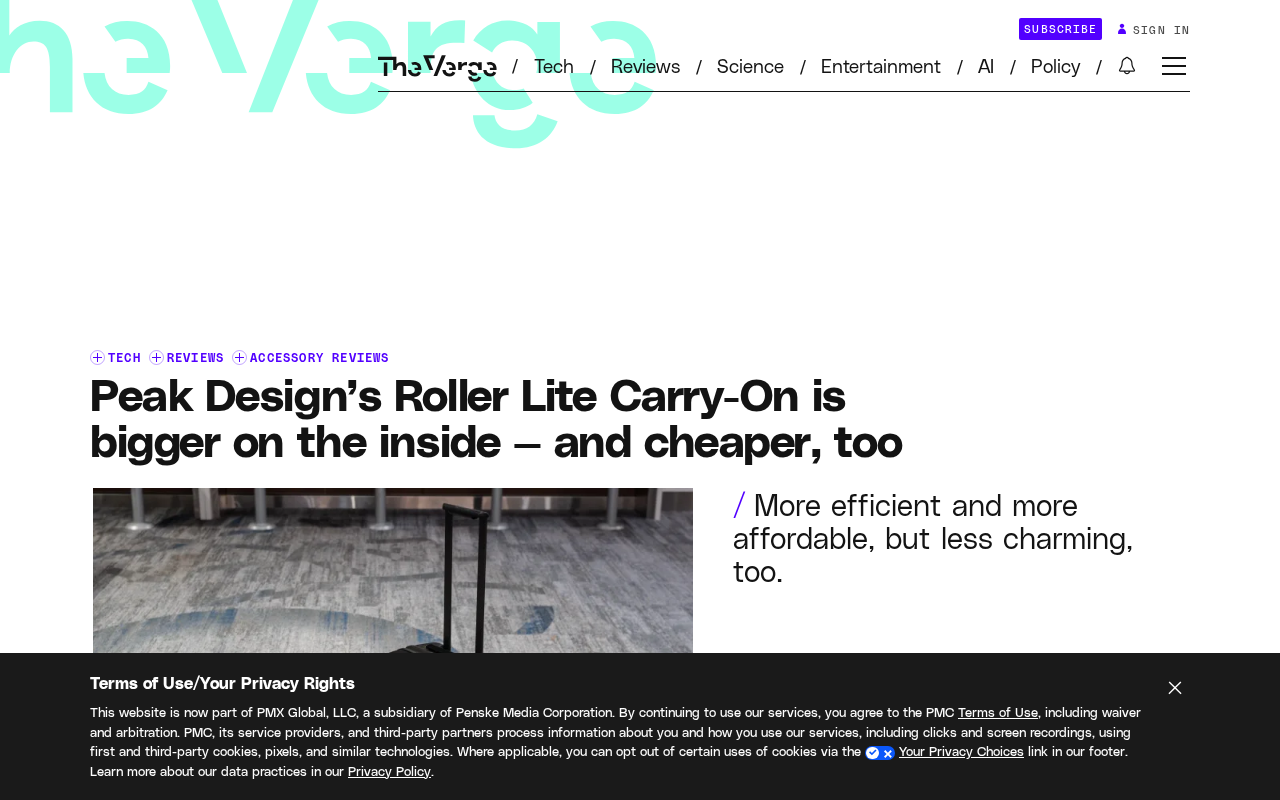
When Peak Design launched its first roller case, the Roller Pro, last year, we praised almost everything about it—except the price. Early backers could get it for as low as $425 during the crowdfunding campaign, but the same model now retails for $599.95. Now Peak Design has introduced the Roller Lite Carry-On, claiming it offers more interior space and a friendlier price.
Pricing Strategy: From Crowdfunding to Mass Production
The pricing trajectory of the Roller Pro reveals a common phenomenon in hardware products: the fading of crowdfunding perks. Early supporters locked in the product at $425, while the official retail price climbed to $599.95—a significant increase. The launch of the Roller Lite is clearly intended to provide a more accessible entry point for price-sensitive photography enthusiasts and travelers. Although the original article does not disclose the specific price of the Lite, its "cheaper" positioning is clear.
For Peak Design, this is a pragmatic move. Its core user base—photographers and content creators—has extremely high demands for gear portability and protection, but not everyone is willing to pay nearly $600 for a roller case. The Lite version retains the brand's design language while lowering the barrier to entry.
In the hardware product space, crowdfunding typically refers to raising funds from the public through platforms such as Kickstarter or Indiegogo and pre-selling products at a discount. The core value of this model is that project creators can validate market demand and recoup funds before mass production, while early supporters can obtain products at a price below retail and bear a certain delivery risk.
It is common industry practice for a significant price gap to exist between the crowdfunding price and the retail price. Reasons include: the crowdfunding stage eliminates channel distribution costs, early supporters bear uncertainty risk, and the cost structure changes as production scale expands. Peak Design itself is a brand that started on crowdfunding platforms, and many of its products have followed the path of "crowdfunding debut—retail price increase." Understanding this mechanism helps put the Roller Pro's price change from $425 to $599.95 into objective perspective, rather than simply viewing it as "a price hike to exploit customers."
Interior Space: Does the Lite Actually Hold More?
The key selling point of this upgrade is "bigger on the inside" from the headline. Typically, a Lite version means simplified materials or structure, but Peak Design claims the Roller Lite actually has greater interior capacity. This suggests that a redesigned interior layout may improve space utilization—for example, more rational compartment division or thinner shell materials.
For photography equipment storage, every bit of additional interior space is enormously valuable. Cameras, lenses, drones, and accessories have extremely high requirements for cushioning and compartmentalization. If the Roller Lite can provide greater capacity while being lighter, it will directly address a user pain point. However, the original article does not provide specific capacity in liters or dimensional comparisons, so actual performance remains to be verified with a hands-on unit.
In the context of bags and cases, "bigger on the inside" refers to the issue of space efficiency rather than an increase in physical exterior dimensions. Because airlines impose strict limits on the three dimensions of carry-on cases (a common standard is approximately 55 × 40 × 20 cm), manufacturers cannot increase capacity by enlarging exterior dimensions; they can only work on shell thickness, frame structure, and compartment layout.
This is especially true for photography roller cases: camera dividers and cushioning foam consume a large amount of space, and how to compress structural thickness while ensuring protection is the core design challenge. Thinner shell materials (such as polycarbonate or composite fabrics), adjustable modular dividers, and frame structures that fit the case more closely are all common means of increasing interior capacity. This also explains why "the Lite actually holds more" is technically possible.
Market Positioning and Competition
As Peak Design expands from camera accessories into the travel case category, the Roller series embodies the brand's understanding of a "mobile studio." The Roller Pro sets a benchmark with its high-end positioning, while the Roller Lite is responsible for volume sales. In the roller case market, it must compete with traditional luggage brands and emerging travel brands, but Peak Design's differentiated advantage lies in its deep understanding of photography scenarios.
With a lower price, the Roller Lite's competitors are no longer just high-end photography cases but also mainstream premium travel cases. Whether it can persuade ordinary travelers to pay a premium for its photography-friendly design is a question Peak Design needs to answer.
Photography roller cases are a relatively niche category, with representative products including Think Tank Photo's Airport series, Pelican's protective cases, and related Lowepro products. These products share common features: customizable interior dividers, emphasis on equipment protection, and certification for airline carry-on dimensions.
Peak Design's differentiation lies in combining travel case design aesthetics with photography storage, blurring the boundary between a "photography equipment case" and an "everyday travel case." With a lower price, the Roller Lite effectively enters the competitive range of premium travel cases, where rivals include brands such as Rimowa, Away, and Tumi. At this point, consumers' decision logic shifts from "equipment protection" to "overall value for money," and Peak Design needs to prove that its photography-friendly design is equally practical for ordinary travelers, not merely a premium exclusive to photographers.
Worth Anticipating but Limited Information
Public information about the Roller Lite is still incomplete. Beyond a lower price and more interior space, key details such as materials, weight, wheel durability, and warranty policy have not yet been disclosed. For a product positioned as "Lite," weight control is particularly critical, and that is precisely what the original article does not mention.
If you are looking for a roller case that balances photography equipment protection with everyday travel and are deterred by the price of the Roller Pro, the Roller Lite is worth adding to your watchlist. But before a full review is available, a cautiously optimistic stance is advisable.
For roller cases, the wheels (casters) are one of the key components determining the user experience. Carry-on cases typically use dual-wheel or four-wheel spinner structures, and the wheel material (such as polyurethane or TPE), bearing quality, and replaceability directly affect rolling smoothness and durability. High-end products often emphasize silent wheels and repairable design.
Weight is also a core metric of the "Lite" positioning. Airline weight limits for carry-on cases vary by carrier, typically between 7 and 10 kg. The lighter the case itself, the more equipment it can carry. In addition, warranty policy reflects a brand's confidence in product durability. Peak Design has offered relatively generous warranties on past products, and whether this policy extends to the Roller Lite is worth watching.
One-line Summary
Peak Design launches the cheaper Roller Lite carry-on case, which actually offers more interior space.
Paragraph Summary
After the Roller Pro's price rose from a crowdfunding price of $425 to $599.95, Peak Design introduced the more affordable Roller Lite Carry-On. The company claims it actually offers more interior space, suggesting improved space utilization through a redesigned compartment layout or thinner shell materials—a significant factor for photography equipment storage. The article analyzes the Roller Pro's pricing trajectory and the fading of crowdfunding perks, noting that the Lite version aims to lower the barrier to entry for photography enthusiasts and travelers while also handling volume sales. At the market level, the Roller Lite must compete with both high-end photography cases and mainstream premium travel cases. However, key information such as its specific price, weight, materials, wheel durability, and warranty policy has not yet been announced, and a complete evaluation still awaits hands-on testing.
Related articles

Claude Fable 5.2 Hands-On: Top Intelligence but Absurdly Expensive
Anthropic releases Claude Fable 5.2 and Mythos 5.2, topping the Artificial Analysis intelligence leaderboard with big gains in scientific reasoning, strong game and hardware design, but max mode costs ~$26.54 per task. Hands-on game, circuit board design, and pricing advice.

1,000 AI Agents Formalize Fermat's Last Theorem in 30 Hours, Anthropic Releases New Claude Models
Anthropic releases Claude Fable 5.2 and Mythos 5.2: 1,000 agents formalize Fermat's Last Theorem in 30 hours, coding costs halved, plus hardware design and physics.

Claude Fable 5.2 Released: A Thousand AI Agents Build a Bootable OS in 8 Days
Anthropic releases Claude Fable 5.2 and Mythos 5.2—same model, two safety tiers. Demo shows 1,000 AI agents build a bootable OS in 8 days, formalize Fermat proof in 30 hours, score 64.6 beating Gemini 4 Carbon, price cut 20%.