Perplexity Open-Sources pplx-embed-v2-late: A Multimodal Multi-Vector Embedding Model

Perplexity open-sources a multimodal multi-vector embedding model for unified text-image retrieval and OCR-free PDF search.
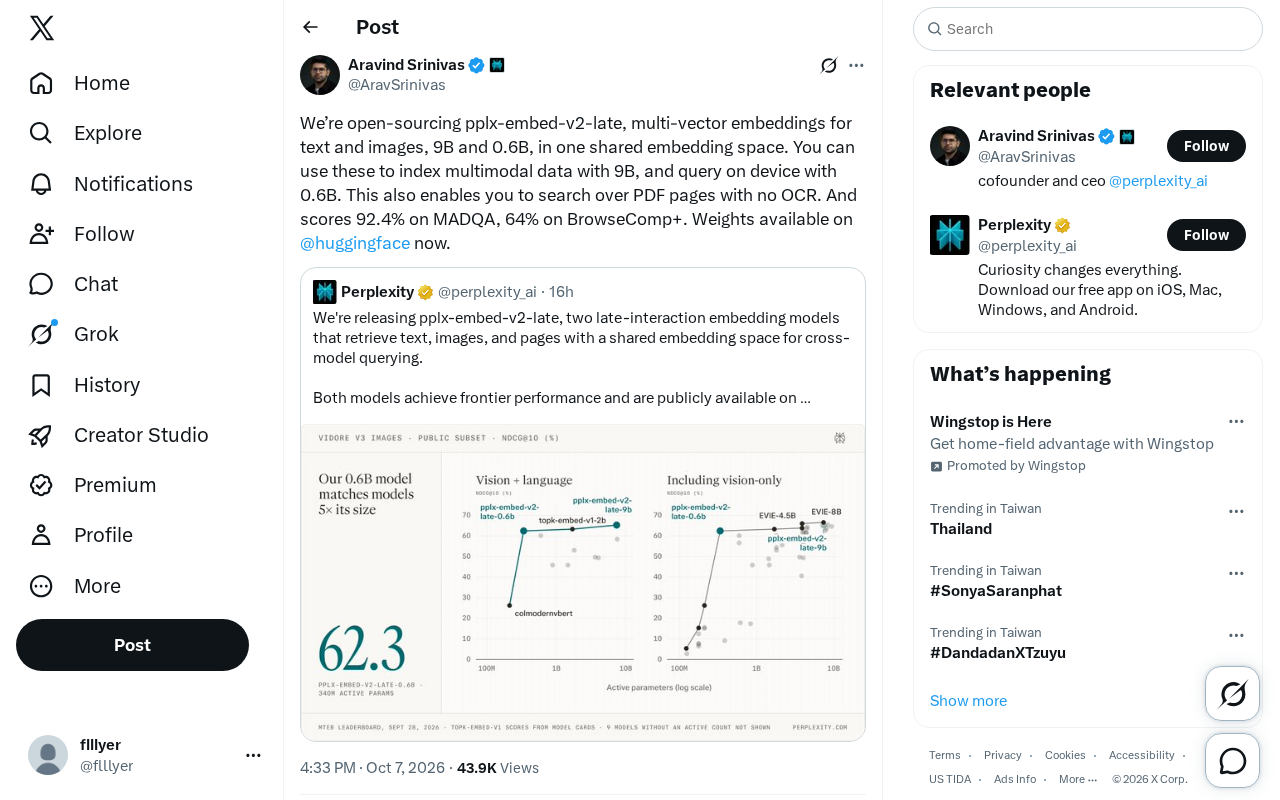
Perplexity has open-sourced pplx-embed-v2-late, a multi-vector embedding model available in 9B and 0.6B sizes that share a unified embedding space — the 9B model handles offline indexing while the 0.6B model enables on-device querying. Using a late interaction architecture similar to ColBERT, it retains token-level vectors for fine-grained retrieval and extends this paradigm to multimodal text-image settings, including OCR-free PDF page retrieval that preserves charts and layout. Official benchmarks show MADQA 92.4% and BrowseComp+ 64%. Weights are available on Hugging Face for building multimodal RAG and document search applications.
Perplexity has announced the open-source release of its multi-vector embedding model pplx-embed-v2-late, which unifies text and images into a single shared embedding space. Available in both 9B and 0.6B variants, the model weights are now hosted on Hugging Face — targeting developers and researchers looking to build multimodal retrieval systems.
One Release, Two Scales: 9B for Indexing + 0.6B for On-Device Queries
The most notable design decision in this release is the use of two models at different parameter scales to cover both ends of the retrieval pipeline. The 9B model handles multimodal data indexing — the computationally intensive, precision-critical offline process of building a document index. The 0.6B model, on the other hand, is designed for on-device querying, capable of running directly on user hardware to reduce latency and cloud dependency.
Because both models share the same embedding space, indexes built with the 9B model can be queried directly using vectors from the 0.6B model. This asymmetric architecture — "large model for indexing, small model for querying" — balances retrieval quality against deployment cost, and opens up a practical path for multimodal search on mobile and edge devices.
This kind of asymmetric retrieval architecture has solid precedent in information retrieval. Its viability depends on a key requirement: both models must be jointly trained or distilled so their output vectors reside in the same metric space — otherwise, distance calculations between query vectors from the small model and index vectors from the large model become semantically meaningless. In practice, this alignment is typically achieved through knowledge distillation or a shared contrastive learning objective. This design is especially critical for on-device deployment: the user's device only needs to load the 0.6B query encoder, while the document index — built offline using the 9B model — can be hosted in the cloud. At query time, only vector retrieval is needed; documents don't need to be re-encoded, dramatically reducing the compute and memory footprint on the device.
OCR-Free PDF Page Retrieval
One of pplx-embed-v2-late's key capabilities is PDF page retrieval without OCR. Traditional document retrieval pipelines rely on OCR to first convert scanned or image-based PDFs into text before indexing — a step that can introduce recognition errors and discard layout, charts, and other visual information.
Multi-vector embedding sidesteps this by treating PDF pages as images directly, mapping visual content into the same embedding space as text. This means charts, formulas, and layout structure can all be included in retrieval. For technical documents, financial reports, and research papers that contain heavy visual content, this approach theoretically preserves more of the original semantics and reduces retrieval gaps caused by OCR distortion.
The limitations of traditional OCR pipelines go beyond error rates — the deeper issue is that OCR is fundamentally a form of information downsampling: it flattens two-dimensional visual layout into a linear text stream, often destroying the relational structure of tables, the hierarchical levels of formulas, and the spatial correspondence between figures and captions. In recent years, approaches like ColPali have pioneered "visual retrieval" by rendering document pages as images and feeding them to vision-language models (VLMs) to extract patch-level multi-vector representations, bypassing OCR entirely. pplx-embed-v2-late takes a similar approach — treating each PDF page as an image fed into a visual encoder, then performing similarity matching against text queries in a shared embedding space. This requires the model to have strong visual text understanding (i.e., OCR-free text perception) and cross-modal semantic alignment capabilities, which is one of the core reasons this model is significantly harder to train than a purely text-based embedding model.
Benchmark Results: MADQA 92.4%, BrowseComp+ 64%
According to officially published figures, the model achieves 92.4% on MADQA and 64% on BrowseComp+. MADQA focuses on multimodal document question-answering scenarios — the high score suggests strong cross-modal semantic alignment between text and images. BrowseComp+ is closer to real-world web browsing-style retrieval tasks, testing the model's ability to handle complex, open-ended queries.
It's worth noting that these results come from the vendor's own testing and lack independent third-party benchmarking. Real-world performance will need to be validated by the community on actual production data. That said, for an openly released model, published benchmarks at least provide a reproducible reference point.
What "Late Interaction" and Multi-Vector Embedding Mean
The word late in the model name refers to late interaction — a technical approach that reveals the model's underlying design. Unlike traditional embeddings that compress an entire passage into a single vector, multi-vector embeddings retain multiple token-level vectors for each document, enabling fine-grained matching between query vectors and multiple document vectors at retrieval time.
This approach (similar in spirit to ColBERT) generally outperforms single-vector methods in recall precision, and is especially well-suited for long documents and information-dense layouts with mixed text and images — at the cost of larger index storage and higher computational overhead. pplx-embed-v2-late extends this paradigm to multimodal text-image settings, which is the core distinction from standard text embedding models.
ColBERT (Contextualized Late Interaction over BERT), proposed by Stanford in 2020, is the most representative work in this line of research. Its core idea: both the query and the document are independently encoded into sequences of token-level vectors — rather than a single sentence vector — and at retrieval time, a "MaxSim" operation is used: for each query token, find the most similar vector in the document's token sequence, then sum those maximum similarity scores to produce a final relevance score. This design lets the model achieve both the retrieval efficiency of a dual-encoder (document vectors can be pre-computed offline) and the fine-grained matching precision of a cross-encoder. The tradeoff is that each document requires storing multiple vectors instead of one, typically making the index several to dozens of times larger than a single-vector approach, and placing higher demands on vector database storage and approximate nearest neighbor (ANN) search performance. pplx-embed-v2-late extends this mechanism to image tokens, allowing local regions of an image — such as specific values in a chart or heading levels in a layout — to participate in fine-grained matching, rather than being compressed into a single global visual vector that loses spatial detail.
What This Means for Developers
The model weights are available for download on Hugging Face. Developers can use them directly to build multimodal RAG (retrieval-augmented generation) systems, document search engines, or knowledge base Q&A applications. The OCR-free PDF retrieval capability is especially appealing for teams working with unstructured documents, while the 0.6B on-device model opens up compelling possibilities for privacy-sensitive, low-latency local retrieval use cases.
The fact that Perplexity — a company whose core business is search — is open-sourcing a retrieval model sends a signal in itself: multimodal, fine-grained vector retrieval is becoming foundational infrastructure for the next generation of search and RAG systems. How well it holds up in practice will ultimately be determined by community replication and real-world testing.
Related articles

Amphibious Transforming Drone: Beyond 100x Power Savings, What Are the Real Needs?
Is the amphibious transforming drone just a gimmick? Starting from the 100x power difference of the M4 Morphobot, explore real application scenarios and thesis topic ideas, analyzing boundary conditions where pure drones and pure ground robots both fail.

Warhound Raises $200 Million: Genetically Engineered "War Dogs" Paired with Anduril Gear
Warhound raises $200M, backed by Ben Lamm and Palmer Luckey, to genetically engineer dogs for military and law enforcement use and equip them with Anduril gear. This article analyzes its technology direction, funding logic, and ethical controversy.

Claude API Comes to Google Cloud: IAM Integration and SDK Access Guide
Anthropic hosts the full Claude API on Google Cloud with IAM-controlled permissions and unified billing. This guide covers the Vertex AI and Anthropic-hosted entry points, IAM role configuration, and SDK access.