Perplexity Pro Running Out of Credits? Should You Upgrade to Max?

Before upgrading Perplexity Pro to Max, diagnose your usage habits — then decide.
A Perplexity Pro user found their premium model credits (like Claude) exhausted before lunch, with the app constantly pushing a Max upgrade. This article breaks down the core Pro vs. Max differences — Max mainly raises call limits on high-cost models and unlocks advanced features, but at a noticeably higher price. Fast credit burn often stems from defaulting to expensive models, long conversation chains, or frequent deep-research use — not necessarily an insufficient plan. A practical decision framework is provided: Max is only worth it if you hit Pro's limits almost daily, rely heavily on specific premium models, and use AI as a core productivity tool. Readers are also warned about platforms' deliberately engineered upgrade nudges.
A Real User Dilemma: Why Do Pro Credits Burn So Fast?
A new Perplexity Pro subscriber recently posted on Reddit, voicing a frustration shared by many: they signed up for Pro specifically to access multiple AI models (like Claude, GPT, etc.), only to find their credits evaporating at a shocking rate.
In their own words, "Claude AI quota might run out before lunchtime, and credits burn through like hell." Shortly after each top-up, the app would hit the limit again — and constantly nudge them toward upgrading to the Max plan. Which raises the real question: Will upgrading to Max actually solve the credit anxiety, or does Max come with its own new limitations?
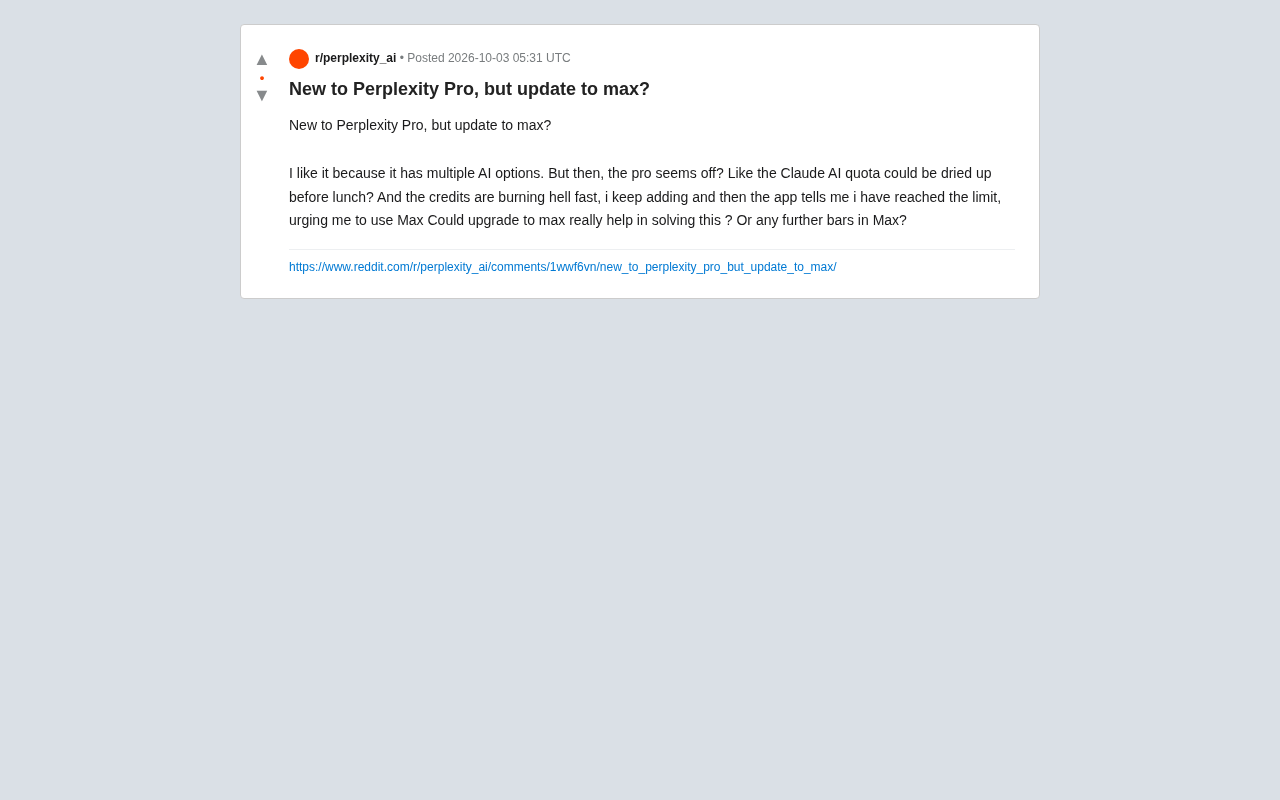
This might look like one user's complaint, but it actually cuts to a broader pain point in AI subscription services: opaque quota systems, high costs when calling premium models heavily, and relentless upsell pressure from platforms.
Core Differences Between Perplexity Pro and Max
Based on publicly available product information, Perplexity's Pro and Max tiers differ primarily across the following dimensions.
Model Usage Quotas
While Pro unlocks access to multiple models, it typically imposes daily or periodic limits on high-cost models — such as advanced Claude versions or premium reasoning models. Heavy users who ask questions in rapid succession can easily hit that "out before lunch" scenario. Max's core selling point is significantly raising (or near-eliminating) these limits, targeting users with high-frequency, professional-grade workloads.
Understanding the quota system requires some context: Perplexity doesn't train Claude or GPT itself — it pays Anthropic, OpenAI, and others via API for every request, which incurs real token costs. The API pricing for top-tier models like Claude 3.5 Sonnet/Opus and GPT-4o is far higher than Perplexity's own smaller models. Without usage caps, a single heavy user could easily consume more than what the subscription revenue covers. This explains why "unlimited" means very different things across different models — it's the platform's balancing act between user experience and marginal cost.
Advanced Feature Unlocks
Max typically also includes capabilities unavailable in Pro, such as priority access to the latest frontier models, more powerful research and deep-search modes, and higher file processing and context limits. For users who rely on Perplexity as a primary productivity tool, these are the real reasons to upgrade.
The Price Jump
It's worth being clear-eyed: Max's monthly fee is noticeably higher than Pro. Whether it's worth it depends entirely on whether you genuinely and regularly hit Pro's quota ceiling. For casual users who exceed limits only occasionally, paying for Max likely isn't a good deal.
Before Upgrading, Figure Out Where Your Credits Are Actually Going
The more rational move before spending more money is to diagnose your own usage patterns.
Many users burn through credits faster than expected due to a few overlooked habits:
- Defaulting to high-cost models: If every query is manually or automatically routed to the most expensive reasoning model, credits will drain fast. For everyday simple searches, the default model is usually sufficient.
- Treating search like a multi-turn conversation: Perplexity is fundamentally a search-oriented tool. Long chains of follow-up questions accumulate API costs quickly.
- Throwing complex tasks at premium models all at once: Deep Research and Pro Search modes consume far more credits per query than standard Q&A.
In other words, if most of your needs are informational retrieval rather than intensive reasoning, optimizing your habits will often save more money than upgrading.
Should You Upgrade to Max? A Decision Framework
Drawing from the Reddit user's situation, here are a few questions to help decide whether upgrading is worthwhile:
- Do you hit Pro's limits almost every day? If you only occasionally exceed the quota, adjusting your habits should be enough. If you're consistently maxing out daily, Max starts to make sense.
- Do you depend on a specific premium model (like an advanced Claude version)? If your workflow is tightly tied to a model that's tightly rationed under Pro, Max's relaxed limits will make a real difference.
- Is AI tooling core to your productivity? For professionals using it for research, writing, or coding, Max's cost can be justified by the work it enables. For casual users, the value proposition is weaker.
If you answer "yes" to two or more of these questions, upgrading to Max is likely worth it. Otherwise, try adjusting your usage patterns first and reassess after a week or two.
Watch Out for Engineered "Upgrade Nudges"
The user mentioned that "the app keeps pushing me to upgrade to Max" — which is a useful reminder to separate genuine need from marketing mechanics. AI subscription services commonly follow a "low-tier acquisition, high-tier monetization" playbook, and frequent quota alerts are themselves a conversion design choice.
This product pattern has a name in SaaS: the usage-triggered upsell funnel. The logic is: let users experience value quickly on the free or low-cost tier, then create friction through quota exhaustion to funnel conversion anxiety toward a paid upgrade. The wording of quota alerts (e.g., "You've used up today's quota") often deliberately omits the option to "switch to a lower-cost model and keep going," reinforcing the impression that upgrading is the only path forward. Recognizing this pattern doesn't mean the higher tier lacks value — it means consumers should be aware that the moment that triggers the urge to upgrade is often the most carefully designed point in the funnel. Don't make a long-term subscription decision driven by in-the-moment anxiety.
The rational approach: run through a full real-world usage cycle on free or Pro first, and let the data speak — is it a feature gap, or a usage habit issue? Only when you can clearly say "Pro is genuinely limiting my output" does upgrading to Max become a smart investment, rather than paying a premium for anxiety relief.
Conclusion
Deciding whether to upgrade from Perplexity Pro to Max is fundamentally a calculation of usage intensity × unit cost. Burning through credits quickly doesn't necessarily mean your plan is too limited — it may simply mean your usage patterns aren't cost-efficient. Diagnose first, then decide. That's how you avoid getting pulled into an endless chain of AI subscription upgrades.
Related articles

Meta vs. Publishers: The AI Data Battle Over Terms of Service Changes and the Future of the Internet
Meta changed its business account terms to allow AI training on linked website data, sparking backlash from publishers and creators. Industry groups demanded negotiations, forcing Meta to remove 'training' wording and delay the effective date. The dispute reveals the deeper battle over data authorization and the future of the internet in the AI era.

When Outside Xbox Meets Blood on the Clocktower: A Legion Match in Minecraft
Outside Xbox guests Ellen and Mike play Minecraft Blood on the Clocktower in a Legion game. How can three good players fight an evil majority amid information noise? This article breaks down Legion mechanics, information-role mind games, and the endgame reversal.

Kimi K3.1 Hands-On Test: Open-Source Model Nears Opus, Video Generation Steals the Show
Kimi K3.1 completed motion graphics, 3D rendering, mini-games, and video generation in a live test. Analysis of its 2.8T MoE architecture, gap vs Opus/GPT, and hidden video generation.