Perplexity Pro Service Downgrade? Long-Time Users Complain About Model Downgrades and Tighter Censorship
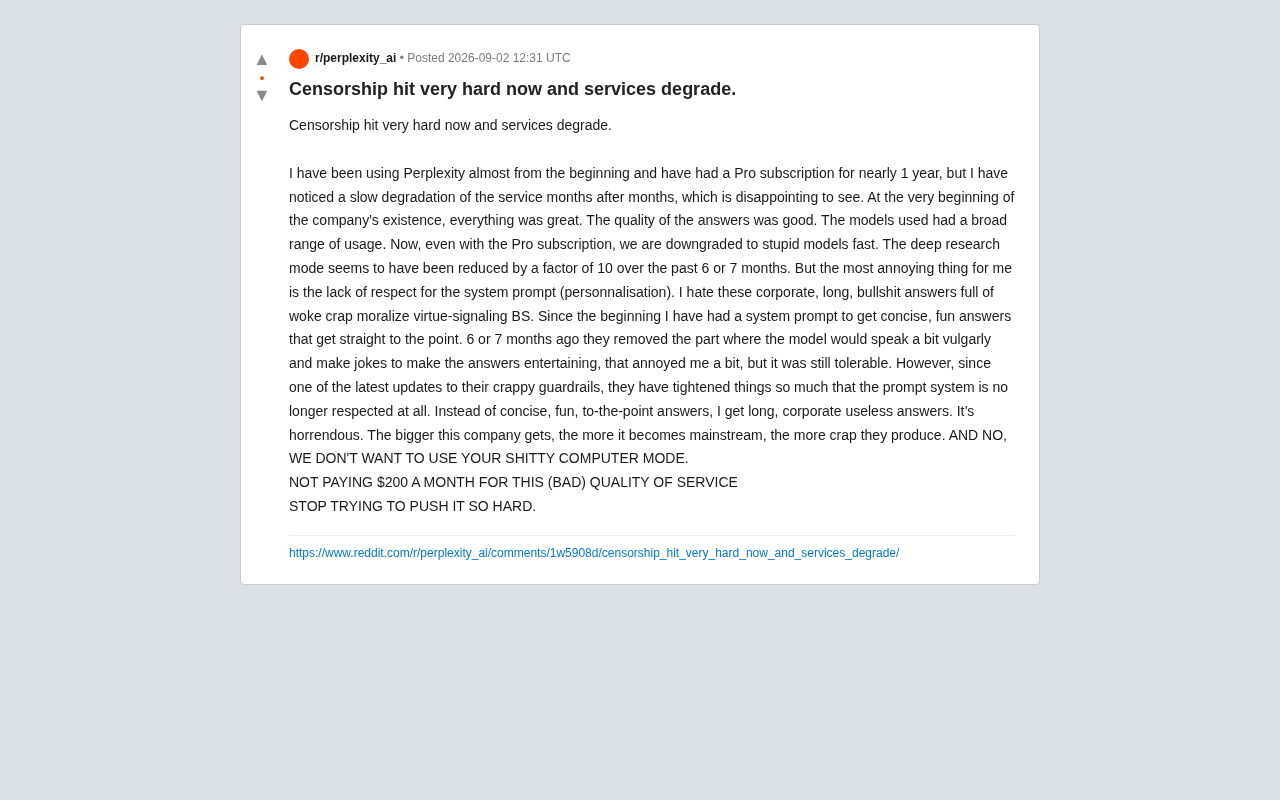
Perplexity Pro users report silent model downgrades, weakened Deep Research, and ignored personalization settings.
A long-time Perplexity Pro subscriber posted on Reddit about significant service quality declines, including weakened Deep Research capabilities, system prompts being overridden by tightened guardrails, and silent model downgrades. The complaints highlight structural tensions AI search products face as they scale: balancing cost control, safety compliance, and user experience—especially for paying power users who expect premium, personalized service.
A Long-Time User's Disappointment: From Amazement to Frustration with Perplexity
Recently, a long-time user who has been using Perplexity almost since its founding and has held a Pro subscription for nearly a year posted a lengthy complaint on Reddit. The post struck a chord with many, pointing to an increasingly common phenomenon: AI search products are experiencing a visible decline in service quality as they scale up.
Perplexity AI was founded in 2022, co-founded by former OpenAI researcher Aravind Srinivas, and positioned as an "AI-native answer engine" aiming to challenge Google's dominance in the search market. By the end of 2024, it had reached a valuation of over $9 billion with monthly active users exceeding 15 million, and its Pro subscription is priced at $20 per month, offering access to more advanced models and additional Deep Research queries. However, under the dual pressures of high-valuation fundraising and intensifying competition—Google pushing into AI search with AI Overviews, OpenAI with ChatGPT's search features, plus multiple major media outlets filing copyright lawsuits over Perplexity's content scraping practices—the company faces the difficult balancing act of simultaneously expanding its user base and controlling inference costs.
The user was blunt: the experience was excellent when the company was just starting out—high-quality answers and a broad range of available models. But over time, "even with a Pro subscription, you get quickly downgraded to worse models." They specifically noted that Deep Research mode's capabilities "seem to have been weakened by roughly 10x over the past 6 to 7 months." Deep Research is one of Perplexity's core premium features, designed to simulate the workflow of a human researcher: unlike a standard search, it performs multiple rounds of web retrieval, cross-validates sources, synthesizes analysis, and generates structured reports, requiring multi-step reasoning and significant computational resources. Due to its compute-intensive nature, Deep Research is also the feature most susceptible to cost pressures—providers have incentives to reduce the number of search rounds, downgrade the underlying model, or limit the depth of each research session. This aligns closely with the user's perception that "capabilities have been drastically weakened."
System Prompts Ignored: Personalization Settings Rendered Useless
The user's biggest frustration wasn't the model downgrade itself, but rather the disregard for system prompts (personalization settings).
In the interaction architecture of large language models, system prompts are a core concept. The message format of mainstream APIs typically consists of three roles: system, user, and assistant. The system prompt serves as a "meta-instruction" for the conversation, injected before user input to define the model's behavioral boundaries, tone, and response logic. Perplexity exposes this capability to end users in the form of "personalization settings," essentially allowing users to participate in writing the system prompt. However, the platform also injects its own safety-related system-level instructions, and when the two conflict, the platform's instructions typically take higher priority—this is the technical root cause of why users feel their "settings aren't working."
This user had set up a custom prompt from the start, aiming for concise, engaging, and straight-to-the-point responses. However, as the product evolved:
- About 6-7 months ago, the company removed the ability for the model to use a slightly casual tone and inject humor to make responses more engaging;
- After a recent "Guardrails" update, system prompts were almost entirely disregarded.
"Guardrails" here refers to a core concept in AI safety—a set of technical and strategic mechanisms designed to constrain model outputs, including input filtering (blocking harmful prompts), output moderation (detecting and suppressing inappropriate content), RLHF alignment training (using reinforcement learning from human feedback to make models refuse dangerous requests), and runtime rule engines. As AI products move toward the mass market, tightening guardrails has become an industry inevitability—since 2023, multiple AI companies have faced PR crises and legal actions over inappropriate model outputs, and companies like Meta, Google, and OpenAI have been continuously strengthening their guardrails. But overly tight guardrails lead to the "over-refusal" phenomenon: models give evasive or formulaic answers even to completely harmless requests.
The result was that the user's "concise, engaging, straight to the point" settings were systematically overridden, replaced by "verbose, formulaic, preachy corporate-style answers." For power users who rely on personalized configurations to boost efficiency, this change essentially wiped out the core value of paying for a subscription.
Behind the Phenomenon: The Cost of Mainstreaming AI Products
This user's complaints actually reveal a trend worth watching in the current AI application landscape.
The Conflict Between Safety Guardrails and User Freedom
As user bases expand and companies go mainstream, providers tend to tighten content guardrails to mitigate legal and reputational risks. This objectively leads to two consequences: first, answers become more conservative and formulaic; second, user-defined instructions get deprioritized or even forcibly overridden.
For casual users, this may not matter much; but for paying premium users, "personalization settings not working" means the differentiated experience they're paying for gets flattened out. This is fundamentally a structural contradiction between the platform's risk-control logic and individual user needs.
Model Downgrading and Cost Control
The user's mention of "being quickly downgraded to worse models" also points to the cost pressures universally faced by AI service providers. Model Routing is a cost optimization strategy widely used by AI providers in production environments—its core idea is that not all user requests need the most powerful model to handle them. Using a lightweight classifier or rule engine, the system dynamically routes requests to models of varying capability (and cost) based on factors like query complexity, subscription tier, and current server load. For example, a simple weather query might be routed to a GPT-3.5-level model, while complex research questions get assigned to GPT-4-level models. Taking GPT-4-level models as an example, the cost of a single complex inference can be 10-50x that of a lightweight model, and when user volumes surge from tens of thousands to millions, running everything on top-tier models is economically unsustainable.
This kind of "silent downgrading," if lacking transparency, easily makes paying users feel deceived. Most providers don't explicitly tell users which model is handling their current request—users can only infer it indirectly through changes in answer quality, which further deepens the trust crisis.
Resistance to New Features
At the end of the post, the user rejected the officially promoted "Computer mode" with near-anger and explicitly stated they were unwilling to pay for a $200/month subscription. This reflects another product operations issue: when the core experience is deteriorating, aggressively promoting new features only intensifies users' negative sentiment. What users want is for original promises to be fulfilled, not to be steered toward paying for new offerings.
Implications for AI Products
While this feedback from a single source represents a personal opinion and cannot speak for all users, the issues it raises have broadly relevant implications:
- Transparency: Should model routing and downgrading strategies be disclosed to paying users?
- User Control: Should safety guardrails preserve some degree of user-adjustable space rather than applying blanket overrides?
- Subscription Value Consistency: As the product evolves, is it maintaining the service level promised at the time of initial subscription?
For fast-growing AI search products like Perplexity, finding the balance between regulatory compliance, cost control, and user experience will be key to retaining their core paying users. Scaling should not come at the expense of loyal users' experience—the frustration behind this post may very well echo the shared sentiment of many silent users.
Note: This article is based on the subjective experience of a single Reddit user. The claims of "service downgrade" have not been officially confirmed and may vary depending on use case, region, and time period.
Related articles

Amphibious Transforming Drone: Beyond 100x Power Savings, What Are the Real Needs?
Is the amphibious transforming drone just a gimmick? Starting from the 100x power difference of the M4 Morphobot, explore real application scenarios and thesis topic ideas, analyzing boundary conditions where pure drones and pure ground robots both fail.

Warhound Raises $200 Million: Genetically Engineered "War Dogs" Paired with Anduril Gear
Warhound raises $200M, backed by Ben Lamm and Palmer Luckey, to genetically engineer dogs for military and law enforcement use and equip them with Anduril gear. This article analyzes its technology direction, funding logic, and ethical controversy.

Claude API Comes to Google Cloud: IAM Integration and SDK Access Guide
Anthropic hosts the full Claude API on Google Cloud with IAM-controlled permissions and unified billing. This guide covers the Vertex AI and Anthropic-hosted entry points, IAM role configuration, and SDK access.