Perplexity Puts Browser Control Behind a Paywall: The Era of Free AI Is Ending
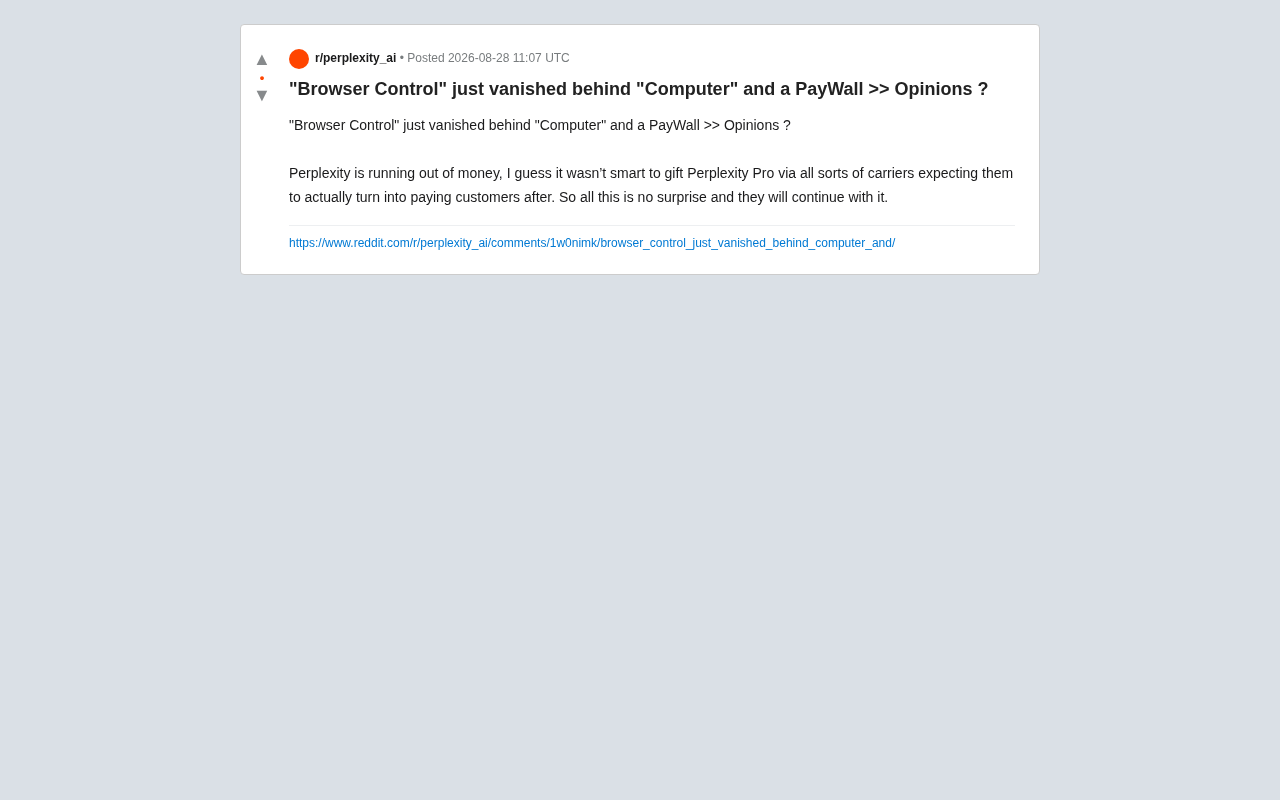
Perplexity paywalls its Browser Control feature, signaling the end of free AI's golden era.
Perplexity quietly renamed its Browser Control feature to "Computer" and placed it behind a paywall, frustrating users who had relied on it for free. The move reflects growing profitability pressures across the AI industry, where subsidized growth strategies clash with high compute costs. As investors demand sustainable unit economics, more AI companies are expected to monetize premium features — marking a shift from growth-first to profitability-first strategies.
What Happened
Recently, Perplexity users discovered in community forums that the previously available "Browser Control" feature had quietly disappeared, replaced by a new feature called "Computer" — now locked behind a paywall. The change sparked widespread discussion and frustration on platforms like Reddit.
Browser Control is a technical capability that allows AI agents to directly manipulate web browsers — including automated clicking, form filling, page navigation, and data extraction. The underlying technology typically relies on browser automation frameworks like Playwright or Puppeteer, combined with large language models' ability to understand intent and plan tasks. The "Computer" feature extends this concept further, generally referring to broader Computer Use capabilities — meaning the AI can not only control browsers but also operate desktop applications, file systems, and other computer functions. This concept first gained widespread attention when Anthropic launched Claude's Computer Use capability in 2024 and has since become a hot direction in the AI Agent space. The naming shift from Browser Control to Computer suggests that Perplexity may have upgraded and expanded its technical capabilities.
For users who had been using the free or trial version of this feature, the combination of "feature migration + paywall" means that a capability they were familiar with has been repackaged and folded into a paid subscription tier. What was once seen as a differentiating highlight — automated browser control — now requires a higher-tier subscription to unlock.
Users' Core Complaints
The Backlash from Free Giveaway Strategies
Some users were blunt in the discussion: "Perplexity is running out of money. They mass-distributed Perplexity Pro through various carriers, thinking those users would convert to paying customers after trying it out, but that wasn't a smart move."
This observation touches on a dilemma that AI products universally face: users acquired through free giveaways often lack genuine willingness to pay. When the subsidy period ends and free benefits expire, these users don't convert into paying customers — instead, they become the loudest complainers when features get restricted.
Perplexity's strategy of distributing Pro memberships through carrier partnerships follows the classic growth playbook of the mobile internet era. Similarly, Uber attracted drivers and riders through massive subsidies early on, and Meituan and Didi fought China's infamous "cash-burning wars." However, AI products face unique challenges with this subsidy logic: traditional internet products have marginal costs approaching zero, where larger user bases drive down per-unit costs (network effects); AI products, on the other hand, incur real compute costs with every use, meaning user growth actually accelerates cash burn. Perplexity's valuation exceeded $9 billion in 2024, but its annualized revenue was reportedly around $100 million — meaning a large number of free users were effectively draining the company's cash reserves. When investors start demanding a clear path to profitability, monetizing high-cost features becomes an inevitable choice.
The Experience Gap from "Delight" to "Paywall"
From a user experience perspective, the biggest issue isn't charging per se — it's the way the feature was quietly renamed and moved behind a paywall. When a feature you've been using suddenly disappears and reappears under a new name in the paid options, users naturally feel they're being taken for a ride. This sense of betrayal tends to provoke more negative emotions than if the feature had been clearly priced from the start.
This negative reaction has solid theoretical grounding in behavioral economics. Nobel laureate Daniel Kahneman's "loss aversion" theory shows that the pain of losing something you already have is roughly twice as intense as the pleasure of gaining something equivalent. When users had already grown accustomed to using Browser Control, its "disappearance" triggered a strong sense of loss rather than mere regret over something "not obtained." More critically, Perplexity chose to rename and relocate the feature rather than issuing a straightforward feature downgrade notice — a lack of transparency easily interpreted as underhanded, further amplifying the erosion of trust. By comparison, SaaS products like Notion and Figma typically provide months of advance notice when adjusting pricing and offer transition periods for existing users. While such approaches can't eliminate dissatisfaction entirely, they significantly reduce churn rates.
The Business Logic Behind the Move
Questioning the Sustainability of Subsidized Growth
As a star startup in the AI search space, Perplexity previously partnered with multiple carriers and distributed Pro memberships at scale to rapidly expand its user base. This "subsidize for growth" playbook was common in the mobile internet era, but it faces far more severe cost pressure with AI products — every AI inference call carries real compute costs.
AI inference refers to the process where a trained large language model processes user requests and generates responses. Unlike model training, inference occurs with every user interaction, and its cost scales linearly with request volume. For a GPT-4-class model, a single API call can cost anywhere from a few cents to tens of cents, depending on the number of input and output tokens. Agent-type tasks are far more expensive than single Q&A interactions — a browser control task might require 10–50 consecutive inference steps (including observing screenshots, deciding the next action, verifying results, etc.), each consuming compute resources and API call fees. Additionally, browser automation requires maintaining cloud-based browser instances, further driving up marginal costs.
Features like browser control and agent automation typically require more powerful models and multi-step task execution, with per-unit costs far exceeding those of ordinary Q&A queries. Placing these high-cost features behind a paywall is, from a business standpoint, an unavoidable cost optimization.
The Pervasive Profitability Anxiety Across AI Products
This incident is not an isolated case — it's a microcosm of the profitability anxiety gripping the entire AI industry. From OpenAI to various AI applications, nearly every vendor is exploring how to strike a balance between exorbitant compute costs and users' willingness to pay. Attracting users for free and then gradually monetizing core capabilities is becoming a universal path.
The AI search space where Perplexity operates is growing increasingly crowded. Beyond Google integrating AI Overviews into traditional search, OpenAI has launched ChatGPT Search, Microsoft offers its Copilot search experience, and domestic players like Metaso AI Search and 360 AI Search are all vying for this market. Perplexity's differentiating advantage lies in its "answer engine" positioning — delivering structured answers with cited sources rather than traditional link lists. Agent capabilities like Browser Control/Computer were originally key to building Perplexity's competitive moat. While placing them behind a paywall may help short-term financial health, it could also give competitors a window to attract users with free Agent features. This trade-off between monetization timing and competitive advantage is the core strategic dilemma facing all AI startups.
For Perplexity, monetizing the "Computer" feature is fundamentally about finding a sustainable revenue model for high-value, high-cost Agent capabilities.
Takeaways and Implications
A Warning for Users
For users who depend on specific features, this change is a reminder: features available during free or trial periods can change at any time. When building workflows, over-reliance on a single product's free capabilities carries risk — it's worth keeping an eye on alternatives and open-source tools. In the browser automation space, open-source alternatives like Browser Use and LaVague already offer self-deployable Agent capabilities. While the barrier to entry is higher, there's no risk of features being suddenly taken away.
Advice for AI Vendors
For AI vendors, how you communicate feature monetization is crucial. Quietly renaming a feature and moving it behind a paywall may technically accomplish commercialization, but it exacts a toll on user trust. More transparent advance notice and clear upgrade paths could help mitigate user resistance. The industry already has positive examples to draw from: when GitHub transitioned Copilot from free preview to paid service, it preserved free access for open-source developers and students; when Midjourney adjusted generation limits, it provided ample advance notice and discussion in its Discord community. The common thread in these approaches is respecting users' right to know and offering reasonable transition plans for different user tiers.
A Signal for the Industry
This small product change reflects a larger trend: AI applications transitioning from "growth-first" to "profitability-first." As capital markets intensify their focus on AI companies' ability to generate profit, we'll likely see more products moving high-value features into paid tiers. The free AI feast is gradually giving way to rational, paid models as the new normal.
From a broader perspective, this transition is closely tied to shifts in the AI industry's overall capital environment during 2024–2025. After the "AI frenzy" investment wave of 2023, investors are becoming more cautious, shifting their evaluation criteria for AI companies from "user growth" to "unit economics" — whether the cost of acquiring each paying user can be covered by their lifetime value. Against this backdrop, Perplexity's feature monetization is not just an individual choice but a necessary stage in the entire industry's march toward commercial maturity.
Conclusion
Perplexity's migration of "Browser Control" to "Computer" behind a paywall may seem like a routine product adjustment, but it actually reflects the difficult trade-offs AI startups face between cost management and growth. For users, it's a reminder that there's no such thing as a free lunch. For the industry, it's a signal worth documenting in the ongoing story of AI commercialization.
Going forward, how to maintain user trust while achieving healthy profitability will be a question every AI product must answer.
Related articles

Amphibious Transforming Drone: Beyond 100x Power Savings, What Are the Real Needs?
Is the amphibious transforming drone just a gimmick? Starting from the 100x power difference of the M4 Morphobot, explore real application scenarios and thesis topic ideas, analyzing boundary conditions where pure drones and pure ground robots both fail.

Warhound Raises $200 Million: Genetically Engineered "War Dogs" Paired with Anduril Gear
Warhound raises $200M, backed by Ben Lamm and Palmer Luckey, to genetically engineer dogs for military and law enforcement use and equip them with Anduril gear. This article analyzes its technology direction, funding logic, and ethical controversy.

Claude API Comes to Google Cloud: IAM Integration and SDK Access Guide
Anthropic hosts the full Claude API on Google Cloud with IAM-controlled permissions and unified billing. This guide covers the Vertex AI and Anthropic-hosted entry points, IAM role configuration, and SDK access.