Perplexity Releases pplx-embed-v2-late: 0.6B and 9B Multimodal Retrieval Models

Perplexity releases 0.6B/9B multilingual multimodal late-interaction embedding models with a shared space enabling asymmetric deployment.
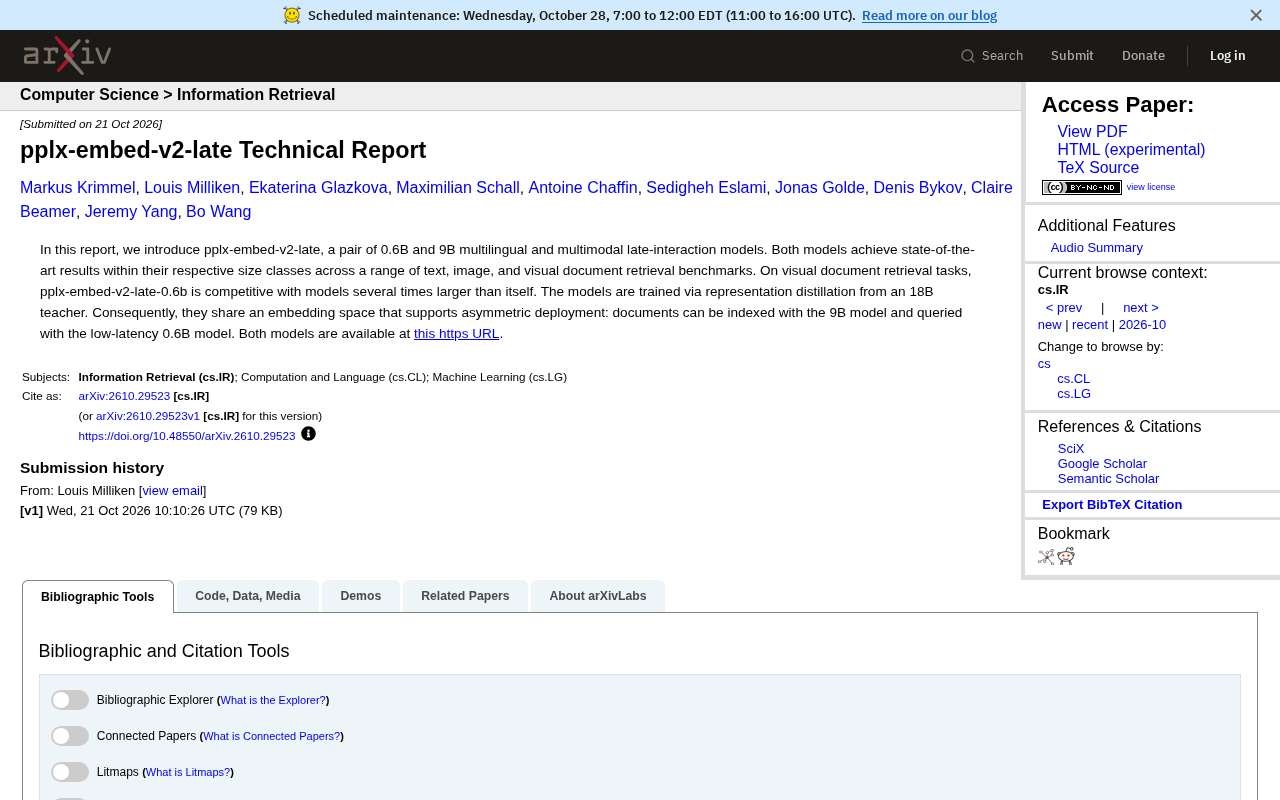
Perplexity AI has released the pplx-embed-v2-late series, comprising 0.6B and 9B multilingual, multimodal late-interaction embedding models that achieve SOTA within their size classes on text, image, and visual document retrieval benchmarks. Both models are distilled from an 18B teacher model and share the same embedding space, enabling asymmetric deployment with a 9B model for offline indexing and a 0.6B model for low-latency online queries—especially valuable for RAG. The 0.6B version can compete with models several times larger on visual document retrieval. The models are on Hugging Face, though specific benchmark numbers await independent verification.
Perplexity AI recently published a technical report introducing the pplx-embed-v2-late series, available in two parameter sizes: 0.6B and 9B. This pair of multilingual, multimodal late-interaction models achieves SOTA results within their size classes on text, image, and visual document retrieval benchmarks, and enables an asymmetric deployment scheme—"large model for indexing, small model for querying"—through a shared embedding space.
Model Architecture and Core Features
pplx-embed-v2-late uses a late-interaction architecture. Unlike bi-encoder models that compress an entire passage of text or an image into a single vector, late-interaction preserves token-level fine-grained representations and performs interaction computation at the retrieval stage, giving it an edge in recall precision. The series supports both multilingual and multimodal inputs, meaning a single embedding space can handle retrieval needs for plain text, images, and visual documents (such as scans or chart-dense PDF pages).
The two versions are positioned as follows:
- pplx-embed-v2-late-0.6b: A lightweight model aimed at low-latency query scenarios, able to compete with models several times its parameter count on visual document retrieval tasks.
- pplx-embed-v2-late-9b: The larger-parameter version, responsible for high-quality document indexing and complex retrieval tasks.
According to the technical report, both models are trained via representation distillation from an 18B teacher model. This training strategy enables the two differently sized models to share the same embedding space, laying the foundation for asymmetric deployment.
Late-interaction is a modeling paradigm in information retrieval, popularized by the ColBERT line of work. Unlike bi-encoder models that encode the query and document each into a single dense vector, late-interaction keeps one embedding vector per token for both query and document, and at retrieval time uses operations such as MaxSim to compute the sum of maximum similarities between query tokens and document tokens as the relevance score. Because it retains token-level representations, it can capture fine-grained term-matching signals, and its recall precision is typically better than that of single-vector models; the cost is a significantly larger index size (hundreds of vectors must be stored per document) and higher scoring-stage computation than dot-product retrieval, so practical systems often combine inverted indexes or vector quantization (such as PLAID) for acceleration.
Representation distillation refers to training methods that let a small model learn the intermediate representations or output embeddings of a large model, as distinct from traditional knowledge distillation that only aligns final labels. In embedding models, a common approach is to make the student's token vectors or similarity distributions approximate the teacher's, thereby "compressing" the large model's semantic space into the small model. Here, both sizes of pplx-embed-v2-late are distilled from an 18B teacher, and the key benefit is that student and teacher land in the same embedding space, allowing indexes and queries produced by different-sized models to interoperate directly without an additional trained mapping layer.
Asymmetric Deployment: Index with 9B, Query with 0.6B
One engineering highlight worth noting in the report is the asymmetric deployment capability enabled by the shared embedding space. In real retrieval systems, document indexing is usually done offline in a one-time batch, where higher computational cost is tolerable; the query side, however, faces real-time requests where latency and throughput are hard constraints. The design of pplx-embed-v2-late allows a 9B model to build the document index and a 0.6B model to handle online queries, with no additional alignment or mapping layer needed because they share the same embedding space.
This pattern is especially valuable for RAG (retrieval-augmented generation) pipelines: index quality is guaranteed by the large model, online service responsiveness is guaranteed by the small model, and the system can significantly reduce query-side compute overhead without sacrificing retrieval effectiveness. The 0.6B version's performance on visual document retrieval, on par with models several times larger, further indicates that the distillation process has well preserved the teacher model's fine-grained visual document understanding capabilities.
RAG (Retrieval-Augmented Generation) refers to the paradigm of retrieving relevant passages from an external corpus and splicing them into the prompt as context before the generative model answers. Its pipeline is typically split into offline indexing and online retrieval: the offline stage chunks documents, encodes them into vectors, and writes them to a vector database; the online stage encodes the user query, performs nearest-neighbor search in the database, and passes the Top-K results to the generative model. The retriever's quality directly determines the factual ceiling of the generated answer, and the query encoder sits on the critical path of every request—so an asymmetric design that is "heavy on the index side, light on the query side" fits RAG's cost structure perfectly. Note that late-interaction indexes use token-level multi-vectors, whose storage overhead is far higher than single-vector indexes; during deployment, you need to assess the vector database's support for multi-vector retrieval and the disk costs.
Benchmark Performance and Competitive Positioning
The technical report states that both models achieve SOTA on text, image, and visual document retrieval benchmarks within their respective size classes. That said, the report's abstract does not provide specific benchmark names or numerical comparisons, so the "SOTA within size class" conclusion currently rests only on the official statement and still lacks third-party reproduction and verification.
Visual document retrieval is the key scenario emphasized in this release. Such tasks require the model to understand layout structure, textual content, and chart information simultaneously, which traditional pure-text embedding models struggle to handle. If the 0.6B version's claim of "competing with models several times its size" on this task holds up in independent evaluations, it will make the model a strong candidate for cost-sensitive document retrieval systems.
Availability and Use Cases
Both models are publicly available on the Perplexity AI organization page on Hugging Face, with the collection at https://huggingface.co/collections/perplexity-ai/pplx-embed-v2.
From an application perspective, the series suits the following scenarios:
- Multilingual document retrieval: enterprise knowledge bases that need cross-lingual recall.
- Visual document search: the retrieval and pre-QA stage for scans, invoices, and chart-heavy reports.
- High-concurrency RAG services: online systems where the query side is latency-sensitive and the index side can be computed offline in batches.
For resource-constrained teams, the 0.6B version offers a lower deployment barrier; for scenarios with higher retrieval quality requirements, a hybrid scheme of 9B indexing plus 0.6B querying can be adopted.
Summary
The core contribution of pplx-embed-v2-late is turning the "size-quality" trade-off into a composable deployment strategy: distillation ensures embedding-space consistency, late-interaction ensures fine-grained retrieval capability, and multimodal and multilingual coverage broadens the applicable scope. Specific benchmark data and independent evaluation results await the full report and community verification, which will be key to judging its actual competitiveness.
One-line Summary
Perplexity releases 0.6B/9B multilingual multimodal late-interaction embedding models with a shared space enabling asymmetric deployment.
Paragraph Summary
Perplexity AI has released the pplx-embed-v2-late series, comprising 0.6B and 9B multilingual, multimodal late-interaction embedding models that achieve SOTA within their size classes on text, image, and visual document retrieval benchmarks. Both models are distilled from an 18B teacher model and share the same embedding space, thus supporting asymmetric deployment with a 9B model for offline document indexing and a 0.6B model for low-latency online queries—especially valuable for RAG pipelines. The 0.6B version can compete with models several times its parameter count on visual document retrieval. The models are publicly available on Hugging Face, but the report abstract does not provide specific benchmark numbers, so the SOTA conclusion still awaits independent evaluation.
Related articles

The Complete Guide to AI Agent Skills: Building Robust Agents with Markdown
Google developer expert explains AI agent skills: codify repeatable instructions and domain conventions in Markdown files, generate with a Skill Creator, validate through evaluation, and iterate continuously so agents like Claude Code load the right context at the right time.
New AI Reverse Engineering Tool REA Lets Claude Clone Any App
REA (Reverse Engineer Anything), GitHub's #1 trending AI reverse engineering tool, lets Claude Code and other agents dissect any app and reproduce features—but also triggers safety blocks. This article covers its capabilities, limits, and ethical boundaries.

How to Provide Effective Context for AI Agents: Start Simple, Build a Single Source of Truth
Explore how to provide effective context for AI agents: start with simple Markdown files, gradually build a central source of truth, and bring in professional vendors at scale. Learn context management strategies for multi-agent collaboration.