Perplexity Web Version Quietly Removes Multiple Features, Sparking Controversy

Perplexity web version silently removes usage stats, model labels, and delete features, sparking user trust concerns.
A Reddit user discovered that Perplexity's web version quietly removed several features including usage statistics API endpoints, AI model identification labels on responses, and the ability to delete individual answers. The mobile app remains unaffected. These changes, made without announcement, raise concerns about transparency, user trust, and developer ecosystem health in the competitive AI search market.
Recap: Perplexity Web Version Quietly Loses Features
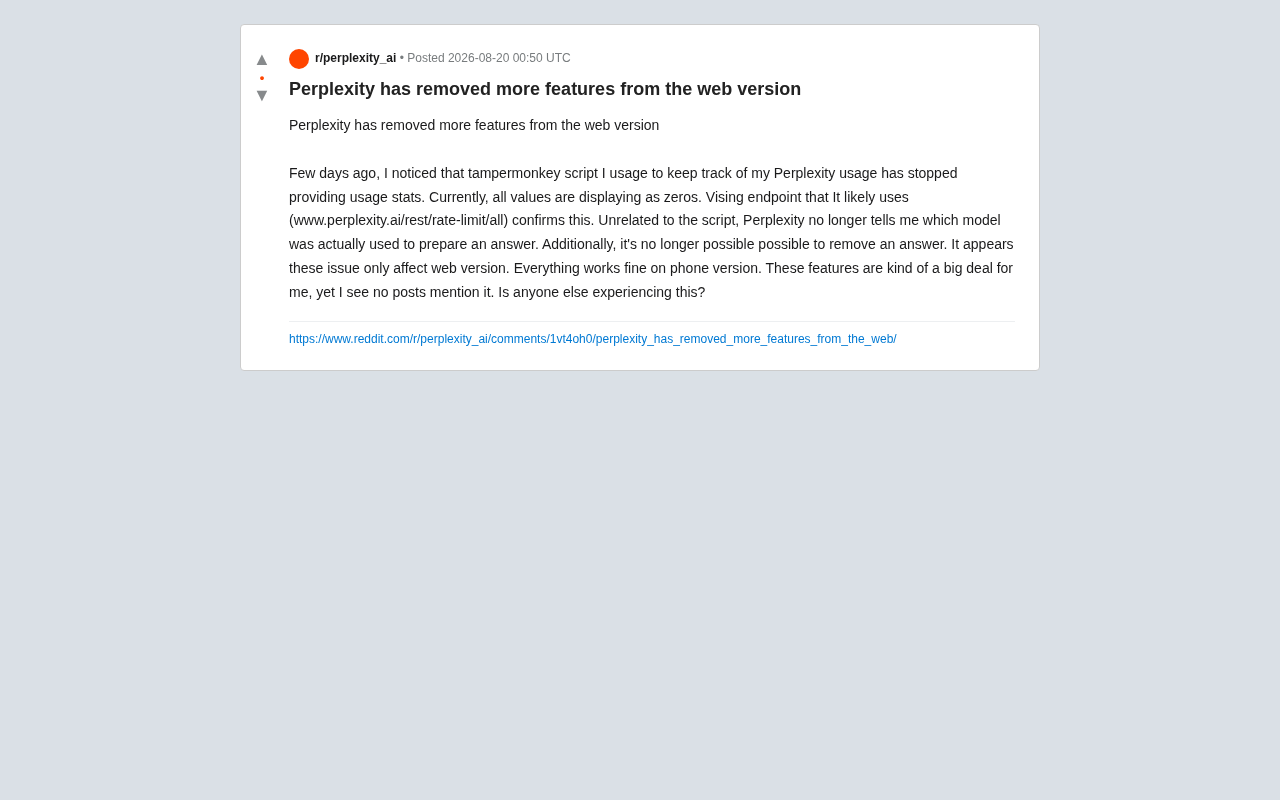
Recently, a heavy Perplexity user posted on Reddit pointing out that Perplexity's web version had quietly removed several previously available features without any announcement. This change has drawn attention and frustration from some users.
According to the user, they had been using a Tampermonkey-based browser script to track their usage on Perplexity. Tampermonkey is currently the most mainstream userscript manager browser extension, supporting Chrome, Firefox, Edge, and other major browsers, allowing users to install and run community-developed JavaScript scripts. These scripts can modify webpage appearance and behavior, or call undocumented API endpoints exposed by websites to retrieve additional information not directly shown in the official interface. Around various SaaS products, technical communities often spontaneously develop large numbers of such scripts to compensate for gaps in official functionality, forming an active unofficial tool ecosystem.
However, a few days ago, this script suddenly stopped working, with all statistics showing zero. After investigation, the user discovered that the endpoint called by the script — www.perplexity.ai/rest/rate-limit/all — was no longer returning valid data, technically confirming backend API changes.
Three Key Features Removed in Detail
Based on the original poster's feedback, the affected features on Perplexity's web version primarily involve three areas:
Usage Statistics Endpoint Disabled
The most direct change is that the rate-limit endpoint no longer provides data externally. Rate limiting is an extremely common traffic control mechanism in web services, used to prevent a single user or application from making too many requests in a short time, thereby protecting server resources and fairly distributing service capacity. Typically, SaaS products expose current user quota usage in HTTP response headers or dedicated endpoints, including used count, remaining count, reset time, and other information. The endpoint Perplexity previously provided was one such information exposure point — while not in public API documentation, technical users often discover and utilize them through browser developer tools.
For users who relied on third-party scripts to monitor daily or monthly usage quotas, this means they can no longer clearly understand how many queries they have remaining. Although this was an unofficial use case, the endpoint closure undeniably affects the habits of these technically-minded users. Vendors may close such endpoints for security considerations (preventing abuse to probe system limits) or architectural refactoring needs.
No Longer Displaying the Actual AI Model Used
More notably, Perplexity no longer tells users which model actually generated a given response. This is particularly important for paying users — Perplexity Pro allows users to switch between multiple models including GPT-4, Claude, and their in-house Sonar, and model transparency directly relates to users' judgment of answer quality and cost.
One of Perplexity AI's key technical features is its multi-model routing architecture. The platform isn't tied to a single large language model but integrates OpenAI's GPT-4 series, Anthropic's Claude series, and their self-developed Sonar model family. Sonar is Perplexity's in-house model fine-tuned from open-source models (such as Meta's Llama series), specifically optimized for Retrieval-Augmented Generation (RAG) scenarios, characterized by fast inference speed, low cost, and strong real-time web information integration capabilities. Different models have their own strengths and weaknesses in reasoning depth, creativity, response speed, and long-context handling, and users' model choices are often based on specific task requirements.
When the system no longer indicates which model was actually called, users cannot verify whether their chosen model was truly used, nor can they provide effective feedback on a specific model's output quality.
Unable to Delete Individual Responses
Additionally, the web version's previously available feature to delete specific responses has also disappeared. For users who want to manage conversation history and clean up irrelevant content, this represents a clear experience regression.
Only Affects Web Version; Mobile App Functions Normally
It's worth emphasizing that the original poster explicitly noted these issues only appear on the web version, while Perplexity's mobile app functions normally in all related areas. This platform-differentiated behavior suggests this may not be a wholesale product strategy cutback, but rather a side effect of a web-end frontend or backend update, or that Perplexity is adopting different feature availability strategies across platforms.
This "platform fragmentation" phenomenon is not uncommon in SaaS product iterations. Gradual rollouts (also known as A/B testing or canary releases) are standard practice in SaaS product iteration — vendors push new features or feature changes to a small subset of users first, observe data metrics and user feedback, then decide whether to roll out broadly. This explains why sometimes only some users report feature anomalies. Additionally, different platforms (Web, iOS, Android) are typically maintained by independent engineering teams with different codebases and release cadences, naturally creating synchronization gaps. In Perplexity's case, the feature difference between web and mobile could be the result of gradual rollout testing, or a temporary regression during a web frontend refactoring process.
But regardless of the reason, removing features without prior communication tends to erode core users' trust.
Why These Changes Matter
At first glance, usage statistics, model labeling, and response deletion might seem like "edge features," but they strike at several sensitive points for AI search products:
Transparency concerns. One of AI search's core competitive advantages lies in trustworthiness. When users cannot know which model generated an answer, the product's "black box" feeling intensifies. Transparency is one of the core ethical and commercial challenges facing AI search products. Unlike traditional search engines that display source links, AI search products synthesize answers through large language models, making it difficult for users to judge information reliability and generation logic. While Perplexity is known for citing sources (attaching reference links to each response), the model selection and reasoning process itself remains a "black box." Both the EU AI Act and related U.S. regulatory discussions list "explainability and transparency of AI systems" as important principles. For consumer AI products, informing users "who is answering your question" is not merely a technical detail but a foundation for building trust. Especially for Perplexity Pro paying users — they pay for multi-model selection rights and deserve the right to know.
User trust concerns. Quietly removing features without any announcement easily leads users to suspect the vendor is "secretly downgrading." In today's intensely competitive AI subscription market — with OpenAI's ChatGPT Plus, Google's Gemini Advanced, Anthropic's Claude Pro all competing for the same paying users — such actions may trigger users to reassess value for money, potentially leading to subscription churn. When industry competition intensifies, reducing transparency may save costs short-term, but will erode brand credibility in the long run.
Developer ecosystem concerns. Shutting down undocumented endpoints like rate-limit, while within the vendor's legitimate rights, also means the third-party tool and script ecosystem built around Perplexity will be impacted. These tools are often voluntarily maintained by core user communities, and their disappearance indirectly weakens product community stickiness. From a platform economics perspective, an active third-party developer ecosystem is a crucial component of a product's moat — it increases users' migration costs and provides functional supplements that the official team has no bandwidth to address.
Currently a Single Source; Official Response Awaited
It should be noted objectively that the information source for this report is currently limited to a single Reddit user's personal feedback. The original poster themselves mentioned they "haven't seen other posts mentioning this" and proactively asked whether other users encountered the same situation. Therefore, whether these changes are intentional product adjustments by Perplexity, temporary technical glitches, or gradual rollout tests remains unconfirmed officially, and lacks cross-verification from a large-scale user sample. For users, distinguishing between "intentional removal" and "technical glitch" often requires waiting for an official statement.
For users who rely on Perplexity's web version for daily work, recommendations include:
- Monitor Perplexity's official channels (blog, support documentation, social media) for relevant explanations
- If model transparency is a strong requirement, prioritize using the mobile app
- Submit issues through official feedback channels to push for a formal response from the vendor
Conclusion
As a representative product in the AI search space, Perplexity's every move draws attention from large numbers of heavy users. This quiet change to web version features, while modest in scale, reflects the universal challenge of "transparency" and "user communication" that AI products face during rapid iteration. For vendors, clear advance notice of any adjustments involving core experience is far more valuable than post-hoc user suspicion. We will continue to follow subsequent developments on this matter.
Related articles

Amphibious Transforming Drone: Beyond 100x Power Savings, What Are the Real Needs?
Is the amphibious transforming drone just a gimmick? Starting from the 100x power difference of the M4 Morphobot, explore real application scenarios and thesis topic ideas, analyzing boundary conditions where pure drones and pure ground robots both fail.

Warhound Raises $200 Million: Genetically Engineered "War Dogs" Paired with Anduril Gear
Warhound raises $200M, backed by Ben Lamm and Palmer Luckey, to genetically engineer dogs for military and law enforcement use and equip them with Anduril gear. This article analyzes its technology direction, funding logic, and ethical controversy.

Claude API Comes to Google Cloud: IAM Integration and SDK Access Guide
Anthropic hosts the full Claude API on Google Cloud with IAM-controlled permissions and unified billing. This guide covers the Vertex AI and Anthropic-hosted entry points, IAM role configuration, and SDK access.