Persimmon Hazelnut Upside-Down Cakes: An Elegant Solution for Autumn Desserts

Kristina Cho's mini persimmon hazelnut upside-down cakes use overlapping persimmon slices as both decoration and non-stick layer—perfect for autumn sharing.
This short YouTube video introduces Kristina Cho's mini persimmon hazelnut upside-down cakes. The cake body replaces some flour with hazelnut flour, yielding a dense, moist texture and concentrated nutty flavor. The bottom is lined with caramel sauce and overlapping thin persimmon slices, which form an elegant petal-like decoration while acting as a non-stick liner for easier unmolding. The mini size suits "friend's giving" gatherings—one per person, no slicing needed. The video emphasizes serving warm to preserve the caramel's flow and the persimmon's softness. The article distills three reusable ideas: nut flour replacing part of the flour to enhance flavor, overlapping fruit slices doubling as decoration and non-stick layer, and mini sizes suited to sharing occasions—offering practical transferable methods for home bakers.
Autumn desserts often fall into the pumpkin-and-apple loop, but Kristina Cho's mini persimmon hazelnut upside-down cakes offer a lighter, more design-forward option. This short YouTube video doesn't walk through complex steps, but a few key details sketch out an autumn dessert worth recreating at home.
A Mini Dessert Made for Sharing
The video opens by setting the scene: this cake is perfect for "friend's giving"—a Thanksgiving gathering among friends. The mini size lowers the barrier to sharing—one per person, no slicing needed, and no one is intimidated by an oversized portion. The cake body is described as having a "dense, fudgy texture," with the nutty aroma of hazelnut flour. The texture sits somewhere between a brownie and a pound cake—substantial and moist, contrasting with the softness of the fruit topping.
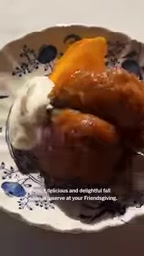
Interestingly, the recipe replaces some of the flour with hazelnut flour, which concentrates the nutty flavor and naturally yields a denser texture. For those used to making upside-down cakes with all-purpose flour, this is an idea that can be carried over to other recipes.
Caramelized Persimmon: Where Design Meets Function
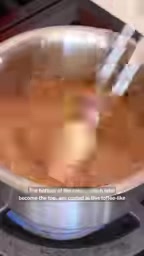
The heart of an upside-down cake is the moment of "flipping"—whatever is laid in the bottom of the pan becomes the top of the cake. This cake's bottom is lined with a toffee-like sauce, in which thin persimmon slices are caramelized and glossed. The video emphasizes that the persimmon slices are arranged in an overlapping pattern, creating an elegant visual effect while also serving as a non-stick layer.

This detail deserves elaboration: during baking, the fruit slices release moisture that forms a barrier with the sugar and butter, making the cake easier to unmold. In other words, the decoration itself does double duty—no extra greasing or flouring needed. This "design as function" approach is very practical in home baking, especially with complex pan shapes or when you're worried about a failed release.
The Visual Logic of Overlapping Arrangement
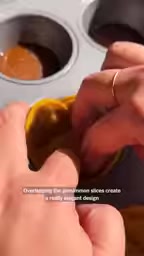
The video specifically notes that "overlapping the persimmon slices create a really elegant design." The slices aren't laid flat but pressed over one another, so the baked top shows a petal-like layering. This arrangement has a hidden benefit too: with no gaps between slices, the caramel sauce won't seep through, giving the top a more intact finish.
For those wanting to recreate it, slice thickness needs to be consistent—too thick and the slices won't bend to fit the pan; too thin and they'll break apart after caramelizing. The video doesn't give specific parameters, but from the finished result, being thin enough to bend while holding shape is key.
Upside-Down Cake is a category of cake where fruit, caramel, and other toppings are laid in the bottom of the pan during baking; after baking, the cake is inverted and unmolded so the bottom becomes the top. Its history dates to the late 19th century in the United States, when early versions often used canned pineapple or apples, becoming a classic home-baking category thanks to its simple method and striking visual appeal. The key to a successful upside-down cake is how well the bottom layer fits the pan: the fruit layer needs even coverage and the caramel sauce needs the right consistency so the top pattern comes out intact when flipped.
Caramelization is a series of chemical reactions that sugars undergo at high temperatures, producing dark flavor compounds and an appealing gloss. In upside-down cakes, caramelization not only gives the persimmon slices an amber appearance but also forms a slightly crisp barrier through the glass transition of sugar, which helps with unmolding. In home baking, caramel sauce is typically made by cooking granulated sugar with butter and cream; keeping the temperature at 160-170°C yields the ideal color and flow.
Hazelnut Flour is made by grinding roasted, peeled hazelnuts; its texture is similar to almond flour, and it's often used to replace part of the wheat flour to add nutty aroma and moisture. Because hazelnut flour contains no gluten, replacing too high a proportion will make the cake structure crumbly—generally 20%-30% of the flour amount is recommended. In mini upside-down cakes, hazelnut flour combined with a small amount of flour maintains the cake's structure while delivering that "dense, fudgy" texture. Additionally, hazelnut flour's higher oil content helps extend shelf life, but it should be refrigerated to prevent oxidative rancidity.
Unmolding: The Fruit Layer as a Non-Stick Liner
The most common failure in upside-down cakes is fruit sticking to the pan, leaving the top mangled after unmolding. This cake's approach is to line the bottom of the pan with persimmon slices, forming a "non-stick liner." The video's exact words are "allowing the cakes to come out of the tins relatively effortlessly."
This logic can be generalized: any thin-sliced fruit with moderate moisture—apples, pears, peaches—can serve a similar purpose when lining the bottom of a pan. The prerequisite is that the caramel sauce covers evenly with no obvious gaps between fruit slices. The video doesn't show the unmolding process but emphasizes "relatively effortlessly," indicating the result is reliable.
A Seasonal Treat to Serve Warm
The video's last line is "Serve these warm." The caramel top of an upside-down cake hardens as it cools; only when served warm can you appreciate the flowing sauce and the softness of the persimmon. The nutty aroma of hazelnut flour also stands out more when warm.
The value of this dessert isn't in its technical difficulty but in a few reusable ideas: using nut flour to replace part of the flour for enhanced flavor, using overlapping fruit slices as both decoration and non-stick layer, and using mini sizes to suit sharing occasions. These details give an ordinary upside-down cake a clear personality and explain why it belongs on an autumn gathering table.
(This article is based on content from Kristina Cho's short video on YouTube; please refer to the original video for recipe details.)
Related articles

Baseten Releases Bison-1 and Groundhog-1, Topping the Decision Model Leaderboard
Baseten releases open-weight decision models bison-1 and groundhog-1 built on Gemma 4; bison-1 scores 76 on the AA Decision Index v2.1 to top the leaderboard. Both support 128k context and image input—here we analyze their capability combination, benchmark significance, and selection advice for developers.

Cline CLI v3.0.75 Released: Yolo Mode Now Default for One-Shot Runs
Cline CLI v3.0.75: one-shot runs now default to yolo mode, --timeout and Ctrl+C can interrupt the first round, read_files is no longer truncated to 8k chars, plus reasoning parameter fixes and 94 new providers.

Cline Desktop v0.0.50 Update: Model Catalog Overhaul and Reasoning Control Fixes
Cline Desktop v0.0.50 fixes Reflection Beam 400 errors, misdelivered reasoning parameters, and stuck compaction; read_files no longer truncates to 8k characters; adds 94 providers and changes 67 default models.