PGP-Clinical-TimeKAN: A Detailed Guide to the Multivariate Physiological Indicator Joint Prediction Framework
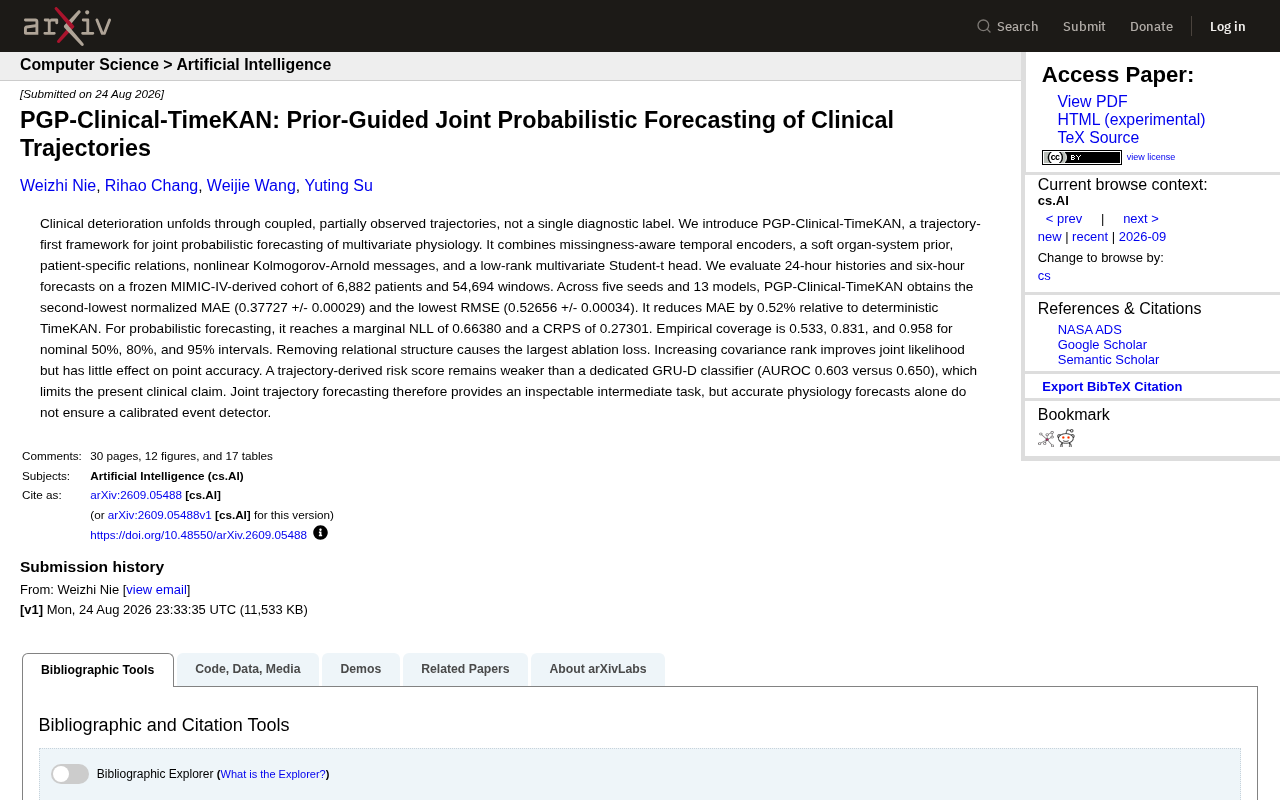
PGP-Clinical-TimeKAN enables joint probabilistic prediction of multivariate physiological indicators for clinical AI.
PGP-Clinical-TimeKAN is a clinical AI framework for joint probabilistic prediction of multivariate physiological indicators. It combines missingness-aware encoding, soft organ-system priors, patient-specific relationship modeling, KAN-based message passing, and low-rank Student-t distributions. Validated on MIMIC-IV data, it achieves state-of-the-art RMSE and well-calibrated uncertainty estimates, though bridging trajectory prediction to event detection remains an open challenge.
PGP-Clinical-TimeKAN: A Detailed Guide to the Multivariate Physiological Indicator Joint Prediction Framework
Clinical deterioration is not a process that can be fully described by a single diagnostic label — it unfolds gradually through multiple coupled, partially observable physiological trajectories. A recent study introduces the PGP-Clinical-TimeKAN framework, specifically designed for joint probabilistic prediction of multivariate physiological indicators, offering a new technical pathway for clinical decision support.
Trajectory-First Prediction Paradigm: From Event Classification to Indicator Forecasting
Traditional clinical prediction models typically focus on classification tasks for single events (such as mortality or readmission rates) while overlooking the dynamic evolution of physiological indicators themselves. PGP-Clinical-TimeKAN adopts a "trajectory-first" design philosophy, placing the joint prediction of multivariate physiological time series at the core of the task. The fundamental shift in this design philosophy is this: rather than having the model directly answer the highly abstract binary classification question "Will the patient deteriorate?", it first answers the far more information-rich prediction task of "How will the patient's blood pressure, heart rate, blood oxygen, and other indicators change in the future?" — and then derives clinical event risk from those predictions.
The framework integrates five key technical modules:
-
Missingness-Aware Temporal Encoder: Medical data universally suffers from irregular sampling and missing values — in the ICU, different physiological indicators are sampled at vastly different frequencies. Heart rate may be recorded every minute, while lab results may only come in every few hours. This encoder is specifically designed for this characteristic, explicitly modeling observation time intervals and missingness patterns to ensure effective information utilization and avoid the information distortion caused by naive interpolation.
-
Soft Organ-System Priors: Medical domain knowledge is incorporated by grouping physiological indicators according to organ systems (e.g., circulatory system indicators include heart rate, blood pressure, and central venous pressure; respiratory system indicators include oxygen saturation, respiratory rate, and tidal volume), forming structured prior constraints. These "soft" priors do not rigidly restrict inter-variable interactions. Instead, they use regularization to guide the model toward prioritizing intra-organ-system correlations while preserving flexibility for cross-system interactions.
-
Patient-Specific Relationship Modeling: The correlation patterns among physiological indicators can vary significantly across patients — for example, the relationship between heart rate and blood pressure in a heart failure patient may be entirely different from that in a sepsis patient. This module dynamically constructs inter-indicator relationship graphs for each patient to capture these individualized differential correlation patterns.
-
Nonlinear Kolmogorov-Arnold Message Passing: KAN networks replace traditional MLPs for graph message passing, enhancing nonlinear fitting capability. Kolmogorov-Arnold Networks (KAN) are a novel neural network architecture proposed by MIT and other institutions in 2024, with theoretical foundations rooted in the Kolmogorov-Arnold representation theorem — which proves that any multivariate continuous function can be represented as a superposition of finitely many univariate continuous functions. Unlike traditional MLPs that use fixed activation functions at nodes, KAN places learnable activation functions on the network's edges (i.e., connection weights), typically implemented as B-spline functions. This design enables KAN to achieve superior fitting accuracy with fewer parameters when handling low-dimensional but highly nonlinear mappings, making it particularly well-suited for modeling the complex nonlinear coupling relationships among physiological indicators.
-
Low-Rank Multivariate Student-t Distribution: This generates joint probabilistic prediction outputs while effectively controlling the number of parameters. The choice of Student-t distribution over the more common Gaussian distribution is because the Student-t distribution has heavier tails, better capturing the outliers and extreme physiological events frequently encountered in clinical data (such as sudden hypotension or cardiac arrhythmias). In the multivariate setting, the multivariate Student-t distribution uses degrees-of-freedom parameters to control tail thickness and a covariance matrix to describe the correlation structure among variables. Low-rank parameterization is a critical engineering optimization strategy that decomposes the full covariance matrix into a low-rank factor plus a diagonal matrix, reducing the parameter count from O(d²) to O(dr) (where d is the variable dimension and r is the rank), substantially lowering computational overhead while preserving the main correlation structure.
Large-Scale Clinical Data Validation on MIMIC-IV
The research team conducted rigorous evaluation on a frozen dataset derived from MIMIC-IV. MIMIC-IV (Medical Information Mart for Intensive Care IV) is a large-scale clinical database jointly maintained by MIT's Laboratory for Computational Physiology and Beth Israel Deaconess Medical Center. It covers de-identified electronic health records of hundreds of thousands of ICU patients from 2008 to 2019, including vital signs, laboratory tests, medication records, nursing documentation, and other multi-modal clinical data. It is one of the most influential publicly available critical care data resources worldwide. Researchers must complete CITI ethics training certification before gaining access. The dataset used in this study contains 6,882 patients and 54,694 time windows. The experimental setup uses 24 hours of historical data to predict physiological indicator changes over the next 6 hours.
In comparison with 13 baseline models, PGP-Clinical-TimeKAN achieved consistently excellent performance across 5 random seeds:
- Normalized Mean Absolute Error (MAE) of 0.37727 ± 0.00029, ranking second
- Root Mean Square Error (RMSE) of 0.52656 ± 0.00034, achieving the best level among all models
- A 0.52% reduction in MAE compared to the deterministic TimeKAN model
Notably, the extremely small standard deviation (MAE of only ±0.00029) indicates the model's high robustness to random initialization — a particularly important quality for clinical deployment scenarios, as healthcare systems cannot tolerate significantly different prediction results from the same model across different runtime instances.
The framework performed equally well on probabilistic prediction metrics:
- Marginal Negative Log-Likelihood (NLL) of 0.66380
- Continuous Ranked Probability Score (CRPS) of 0.27301. CRPS is a core metric for evaluating probabilistic prediction quality, measuring the discrepancy between the predicted cumulative distribution function and the actual observed value. Unlike NLL, CRPS is more robust to distributional assumptions and does not produce dramatic fluctuations due to individual extreme observations. CRPS simultaneously accounts for prediction sharpness (i.e., the compactness of the distribution) and calibration (i.e., the reliability of confidence intervals), making it a comprehensive metric for probabilistic prediction evaluation.
- Empirical coverage rates of prediction intervals at nominal 50%, 80%, and 95% confidence levels were 0.533, 0.831, and 0.958, respectively, demonstrating strong uncertainty calibration. Ideally, a 50% confidence interval should cover exactly 50% of actual observations. The close alignment between actual coverage rates and nominal levels indicates that the model's uncertainty estimates are trustworthy — neither overconfident nor overly conservative.
Ablation Experiments Reveal Component Contributions
Ablation experiments systematically revealed each module's contribution to final performance. Ablation experiments are the standard method in deep learning research for validating model design effectiveness: by sequentially removing or replacing individual model components and observing performance changes, the independent contribution of each component is quantified.
The study found that removing the relational structure modeling caused the largest performance degradation, fully demonstrating the importance of patient-specific relationships for prediction accuracy. This means that the dynamic correlations among different physiological indicators — such as the coordinated relationship between temperature elevation and white blood cell count changes in infected patients — are crucial for accurate prediction, and these correlations vary from patient to patient.
Increasing the rank of the covariance matrix improved joint likelihood but had limited impact on point estimate accuracy — indicating that the model genuinely captures inter-variable correlation structures rather than merely improving univariate prediction. Specifically, a higher covariance rank enables the model to express richer inter-variable dependencies (such as the pattern of blood pressure dropping simultaneously as heart rate rises), but this improvement is primarily reflected in the quality of the joint distribution rather than in the prediction mean accuracy of individual variables.
Notably, despite the excellent physiological trajectory prediction results, risk scores derived from predicted trajectories still underperformed a dedicated GRU-D classifier on clinical event detection tasks (AUROC 0.603 vs. 0.650). GRU-D is a recurrent neural network variant specifically designed for clinical time series data, proposed by Zhengping Che et al. in 2018. It builds upon the standard GRU (Gated Recurrent Unit) by introducing a temporal decay mechanism to explicitly model the impact of missing values — when a variable has not been observed for an extended period, its hidden state gradually decays toward the empirical mean. This makes it particularly suitable for handling the irregular sampling and extensive missingness prevalent in ICU data, establishing it as a widely used strong baseline model in clinical event prediction.
This finding reveals an important truth: accurate physiological indicator prediction does not automatically equate to a well-calibrated event detector. The deeper reason is that clinical events (such as sepsis onset or cardiac arrest) often depend on specific combination patterns and threshold effects of physiological indicators, rather than simple numerical trends. A model that can precisely predict blood pressure trajectories may not be able to accurately determine when a blood pressure drop constitutes a clinical crisis requiring intervention.
Clinical Application Prospects and Real-World Challenges
The research team candidly acknowledges that while joint trajectory prediction provides an interpretable intermediate task capable of presenting clinicians with a complete picture of future physiological states, further exploration is needed to transform it into a reliable clinical decision support tool. A "semantic gap" exists between physiological trajectory prediction and clinical event detection, requiring more refined risk modeling approaches to bridge. This gap is a universal challenge in clinical AI: precise prediction at the physiological level operates at the "data-driven" layer, while clinical decision-making requires crossing over to the "knowledge-driven" layer, involving comprehensive judgment of pathophysiological mechanisms, treatment intervention effects, and individualized risk thresholds.
The framework offers three core advantages for clinical applications:
-
Transparency: It predicts interpretable physiological indicator trajectories rather than black-box risk scores. Clinicians can intuitively see specific information such as "the patient's blood pressure is expected to drop from 120/80 to 90/60 over the next 3 hours" rather than receiving only abstract values like "deterioration risk 87%." This transparency helps build clinician trust in AI systems and facilitates secondary judgment based on their clinical experience.
-
Multi-Task Potential: A single set of prediction results can serve multiple downstream clinical decision-making scenarios. For example, complete physiological indicator trajectory predictions can be used for early warning system trigger decisions, can assist in fluid resuscitation strategy development, and can support optimization of mechanical ventilation parameters.
-
Uncertainty Quantification: Probabilistic outputs provide explicit confidence information for clinical judgment. In clinical practice, knowing "how confident the model is in this prediction" is just as important as knowing "what the model predicted." When prediction uncertainty is high, the system can prompt clinicians to increase monitoring frequency or seek additional tests, rather than blindly relying on model output.
Summary
PGP-Clinical-TimeKAN provides a valuable new perspective for clinical AI research: shifting from single-event classification to multivariate trajectory prediction, from deterministic outputs to probabilistic distribution modeling, and from ignoring medical priors to actively integrating domain knowledge. This paradigm shift has the potential to drive the development of more trustworthy and practical clinical decision support systems, while also pointing the way for future research to bridge the gap between trajectory prediction and event detection. From a broader perspective, this work reflects an important evolutionary trend in clinical AI: moving from pursuing metric optimality on single tasks toward building more comprehensive, interpretable prediction systems that are deeply integrated with clinical workflows.
Key Takeaways
Related articles
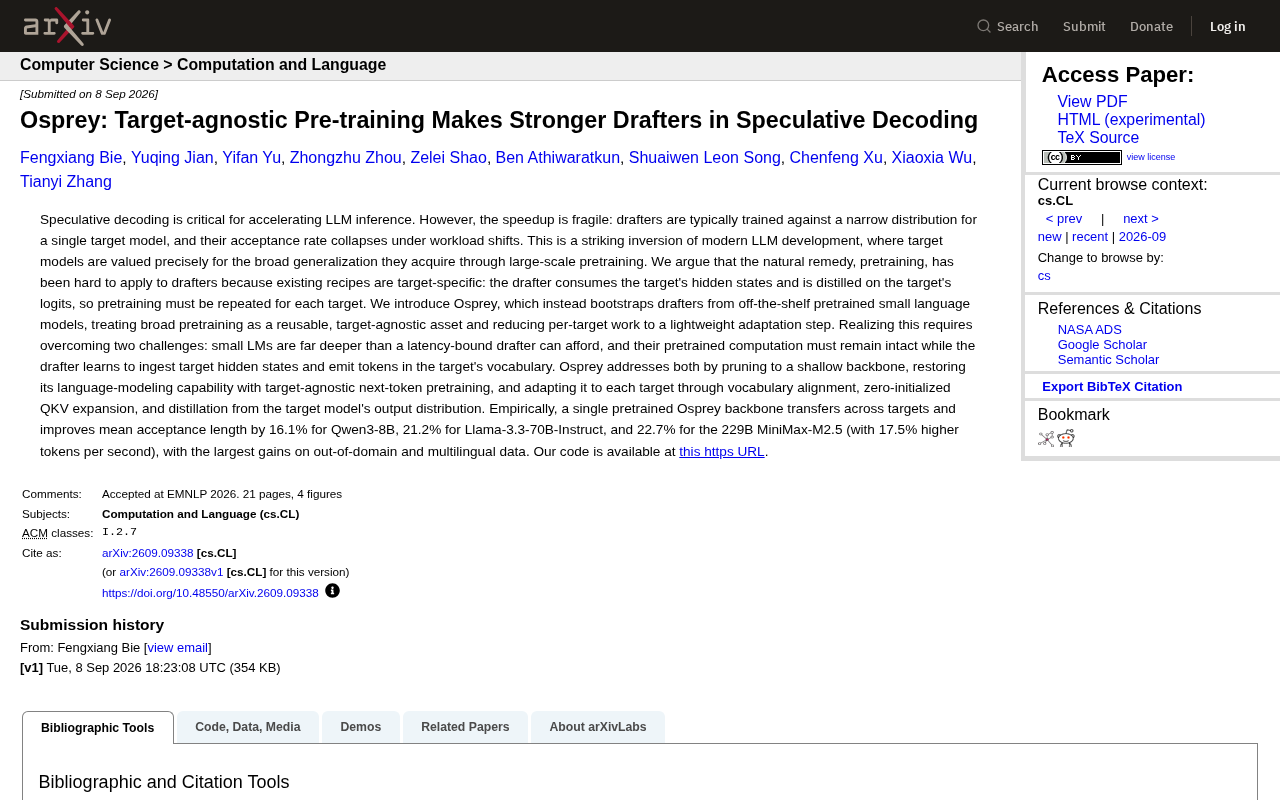
Osprey: General-Purpose Pretraining Makes Speculative Decoding Draft Models More Efficient
Osprey treats pretraining as a reusable, target-agnostic asset. Through pruning and lightweight adaptation, a single draft model transfers across multiple LLMs, boosting mean acceptance length by 16%-22%.

CriticGen: A New Framework That Transforms AI Evaluation into Actionable Improvement Feedback
CriticGen proposes a generation-aware evaluation framework that transforms AI assessment from passive scoring to an active optimization loop, achieving 73.17% answer improvement and 93.28% non-degradation rate.

Vercel AI SDK workflow-harness Update Analysis
Deep analysis of Vercel AI SDK workflow-harness 1.0.107 update: architecture design, engineering practices, and developer value for building reliable AI apps.