Vercel AI SDK workflow-harness Update Analysis
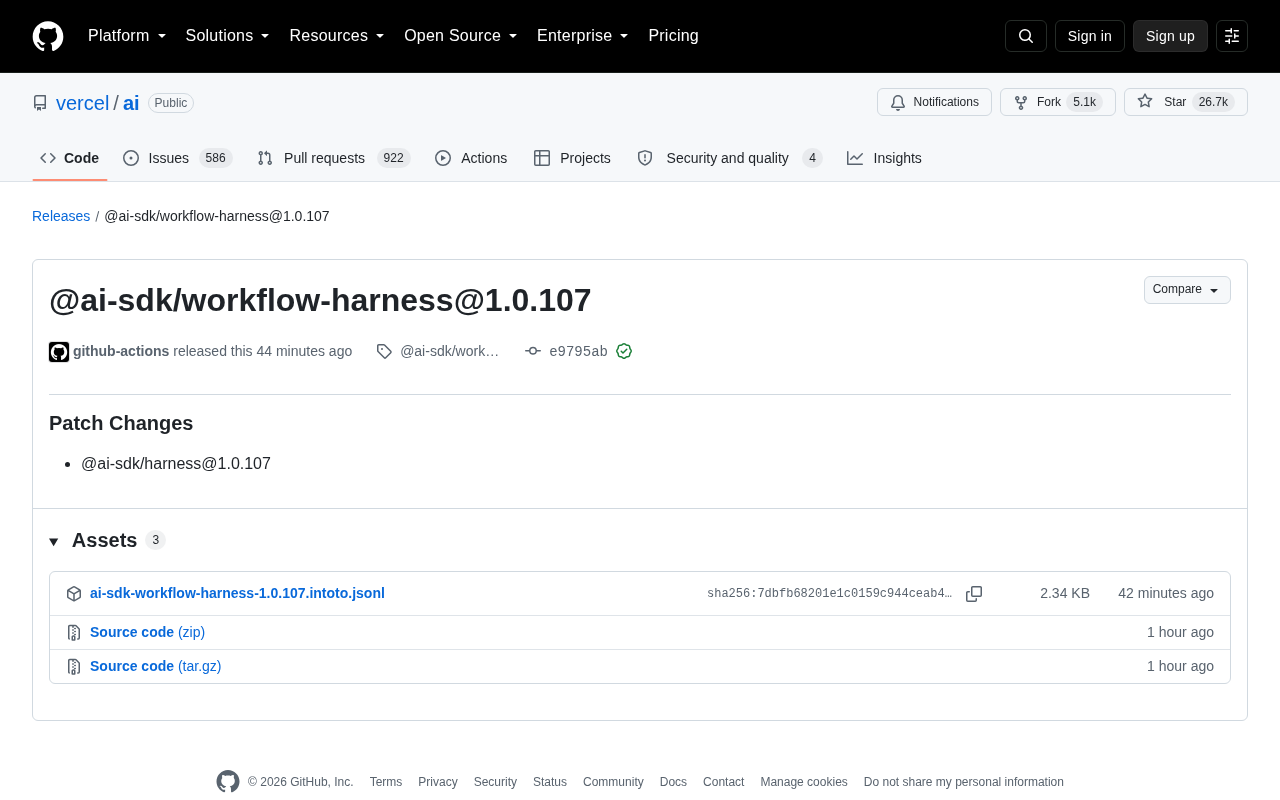
Analyzing Vercel AI SDK's workflow-harness update and its implications for AI workflow orchestration.
Vercel AI SDK's workflow-harness 1.0.107 patch update reflects key trends in AI development tooling. This article examines the component's role in orchestrating complex AI workflows, its layered modular architecture, mature engineering practices including automated CI/CD releases and supply chain security, and how developers can leverage the modular ecosystem to build more reliable Agent-based AI applications.
Continuous Iteration in the AI SDK Ecosystem
Vercel's AI SDK has become a critical piece of infrastructure for building AI applications, earning over 26.7k stars and 5.1k forks on GitHub, making it one of the most popular open-source AI development toolkits today. Recently, the project released @ai-sdk/workflow-harness@1.0.107 — a patch-level update that, while modest in scope, reflects Vercel's ongoing investment in AI workflow orchestration.
Vercel is a globally leading frontend cloud platform company, best known in the developer community for the Next.js framework. AI SDK is an open-source toolkit launched by Vercel in 2023, designed to provide JavaScript/TypeScript developers with a unified interface for AI model integration. It supports major LLM providers including OpenAI, Anthropic, Google Gemini, and Mistral, offering a unified API abstraction layer that frees developers from worrying about underlying model differences. AI SDK's core advantage lies in its deep integration with React Server Components and Next.js streaming rendering, enabling seamless frontend-backend experiences for AI applications. This is precisely why it occupies a unique position in the full-stack AI application development ecosystem.
This article takes a deep dive into the workflow-harness component's role, the overall architectural logic of AI SDK, and its practical significance for developers building complex AI applications.
workflow-harness Component Deep Dive
Functional Positioning and Core Value
In software engineering, a "harness" typically refers to a framework used to drive, test, or orchestrate the execution of a system. In the AI SDK context, workflow-harness serves as the runtime scaffold for orchestrating and executing AI workflows — connecting multiple AI calls, tool invocations, state management, and other steps into controllable workflows.
As AI applications evolve from simple single-turn conversations to complex scenarios involving multi-step reasoning, Agent collaboration, and tool chain invocations, basic model call interfaces are no longer sufficient. This trend has already given rise to workflow orchestration frameworks like LangChain, LlamaIndex, and CrewAI in the industry. Typical AI workflows include: the document retrieval–context injection–generation pipeline in Retrieval-Augmented Generation (RAG), the plan-execute-reflect loop in Agent systems, and routing and aggregation in multi-model collaboration scenarios. Developers need an orchestration layer capable of managing execution order, error retries, and state passing — and workflow-harness is the key component filling this need. Its emergence signals that Vercel is directly entering this fiercely competitive workflow orchestration space, extending AI SDK's capability boundary from model calls to full application orchestration.
Technical Background: Agent Architecture and Multi-Step Reasoning
Agents are one of the hottest architectural paradigms in AI application development today. Unlike traditional single-shot model calls, Agents can autonomously plan task steps, invoke external tools (such as search engines, code executors, and database queries), and dynamically adjust execution paths based on intermediate results. OpenAI's Function Calling, Anthropic's Tool Use, and Google's Gemini Function Calling all provide the underlying capabilities that support Agent architectures. On top of these, developers also need engineering capabilities like state management, error recovery, timeout control, and parallel execution — these are precisely the core value propositions of workflow-harness-type components. Without a reliable workflow orchestration layer, complex Agent systems are like construction projects without scaffolding — difficult to run stably in production environments.
Modular Architecture Design
The release notes for this update explicitly state that the changes depend on a synchronized update to @ai-sdk/harness@1.0.107. This reveals that AI SDK employs a layered modular architecture: the lower-level harness provides general-purpose execution scaffold capabilities, while workflow-harness encapsulates workflow-specific logic on top of it. This design enables core capabilities to be reused while keeping each module's responsibilities clearly separated.
This layered design is known in the modern JavaScript ecosystem as the monorepo architecture, and Vercel itself is a champion of this pattern — its open-source Turborepo tool was built specifically for managing large monorepo projects. By splitting AI SDK into multiple independently published packages (such as @ai-sdk/openai, @ai-sdk/anthropic, @ai-sdk/harness, @ai-sdk/workflow-harness, etc.), developers can precisely import only the modules they need, avoiding unnecessary dependency bloat, while each module can iterate independently without affecting others.
Maturity in Engineering Practices
Version Iteration Strategy
1.0.107 follows Semantic Versioning (SemVer), and the patch number has already accumulated to 107, indicating frequent iteration. Semantic Versioning is a version numbering standard proposed by GitHub co-founder Tom Preston-Werner, following the format MAJOR.MINOR.PATCH. The MAJOR version increments for incompatible API changes, MINOR for backward-compatible feature additions, and PATCH for backward-compatible bug fixes. 1.0.107 means the component has undergone 107 patch fixes since its 1.0.0 official release — not uncommon in the fast-iterating frontend ecosystem, but it also demonstrates that the component's use cases are rich enough to continuously uncover edge cases requiring fixes.
Frequent patch releases typically imply two things: first, the project is under active maintenance with a team that responds quickly to issues; second, the project employs an automated release pipeline — this particular release was automatically completed by github-actions, accompanied by GitHub's verified signature (GPG key ID: B5690EEEBB952194). This CI/CD (Continuous Integration/Continuous Deployment) driven release model allows every code merge to automatically trigger version building, testing, and publishing, greatly reducing the risk of errors from manual operations.
Supply Chain Security Assurance
This release has been verified with GitHub's signature verification. In an era where open-source software supply chain attacks are increasingly frequent, signature verification mechanisms ensure that release artifacts haven't been tampered with and that their origin is trustworthy.
Software supply chain security has become one of the most serious threats in information security in recent years. The 2021 SolarWinds incident affected thousands of businesses and government agencies, the 2022 node-ipc malicious code injection directly impacted numerous projects in the npm ecosystem, and the xz-utils backdoor incident in early 2024 exposed the fragility of open-source maintainer trust chains. In the npm ecosystem, dependency chains can run dozens of layers deep, and a breach at any link could affect millions of projects. GPG signature verification uses cryptographic methods to ensure the publisher's identity is authentic and the code hasn't been tampered with. GitHub Actions automated releases combined with emerging signing solutions like Sigstore are becoming best practices for secure open-source project releases.
For a library like Vercel AI SDK that is widely integrated into production environments, this practice is particularly critical and worth emulating by other open-source projects.
How Developers Benefit
Building More Reliable AI Workflows
For developers currently using Vercel AI SDK to build Agents or multi-step AI applications, continuous harness updates mean more stable workflow execution capabilities. While patch updates often just fix bugs or make minor optimizations, it's precisely this continuous refinement that forms the reliability foundation of production-grade tools. In real-world AI application scenarios, the workflow orchestration layer needs to handle numerous edge cases: model API timeouts and retries, streaming response interruption recovery, concurrency control for tool calls, and behavioral differences between model providers. Each patch fix may resolve a stability issue in a specific scenario.
Teams using these components are advised to stay up-to-date with version releases, especially on critical paths involving workflow orchestration, where patch fixes may address potential edge case issues. Consider configuring automated dependency update tools like Dependabot or Renovate to ensure timely security fixes and stability improvements.
Embracing a Modular Ecosystem
The division of labor between harness and workflow-harness shows that Vercel is building AI SDK into a highly modular ecosystem. Developers can import different capability modules on demand rather than carrying the weight of an entire monolithic framework. This design philosophy has positive implications for controlling application size and reducing dependency complexity.
This philosophy is consistent with the JavaScript ecosystem's "small modules" approach, but more deliberate than the overly fragmented practices of the early npm ecosystem — AI SDK's module boundaries are drawn along sensible functional domains (model providers, execution engines, workflow orchestration, etc.) rather than simple function-level splitting. When building AI applications, developers can mix and match according to their actual needs: if only basic model calling capabilities are needed, import the core package and the corresponding provider package; if complex Agent orchestration is required, add the workflow-harness module on top. This progressive capability expansion approach significantly lowers the barrier to entry for AI application development.
AI Tooling Evolution Trends Through the Lens of a Patch Update
At first glance, a patch update like @ai-sdk/workflow-harness@1.0.107 may seem unremarkable. But placed within the broader trajectory of Vercel AI SDK's evolution, it reflects several noteworthy trends: AI development is moving from simple calls to complex orchestration, and toolkits are maturing toward modular, verifiable, and automated release practices.
From a more macro perspective, the entire AI development tool ecosystem is undergoing a paradigm shift from "model-centric" to "application-centric." Early AI development tools primarily solved the problem of "how to call models," while today's focus has shifted to "how to build reliable applications with models." This transformation has generated enormous demand for engineering capabilities like workflow orchestration, observability, evaluation and testing, and security safeguards. Vercel AI SDK's investment in these capabilities through components like workflow-harness is a proactive response to this trend.
For developers, choosing a foundational library with active iteration and sound engineering practices often does more to ensure long-term project health than chasing the latest model capabilities. Vercel AI SDK's sustained investment in this area is a key reason it continues to rank among the top AI tools on GitHub.
Key Takeaways
Related articles
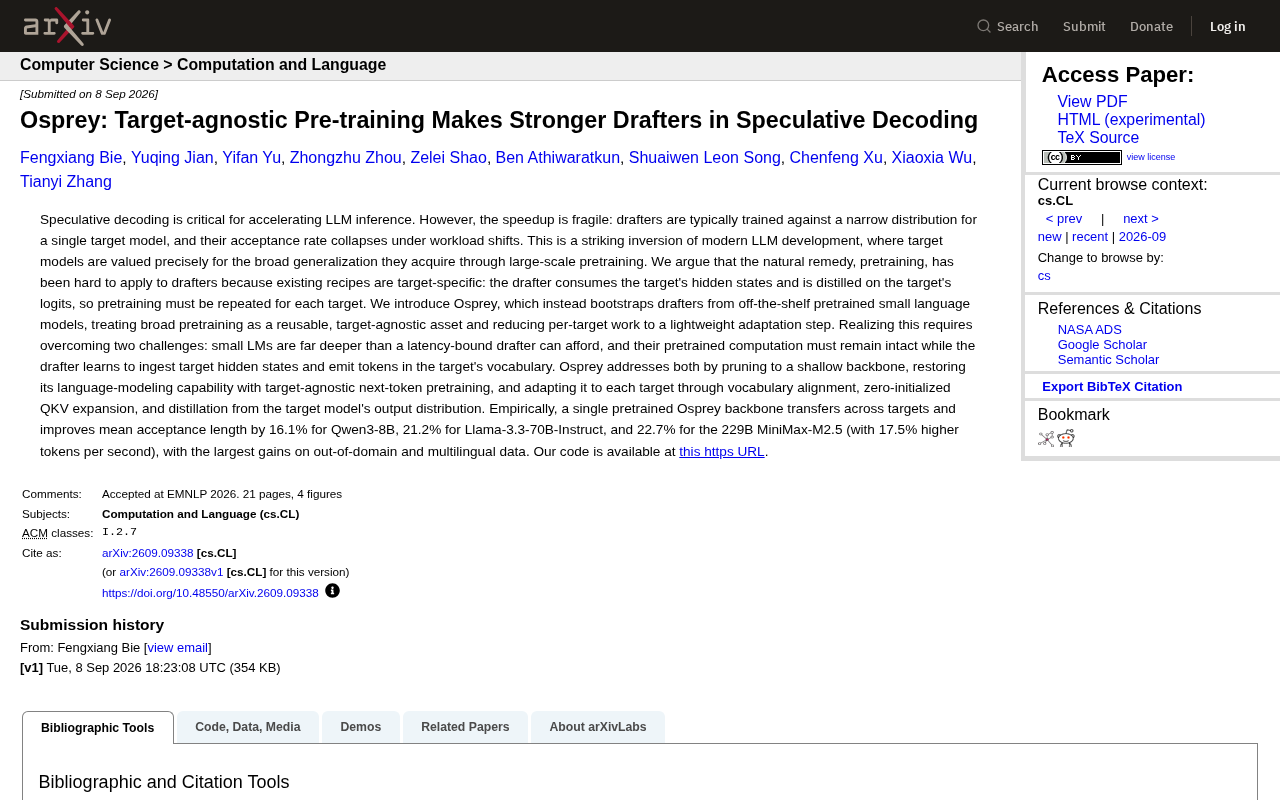
Osprey: General-Purpose Pretraining Makes Speculative Decoding Draft Models More Efficient
Osprey treats pretraining as a reusable, target-agnostic asset. Through pruning and lightweight adaptation, a single draft model transfers across multiple LLMs, boosting mean acceptance length by 16%-22%.
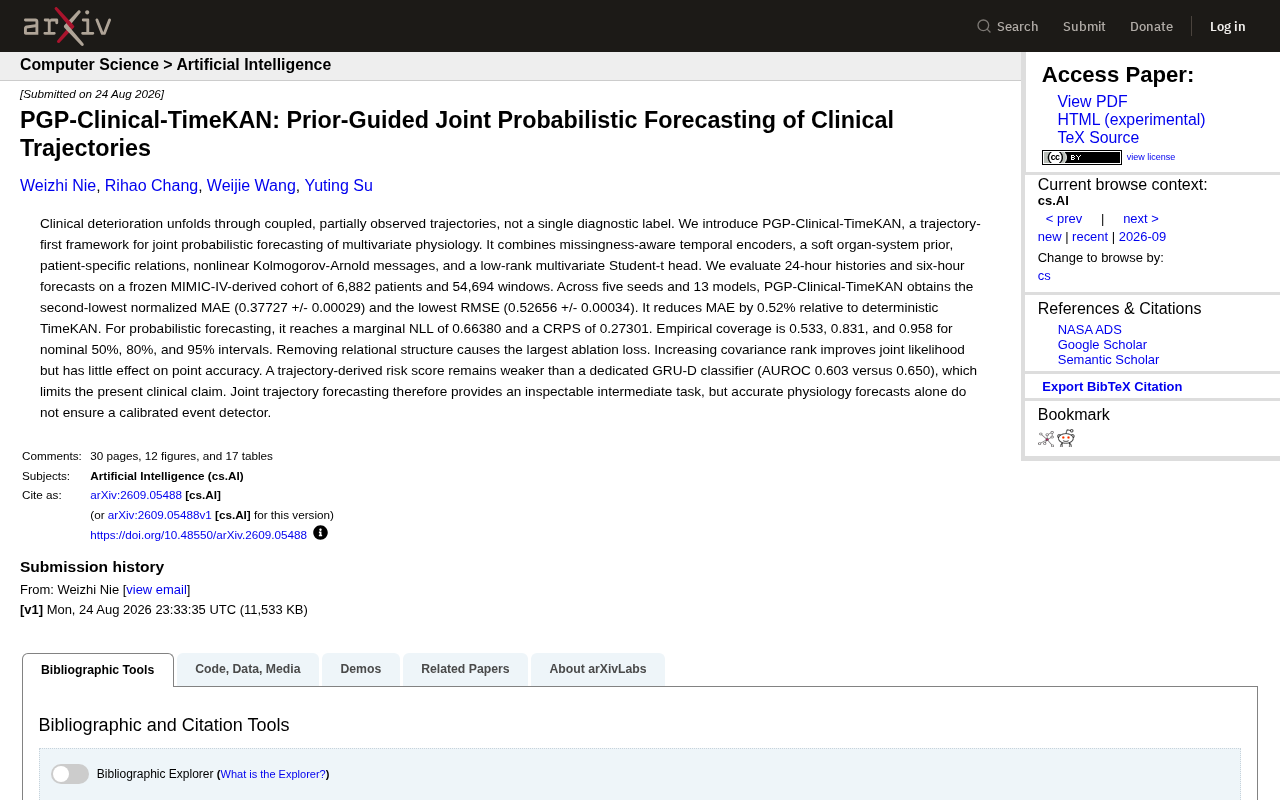
PGP-Clinical-TimeKAN: A Detailed Guide to the Multivariate Physiological Indicator Joint Prediction Framework
An in-depth analysis of the PGP-Clinical-TimeKAN framework for joint probabilistic prediction of multivariate physiological indicators, covering trajectory-first paradigm, KAN message passing, MIMIC-IV validation, and ablation studies.
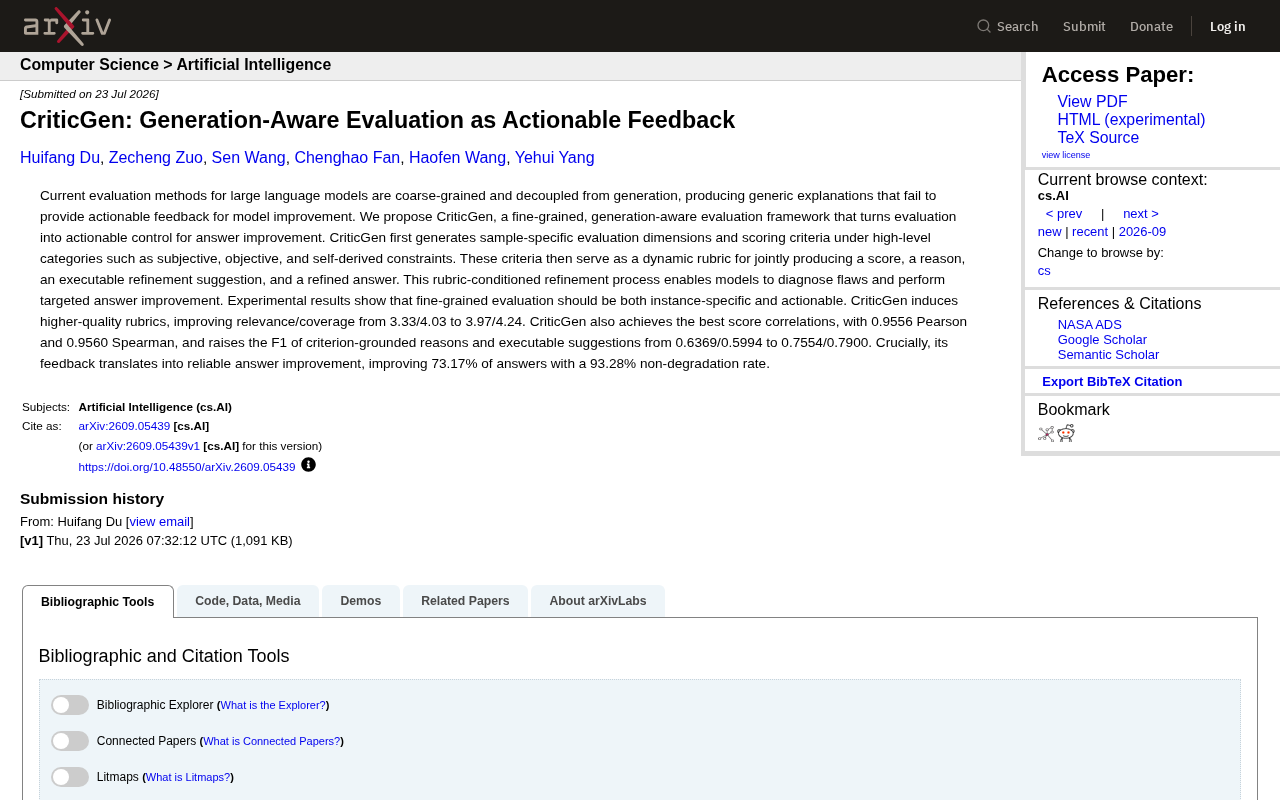
CriticGen: A New Framework That Transforms AI Evaluation into Actionable Improvement Feedback
CriticGen proposes a generation-aware evaluation framework that transforms AI assessment from passive scoring to an active optimization loop, achieving 73.17% answer improvement and 93.28% non-degradation rate.