Pharmacy Professionals Learning AI From Scratch: 5 Directions and a 4-Stage Learning Path
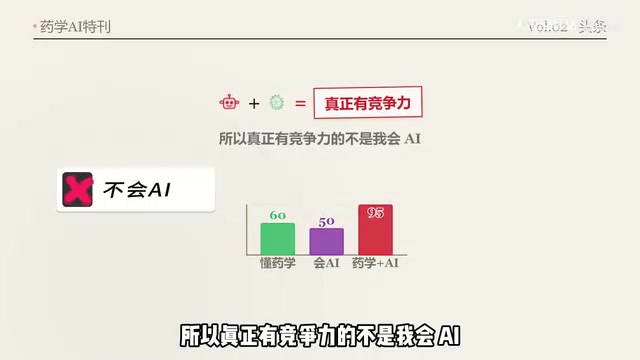
Pharmacy professionals should anchor AI learning in domain expertise, not algorithms.
This article, drawn from a Bilibili tutorial for pharmacy learners, argues that pharmacy professionals' true edge lies in deep domain knowledge — AI is just a tool. It outlines five Pharmacy + AI tracks (AIDD, clinical pharmacy/RWE, pharmaceutics, TCM, pharmacovigilance), each requiring a different technical stack. A four-stage learning path guides beginners from Python and data analysis basics, through machine learning fundamentals, into direction-specific skills, and finally into end-to-end projects. The central message: what matters isn't how many algorithms you know, but whether you can define pharmacy problems clearly, explain your data, evaluate model limitations, and give results genuine pharmacy meaning.
For pharmacy practitioners and students, AI is no longer a distant concept. Drug discovery, molecular screening, formulation development, real-world evidence research, pharmacovigilance — an ever-growing range of pharmacy scenarios are being reshaped by AI tools. But a common misconception is that many pharmacy professionals jump straight into grinding through Python, machine learning, and deep learning, as if they need to master every algorithm out there. This approach often yields diminishing returns.
This article is based on an AI learning tutorial for pharmacy professionals on Bilibili. Its core message is clear: What truly matters for pharmacy professionals learning AI isn't how many algorithms you know — it's whether you can use AI to solve pharmacy problems, and whether you understand pharmacy better than someone with a purely computer science background.
Is Pharmacy + AI Actually Worth Pursuing?
Let's address the most pressing question first: Yes, it's worth it — but not in the way the internet likes to claim, where "after one course your salary doubles and you can publish SCI papers just by running a model."
The real reason to pay attention is that AI has genuinely entered the pharmacy pipeline: drug discovery, molecular screening, formulation development, real-world evidence research, and pharmacovigilance. For pharmacy professionals, this means an expanded toolkit. Where you once might have only run experiments, reviewed literature, or done statistics, you now have methods capable of handling larger datasets, predicting outcomes, screening candidate compounds, and even identifying patterns from massive literature corpora and real-world data.
The key is positioning. True competitive advantage isn't "I know AI" — it's "I understand pharmacy and know how to use AI to solve pharmacy problems." Pharmacy knowledge is your foundation; AI is just a tool. This principle runs throughout the tutorial and is what distinguishes it from generic AI courses.
Five Directions for Pharmacy + AI
The tutorial recommends focusing on five main tracks. Each corresponds to a completely different technical stack depending on your background — choosing the wrong direction means wasted effort.
Track 1: AI-Driven Drug Discovery (AIDD). Best suited for those with backgrounds in medicinal chemistry, pharmacology, bioinformatics, or pharmaceutical engineering. Key areas include target identification, virtual screening, molecular property prediction, activity prediction, ADMET prediction, and molecular generation and optimization. This direction demands more computational capability and will eventually involve RDKit, molecular descriptors, machine learning, and graph neural networks.
Track 2: Clinical Pharmacy, Real-World Evidence + AI. Suited for clinical pharmacists, hospital pharmacists, and pharmacoepidemiology professionals. The goal here isn't generating new molecules but rather analyzing prescription data, studying adverse drug reactions, predicting patient risk, analyzing real-world data, and extracting information from medical text. Python, SQL, statistical analysis, NLP, and large language models are far more practical here than jumping straight into molecular generation.
Track 3: Pharmaceutical Sciences + Machine Learning. Covers formulation optimization, process parameter prediction, and quality attribute prediction. The tutorial makes a pointed observation: pharmacy students don't need to dive into complex deep learning every time they see AI. Many real-world problems can first be addressed with traditional machine learning or even statistical models as a solid baseline. Clearly defining the pharmacy problem matters more than model complexity.
Track 4: Traditional Chinese Medicine (TCM) + AI. Includes TCM ingredient data analysis, TCM quality assessment, multi-omics data, and TCM knowledge mining. There's a sharp reminder here: don't assume "TCM + AI" means innovation just because you ran a network pharmacology analysis with some algorithm. What truly matters is data quality, research question design, and validation methodology.

Track 5: Pharmacovigilance and Drug Safety + AI. This track focuses on information extraction, risk signal identification, and assisted analysis from adverse event reports, medical literature, and real-world data. It's especially suitable for those familiar with drug safety, pharmaceutical management, and clinical data.
Although all five fall under the "Pharmacy + AI" umbrella, what you actually need to learn in each is entirely different. So for a complete beginner, the first step shouldn't be "Should I learn CNNs or Transformers?" — it should be "What pharmacy problem do I want to solve with AI?" Only after deciding on a direction should you start filling in the technical knowledge.
ADMET is a core evaluation framework in drug discovery, covering Absorption, Distribution, Metabolism, Excretion, and Toxicity. No matter how potent a candidate molecule is, poor ADMET properties are a leading cause of clinical development failure. Traditional ADMET characterization relies on extensive in vitro and in vivo experiments — time-consuming and resource-intensive. AI models can predict these properties directly from molecular structure, allowing "undruggable" candidates to be filtered out far earlier in the pipeline. QSAR (Quantitative Structure–Activity Relationship) uses mathematical models to establish quantitative relationships between molecular structural features and biological activity. It's the most classical modeling paradigm in AIDD and the best entry point for pharmacy professionals to understand how machine learning operates in chemical space. Graph Neural Networks (GNNs) are a class of deep learning models designed specifically for graph-structured data. Since molecules can naturally be represented as atom-bond graphs, GNNs have become one of the dominant architectures for molecular property prediction, capturing richer topological information than traditional molecular descriptors.
A 4-Stage Learning Path for Complete Beginners
For learners starting from scratch, the tutorial lays out a clear four-stage roadmap.
Stage 1: Build Data Analysis Skills
You don't need to grind through Python from the ground up. Start with Python basics, then learn the fundamentals of NumPy, Pandas, Matplotlib, and Scikit-learn.

One common misconception needs correcting here: it doesn't mean you can skip math entirely. You don't need to start by proving theorems in calculus, but you must understand basic probability and statistics, linear algebra, classification and regression concepts, and model evaluation metrics. Without this, you're just calling library functions without knowing why a model works or why it fails.
Stage 2: Learn Machine Learning
Focus on understanding classification, regression, cross-validation, feature engineering, data splitting, overfitting, and common model evaluation methods. There's no rush to jump into deep learning at this stage. A more valuable piece of advice: Find a real pharmacy dataset and run through the entire pipeline once — data cleaning, feature processing, model training, model evaluation, and result interpretation. That's worth more than watching 20 algorithm tutorials.
Overfitting is one of the most common pitfalls in machine learning — it refers to a model that performs extremely well on training data but generalizes poorly to new data, essentially because it has "memorized" the noise in the training set rather than the underlying patterns. In pharmacy datasets, where sample sizes tend to be small compared to internet-scale data, the risk of overfitting is especially pronounced. Cross-validation is the standard tool for combating overfitting: by splitting data into multiple folds that take turns serving as training and validation sets, it provides a more reliable estimate of model performance. Feature engineering is particularly critical in pharmacy settings — the selection and transformation of molecular fingerprints, molecular descriptors, and clinical indicators directly determines whether a model can capture meaningful patterns. Understanding the pharmacy significance of these concepts is more valuable than knowing how to tune API parameters, and it represents a genuine advantage that pharmacy-trained individuals hold over those with purely computational backgrounds.
Stage 3: Branch Into Your Specific Direction
At this stage, fill in the technical knowledge that corresponds to the direction you've chosen:
- AIDD: Learn RDKit molecular fingerprints, molecular descriptors, QSAR, and molecular property prediction, then explore graph neural networks and Transformer architectures as project needs arise.
- Clinical pharmacy, real-world evidence, or pharmacovigilance: Focus on SQL, statistical analysis, clinical data processing, text mining, and NLP.
- Pharmaceutical sciences: Build machine learning models around formulation data, process parameters, and quality metrics.
The guiding principle here is: Don't just follow what everyone else is learning.

Stage 4: Complete an End-to-End Project
This is the most important step. For AIDD, build a molecular property prediction project. For clinical pharmacy, tackle an adverse drug reaction or patient risk prediction project. For pharmaceutical sciences, work on a formulation or process parameter optimization project.
The point isn't how sophisticated your model is. What matters is whether you can fully answer these questions: Where does the data come from? Why did you preprocess it this way? Why did you choose this model? What is the baseline? How do you evaluate the results? Where might the model fail? Do the results carry genuine pharmacy significance? If you can answer all of these, you've truly broken through the entry point of Pharmacy + AI.
Baseline refers to the reference standard established using the simplest possible approach (e.g., logistic regression, random guessing, or historical averages) before introducing more complex models. The value of a baseline is this: if a deep learning model can't even outperform simple logistic regression, the problem likely lies in feature engineering or data processing — not in needing a more complex architecture. In pharmacy research, many papers skip baseline comparisons entirely, making it difficult to assess the actual gain from using an AI model. Running a baseline first and iterating from there is standard practice in both industry and rigorous academic research, and it's a key benchmark for judging the quality of any AI pharmacy project.
A Final Word of Advice for Pharmacy Professionals
The closing message of this tutorial is worth sitting with for anyone in pharmacy considering a pivot toward AI: Don't abandon your professional advantage to compete head-on with computer science graduates on algorithm benchmarks.
Your pharmacy knowledge is your foundation. Python, machine learning, and large language models are just tools. What's truly scarce is someone who both understands pharmacy problems and knows how to apply AI tools effectively. This advice applies to practitioners across all specialized domains — in the age of AI, your competitive moat rarely comes from the algorithms themselves, but from a deep understanding of the specific problems at hand.
For pharmacy professionals, rather than anxiously chasing every new technology update, the better first step is to think clearly about what pain points in your own subspecialty are actually worth solving with AI. Get the direction right, and the tools will follow naturally.
Related articles

CSS Anchor Positioning: A New UI Positioning Approach Without JavaScript
A deep dive into CSS Anchor Positioning: from anchor-name and position-anchor to the anchor() function, position-area shorthand, position-try-fallbacks, anchor-size, and upcoming anchor queries.

New AI Chart Interaction: Continuous Follow-up Questions and Visualization in Conversation
Explore a new AI interaction method for continuously generating charts in conversation. Use the /visualize command to ask follow-up questions and visualize answers in the same chat window, improving data analysis efficiency.

Cursor Merges Into X Subscription: Paid Plans Share Unified Usage Pool, Grok Model Coding Usage Doubled
Cursor joins The X Subscription with a unified usage pool and doubled Grok coding quota. Third-party models shift to API pricing. Existing users can keep or migrate plans.