Philosophical Reflections Under the Starry Sky: Humanity's Smallness and Greatness in the Cosmos in the Age of AI

Facing the dual vastness of AI and the cosmos, humanity stays small yet keeps exploring with awe.
Starting from an ancient prayer, the article juxtaposes humanity's awe before the cosmos with its astonishment at AI, arguing that the AI era needs a humanistic anchor to calibrate direction. Acknowledging that "the boat is small and the sea is great" is the true starting point for exploration, and smallness itself drives humanity's greatest creations.
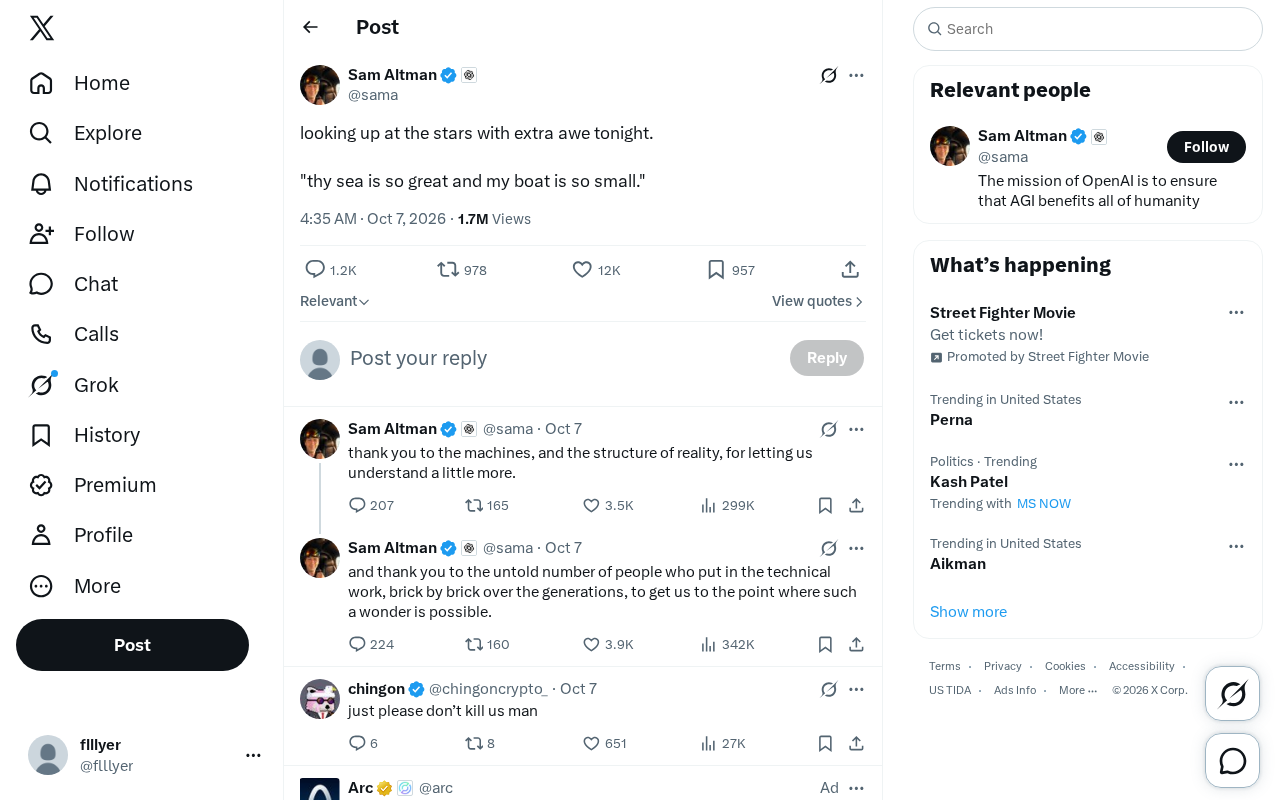
When a tech professional gazed up at the stars late at night and let out the sigh "thy sea is so great and my boat is so small," this ancient prayer found an entirely new resonance in the age of AI. Facing both the vastness of the cosmos and the rapid iteration of artificial intelligence, humanity's self-perception is undergoing a profound recalibration.
A Cognitive Leap from the Sea of Stars to Silicon-Based Intelligence
Humanity's reverence for the cosmos dates back to ancient times. From ancient navigators relying on starlight to find their bearings, to modern astronomers using telescopes to explore galaxies billions of light-years away, we have always sought to measure our place in the universe. Today, another kind of "infinity" is being surveyed—artificial intelligence models are growing exponentially in parameters, devouring massive datasets, and demonstrating surprising reasoning and creative capabilities. This artificially constructed "digital ocean" forms a fascinating echo with the starry sky overhead.
The image of "my boat is so small" in the original text precisely captures this predicament: whether facing the physical scale of the cosmos or the capability boundaries of AI systems, the individual is small. But smallness does not mean powerlessness—on the contrary, it is precisely this awareness that drives humanity to keep building boats and keep setting sail.
Why We Still Need to "Look Up at the Stars" in the Age of AI
Technological Optimism Needs a Humanistic Anchor
Discussions in the AI field are often dominated by quantitative metrics such as efficiency, compute, and parameters. However, a healthy technological ecosystem needs perspectives that transcend instrumental rationality. Looking up at the stars is a metaphor: it reminds us that while pursuing more powerful models, we must not lose our humility before the unknown and our pursuit of meaning. Every major leap in the history of science and technology has been accompanied by an adjustment in humanity's self-understanding—Copernicus, Darwin, Freud, and now the AI era is no exception.
The "humanistic anchor" mentioned in the text can be understood as a value compass that provides direction and a framework of meaning for technological development. Technology itself only answers "can we do it," while the humanities answer "should we do it" and "why do we do it." In the AI field, this anchor manifests concretely as sustained concern for privacy, fairness, responsibility, and human dignity. Historically, Copernicus moved Earth from the center of the universe, Darwin placed humanity within biological evolution, and Freud revealed the unconscious beneath rationality—each scientific leap shook humanity's self-image, and each ultimately rebuilt a new equilibrium through humanistic reflection. The challenge in the AI era is more direct: when machines begin to take on cognitive labor, humanity must answer anew "what is the unique value of being human." Therefore, the humanistic anchor is not a constraint on technology, but a crucial counterbalance that prevents technological optimism from sliding into technological blindness.
Maintaining the Spirit of Exploration Amid Uncertainty
Current AI systems still suffer from hallucinations, bias, and inexplicability, much like early navigators facing unknown waters. Acknowledging that "the boat is small and the sea is great" is not retreat, but rather setting a realistic starting point for exploration. This attitude is especially important for AI researchers: when facing unresolved fundamental problems—alignment, generalization, consciousness—maintaining reverence is more valuable than blind confidence.
"AI hallucination" refers to large language models generating plausible-sounding but factually incorrect content when lacking reliable evidence; "bias" refers to models inheriting and amplifying discriminatory patterns existing in society from training data; "inexplicability" refers to the difficulty of fully tracing and understanding the decision-making processes of deep neural networks. Together, these three types of problems constitute the "unknown waters" of current AI systems. Alignment research attempts to keep model objectives consistent with human values, generalization research focuses on whether models can maintain robust performance outside the training distribution, and discussions about machine consciousness remain at the intersection of science and philosophy. Precisely because these fundamental problems remain unsolved, comparing the current stage to early navigation is apt: charts are incomplete, compasses are crude, but every cautious trial voyage expands the boundaries of the knowable.
The Dialectical Relationship Between Smallness and Creativity
Interestingly, humanity's greatest creations have often been born from a clear-eyed awareness of its own limitations. It was precisely the realization that we could not reach the stars with our bodies alone that led us to invent rockets; it was precisely the realization that the brain's computational power is limited that led us to build computers and neural networks. If AI truly is some kind of "great sea," then the reason humanity's small boat can sail lies precisely in continuous learning, collaboration, and the courage to cross boundaries.
This tweet contains no specific technical details or product announcements, but it touches on a more fundamental question: on the eve of the intelligence explosion, how do we define our position? Perhaps the answer lies in this simple sigh—remain in awe, but never stop rowing.
"Intelligence explosion" is a concept proposed by philosopher I.J. Good in 1965, referring to the idea that once a superintelligent system can improve itself, it may enter a positive feedback loop of rapidly escalating capability. This hypothesis remains unresolved to this day, but it has profoundly influenced discussions on AI safety and governance: if intelligence levels could leap dramatically in a short time, would humanity be able to establish effective control and alignment mechanisms beforehand? The sense of "on the eve of the intelligence explosion" conveyed by the tweet is precisely an emotional projection of this uncertainty. It does not demand a definitive answer, but reminds practitioners to simultaneously consider institutional, ethical, and global collaboration—the "small boat's" control systems—while pursuing capability breakthroughs.
Conclusion: The Boat's Direction Is Calibrated by Thought
The waves of technology will not cease, and the gaze at the starry sky will never go out of style. For AI practitioners and ordinary people concerned about AI alike, this short phrase spanning time and space offers a precious intellectual posture: view algorithms through the scale of the cosmos, and calibrate code with the warmth of the humanities. Thy sea is so great—but it is precisely the voyages of countless "small boats" that constitute humanity's most moving posture in the face of the unknown.
One-line Summary
Facing the dual vastness of AI and the cosmos, humanity navigates as a small boat—staying in awe while continuing to explore.
Paragraph Summary
Starting from an ancient prayer, the article juxtaposes humanity's awe before the cosmos with its astonishment at artificial intelligence, noting that both make individuals feel their own smallness. The author argues that technological discussions in the AI era cannot focus solely on efficiency and compute; they also need a humanistic anchor to calibrate direction. Facing unresolved challenges such as hallucination, bias, inexplicability, alignment, and generalization, acknowledging that "the boat is small and the sea is great" is a realistic starting point for exploration, not a retreat. The article further reveals the dialectical relationship between smallness and creativity: it is precisely a clear awareness of one's own limitations that drove the birth of rockets, computers, and neural networks. The conclusion emphasizes viewing algorithms through the scale of the cosmos and calibrating code with the warmth of the humanities—the voyages of countless small boats constitute humanity's most moving posture in the face of the unknown.
Related articles

5 Practical Ways Real Estate Agents Can Use AI to Boost Efficiency (2026 Edition)
How can real estate agents use AI to boost efficiency? Based on a YouTube walkthrough, this breaks down five methods — ChatGPT for listing descriptions, Canva for marketing materials, forms for open house leads, Zapier for automated follow-up, and seller meeting prep — and flags risk boundaries like fair housing laws, photo authenticity, and price verification.

Grok Bot vs ChatGPT Agent: Which AI Agent Is More Powerful?
How does Grok Bot differ from ChatGPT Agent? This comparison examines how they work: Grok Bot has a cloud computer and runs persistently inside tools to execute multi-step tasks automatically; ChatGPT Agent operates web pages in a browser and is more mature at general tasks. Includes selection advice.

Walmart Agent Gateway: AI Shops for You Automatically—Why Is Amazon Going the Opposite Way?
Walmart's Agent Gateway lets ChatGPT, Gemini and other AI assistants access its product catalog to search, compare and add to cart, with spending limits and per-purchase approval. Amazon blocks external AI agents—two retail giants, opposite paths. Currently US-only, India may follow.