Phrase-Level Speculative Decoding: A New Breakthrough on Frozen Target Models
Bypassing BPE constraints with a phrase-level draft vocabulary for plug-and-play LLM inference acceleration.
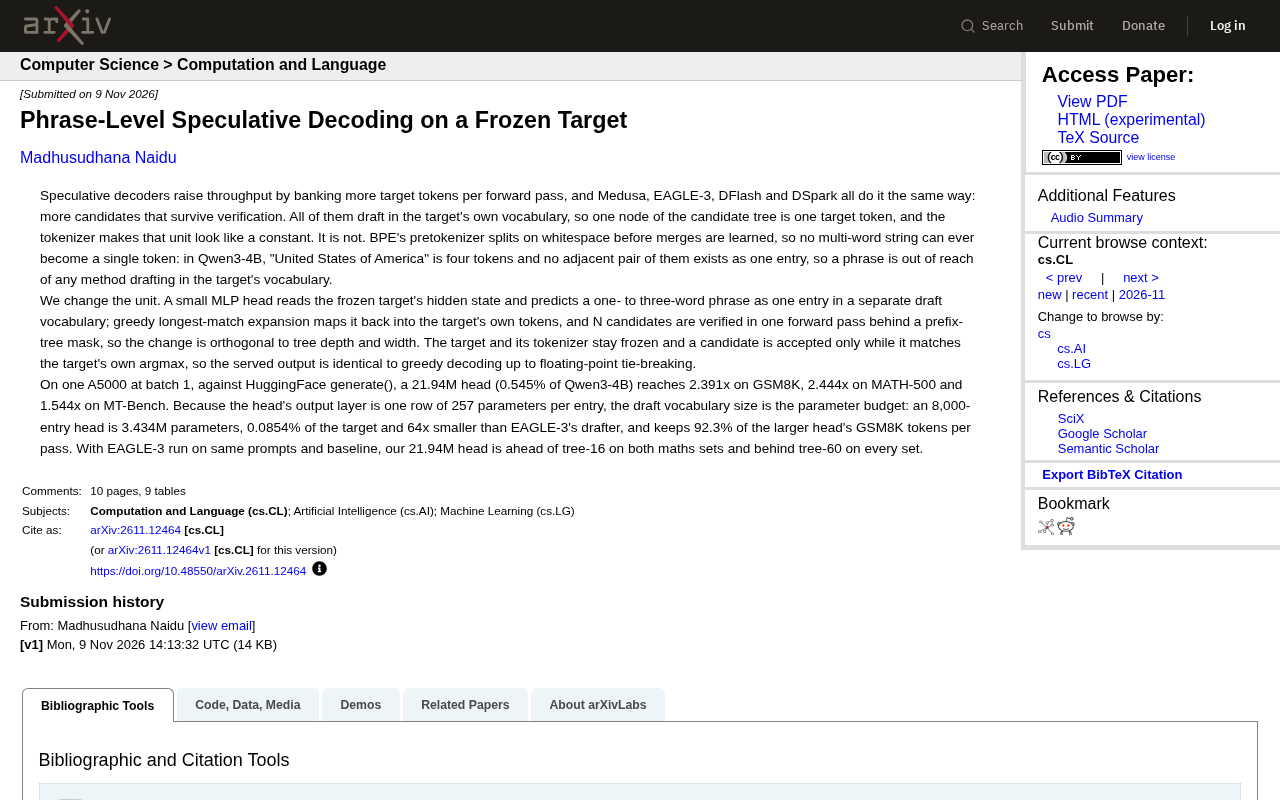
Mainstream speculative decoding methods like Medusa and EAGLE-3 draft within the target vocabulary, but BPE pre-tokenization splits on whitespace, making multi-word phrases impossible as single tokens—a structural ceiling. The researchers introduce an independent draft vocabulary of one-to-three-word phrases predicted by a small MLP head from the frozen target model's hidden states, then expanded into target tokens and verified N-at-a-time with a prefix-tree mask. The target model stays frozen and output matches greedy decoding. A 21.94M-parameter head (0.545% of Qwen3-4B) achieves 2.391x on GSM8K, 2.444x on MATH-500, and 1.544x on MT-Bench; an 8,000-entry head is 64x smaller than EAGLE-3's drafter while retaining 92.3% of accepted tokens. Limitations: validated only at batch size 1 and trails tree-60.
Speculative Decoding is one of the mainstream approaches for improving LLM inference throughput. Medusa, EAGLE-3, DFlash, DSpark, and similar methods share the same core idea: let a draft model propose more candidate tokens, then accept as many of them as possible through a single forward-pass verification. However, all of these methods assume they operate within the target model's own vocabulary, with each node in the candidate tree corresponding to one target token. This seemingly obvious assumption is, in fact, exactly where the performance ceiling lies.
Vocabulary Constraint: Why Multi-Word Phrases Cannot Be a Single Token
The pre-tokenization step of a BPE tokenizer first splits on whitespace, then learns merge rules. As a result, any phrase containing a space can never become a single token. Taking Qwen3-4B as an example, "United States of America" is split into four tokens, and no combination of any two adjacent tokens exists in the vocabulary either. This means that all methods that draft within the target vocabulary cannot directly generate cross-word phrase units.
This limitation is not an implementation detail but a structural constraint imposed by the tokenization mechanism. Since phrases cannot be represented in the target vocabulary, breaking through this limitation requires changing the unit of drafting.
BPE (Byte Pair Encoding) is the most commonly used subword tokenization algorithm in modern large language models. Its training process is roughly as follows: first, pre-tokenization splits the corpus on whitespace and punctuation into morpheme-level initial units; then, the co-occurrence frequency of adjacent unit pairs is counted, and the most frequent pair is repeatedly merged until the vocabulary reaches a preset size. The key point is that merges only occur within pre-tokenization boundaries—the pre-tokenization stage has already split "United", "States", "of", and "America" into separate segments using spaces, and no matter what merge rules are learned afterward, they cannot cross these boundaries to glue a space-containing phrase into a single vocabulary entry. Therefore, the vocabulary may contain forms like " United" (with a leading space), but never "United States". This constraint applies equally to all tokenizers based on BPE and its variants (such as WordPiece and Unigram); it is a structural feature of the subword tokenization paradigm, not an oversight in any particular model implementation.
Changing the Unit: From Tokens to Phrases
The research team's approach is to introduce an independent draft vocabulary, where each entry corresponds to a one-to-three-word phrase. A small MLP head reads the hidden states of the frozen target model and directly predicts phrase entries, which are then expanded into the target model's own token sequence via greedy longest matching. N candidate phrases are verified in a single forward pass using a prefix-tree mask, so this modification is orthogonal to tree depth and width and does not conflict with existing tree-based verification methods.
Throughout the process, the target model and its tokenizer remain frozen. A candidate is accepted only when it matches the target model's own argmax, so the final serving output is exactly identical to greedy decoding (with only floating-point tie-breaking differences). This guarantees that output quality is unaffected while achieving speed improvements.
A prefix-tree mask is the core mechanism for parallel verification in tree-based speculative decoding. When the draft model proposes multiple candidate sequences at once, these sequences often share common prefixes; organizing them into a prefix tree avoids redundant computation. During verification, the target model performs one forward pass over all tree nodes, but the attention mask is designed to allow each node to attend only to nodes on its ancestor path, ensuring that the hidden state at each position is equivalent to the result of a separate forward pass along that path. The target model's argmax is then compared with candidate tokens layer by layer along the tree structure, truncating at the longest acceptable path and accepting multiple tokens at once. In this phrase-level scheme, each node of the tree is replaced by a phrase entry while the mask logic remains unchanged, so it can be freely combined with existing tuning dimensions such as depth and width.
Measured Performance: Small Head, Big Gains
On a single A5000 with batch size 1, compared with HuggingFace generate(), a 21.94M-parameter draft head (only 0.545% of Qwen3-4B) achieves 2.391x speedup on GSM8K, 2.444x on MATH-500, and 1.544x on MT-Bench. The higher speedup on math tasks indicates that phrase-level drafting has an advantage in structured reasoning scenarios.
Since each entry in the draft head's output layer requires only one row of 257 parameters, the size of the draft vocabulary directly determines the parameter budget. An 8,000-entry head has only 3.434M parameters, accounting for 0.0854% of the target model—64 times smaller than EAGLE-3's drafter—while still retaining 92.3% of the larger head's accepted tokens per round on GSM8K. This means that in scenarios with extremely tight parameter budgets, the phrase-level method can still provide considerable speedup.
Comparison with EAGLE-3 on the same prompts and baseline shows that the 21.94M draft head leads tree-16 on the two math datasets but trails tree-60 on all datasets. This indicates that the phrase-level method is competitive under moderate draft configurations but still has room for improvement in configurations that aggressively pursue acceptance length.
EAGLE-3 is one of the most representative speculative decoding schemes currently available. It improves acceptance rates through feature-level drafting (autoregressive prediction at the level of the target model's hidden states) and multi-layer feature fusion; its drafter typically contains tens to hundreds of megabytes of parameters and relies on alignment during training. The tree-16 and tree-60 mentioned here refer to the node-scale configurations of the candidate tree during verification: the larger the tree, the higher the upper limit of tokens acceptable per round, but the computational and memory overhead of the verification forward pass also increases. Therefore, "the small head trailing tree-60" is not simply a matter of model capacity but a trade-off between candidate coverage breadth and verification cost—the phrase-level method trades an extremely small parameter budget for high per-parameter returns, but in scenarios pursuing extreme acceptance length, its single-round candidate space is still limited by the size of the phrase vocabulary.
Significance and Limitations
The most noteworthy aspect of this work is that it breaks out of the mindset of "drafting within the target vocabulary". The pre-tokenization rules of the tokenizer are a long-overlooked constraint, and phrase-level drafting bypasses it directly. Since the target model is fully frozen and the output is identical to greedy decoding, this method can be layered onto existing serving stacks as a plug-and-play acceleration layer without retraining the target model.
The limitations are equally clear: it has so far been validated only with batch size 1, and performance under batched inference has not yet been addressed; the gap with tree-60 indicates that when pursuing extreme acceptance rates, the candidate coverage of phrase-level drafting may be inferior to large-scale tree-based drafting. In addition, the construction of the phrase vocabulary and generalization across languages and domains are not sufficiently discussed in the original article.
For teams that need to deploy large models under limited GPU memory without sacrificing output determinism, phrase-level speculative decoding offers a new direction worth watching. It reopens "unit"—a design variable long treated as a constant—as a degree of freedom, and this is often exactly where system-level optimization breakthroughs lie.
One-line Summary
Bypassing BPE tokenization constraints, phrase-level draft vocabulary enables plug-and-play LLM inference acceleration.
Paragraph Summary
The article points out that mainstream speculative decoding schemes such as Medusa and EAGLE-3 all default to generating candidate tokens within the target model's vocabulary, while the pre-tokenization of BPE tokenizers splits on whitespace, making multi-word phrases impossible to represent as a single token—a structural constraint that constitutes the performance ceiling. The research team introduces an independent draft vocabulary where each entry corresponds to a one-to-three-word phrase; a small MLP head reads the frozen target model's hidden states to directly predict phrases, then expands them into target token sequences, and verifies N candidates at once with a prefix-tree mask. The target model and tokenizer remain frozen throughout, and the output is identical to greedy decoding. A 21.94M-parameter draft head (0.545% of Qwen3-4B) achieves 2.391x speedup on GSM8K, 2.444x on MATH-500, and 1.544x on MT-Bench; an 8,000-entry head has only 3.434M parameters—64 times smaller than EAGLE-3's drafter—while retaining 92.3% of accepted tokens per round. Limitations include validation only at batch size 1 and trailing the tree-60 configuration.
Related articles

Anthropic IPO and GPT-6.2 Astra: Data Dependencies and Safety Concerns Behind the Model Competition
In-depth analysis of Anthropic's IPO and GPT-6.2 Astra: model performance depends on training data, not universal intelligence; chain-of-thought monitoring is failing as a safety pillar.

Atlassian Teamwork Graph: Giving AI Agents Better Context
Atlassian leverages Jira's contextual advantage to build Teamwork Graph, connecting people, projects, documents, and code so AI agents deliver better output with fewer tokens.

DeepMind CTO: Products Are the Real Path to AGI
Google DeepMind's Koray Kavukcuoglu on the podcast: AGI has no test; products are the real path to AGI; each Gemini generation is handcrafted, architecture keeps evolving, and safety relies on real-time monitoring of chain-of-thought.