Physics-Guided Diffusion Model: 16x Faster Flood Forecasting with Higher Accuracy

A conditional diffusion model guided by coarse-resolution simulations rapidly generates high-resolution flood ensemble forecasts.
This study proposes using a conditional DDPM to replace expensive 2D shallow water equation solving for four-day, 30 m resolution water depth forecasting, conditioned on 100 m or 150 m coarse hydrodynamic simulations and trained on SWE simulations of 113 historical storms. The 150 m condition performs best, cutting mean RMSE from 0.170 m to 0.048 m with a CSI of 0.839. A 20-member ensemble reduces error by 5-11% and provides exceedance probabilities, though it is underdispersive (spread/error 0.35-0.73). On a single GPU, forecasts are 7.8–16.3x faster than 30 m SWE, with 14-day speedups estimated at 12–58x, enabling operational regional probabilistic flood forecasting.
Traditional flood forecasting methods rely on solving the full 2D shallow water equations (SWE), and even with GPU acceleration, the computational cost remains high. A recent study proposes using a conditional denoising diffusion probabilistic model (DDPM) to predict the spatiotemporal evolution of water depth fields, achieving an order-of-magnitude speedup in forecasting while maintaining accuracy.
From Solving Equations to Generating Fields: A Shift in Approach
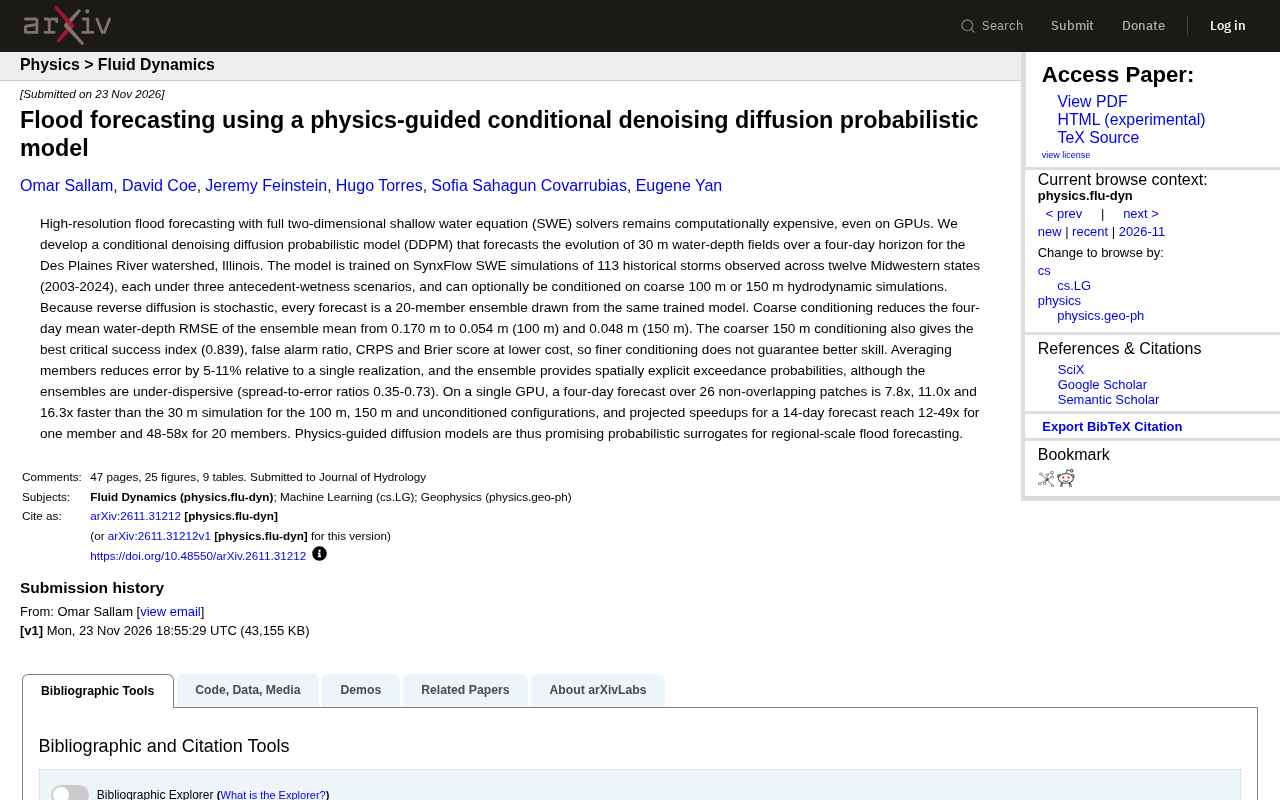
The research team focused on the Des Plaines River basin in Illinois, aiming to forecast 30-meter resolution water depth fields over a four-day lead time. They trained a conditional DDPM using training data from simulations of 113 historical storms by the SynxFlow SWE simulator—these storms occurred between 2003 and 2024 across twelve states in the Midwestern United States, with three antecedent soil moisture scenarios set for each storm.
The key design of the model lies in the word "conditional": it can optionally take coarse-resolution (100 m or 150 m) hydrodynamic simulation results as input conditions to guide the diffusion process in generating high-resolution water depth fields. This is equivalent to letting the model learn the mapping from coarse-grained physical simulations to fine-grained real fields.
Because the reverse diffusion process is inherently stochastic, each forecast draws 20 members from the same trained model to form an ensemble forecast. This means the model not only provides a deterministic water depth field but also naturally offers uncertainty information.
DDPM (Denoising Diffusion Probabilistic Model) is a class of generative models whose core idea involves two processes: a forward process that gradually injects Gaussian noise into data until it becomes pure noise, and a reverse process that trains a neural network to progressively denoise from noise and recover the original data distribution. A conditional DDPM introduces additional inputs (such as coarse-resolution simulation results, time steps, boundary conditions, etc.) on top of this to guide the generation process so that outputs conform to specific constraints. Compared with GANs or VAEs, DDPMs train more stably and naturally produce diverse samples, making them suitable for constructing ensemble forecasts. The cost is that inference requires multiple iterative denoising steps, but it still offers a speed advantage over traditional numerical simulation.
Coarse Conditions Perform Better: The Accuracy-Cost Trade-off
A counterintuitive finding is that finer conditions do not guarantee better forecast skill.
Under the unconditional setting, the four-day mean water depth RMSE of the ensemble mean is 0.170 m. Introducing 100 m conditions reduces it to 0.054 m, while 150 m conditions further reduce it to 0.048 m. On the Critical Success Index (CSI), the 150 m condition reaches 0.839, while also achieving the best false alarm rate, CRPS, and Brier score, at lower computational cost.
This suggests that the role of conditional information is more about constraining large-scale circulation structures rather than correcting details pixel by pixel. The 150 m condition provides just enough physical constraint without introducing excessive noise.
The Critical Success Index (CSI) is a commonly used binary verification metric in flood forecasting, defined as hits divided by (hits + misses + false alarms), ranging from 0 to 1, with values closer to 1 indicating higher forecast skill. It accounts for both misses and false alarms but is sensitive to rare events. The False Alarm Rate (FAR) is false alarms divided by (hits + false alarms), measuring the proportion of forecast events that did not actually occur. CRPS (Continuous Ranked Probability Score) and the Brier score are used to evaluate the calibration and sharpness of probabilistic forecasts: CRPS measures the difference between the ensemble forecast and the observed cumulative distribution, while the Brier score evaluates the mean squared error of probabilistic forecasts at a given threshold. Together, these metrics characterize both deterministic accuracy and probabilistic reliability.
The Value and Limitations of Ensemble Forecasting
Averaging over 20 members reduces error by 5% to 11% compared with a single realization. The ensemble also provides spatially explicit exceedance probabilities—i.e., the probability that water depth at each location exceeds a specific threshold—which is valuable for risk assessment and early warning decisions.
However, the study candidly points out limitations: the ensemble is underdispersive, with spread-error ratios between 0.35 and 0.73, meaning that differences among ensemble members are insufficient to fully reflect true uncertainty. This suggests that future research needs to improve ensemble sampling strategies or introduce variance correction.
Ensemble underdispersion refers to the situation where the spread among ensemble forecast members is smaller than the error of the ensemble mean, typically measured by the spread-error ratio. Ideally this ratio should be close to 1, indicating that differences among ensemble members precisely reflect forecast uncertainty. A ratio below 1 indicates that the ensemble is overconfident and underestimates actual uncertainty, which may lead to underestimation of risk in early warning decisions. Underdispersion commonly occurs when data assimilation is insufficient, model errors are unaccounted for, or sampling strategies are imperfect. Improvement methods include variance correction, stochastic perturbation parameterization, increasing ensemble size, or post-processing techniques (such as ensemble model output statistics).
Speed Advantage: From Hours to Minutes
On a single GPU, running four-day forecasts over 26 non-overlapping tiles, the 100 m condition configuration is 7.8 times faster than 30 m SWE simulation, the 150 m condition is 11.0 times faster, and the unconditional configuration is 16.3 times faster. For 14-day forecasts, the single-member speedup is estimated to reach 12 to 49 times, and the 20-member ensemble can reach 48 to 58 times.
This order-of-magnitude speedup makes regional-scale probabilistic flood forecasting feasible in operational settings—traditional methods already take considerable time for a single four-day simulation at 30 m resolution, whereas the diffusion model can complete an entire ensemble forecast in the same amount of time.
Prospects and Open Questions
This study demonstrates the potential of physics-guided diffusion models as probabilistic surrogate models for regional flood forecasting. The flexibility of the conditional diffusion framework lies in its compatibility with physical simulations at different resolutions as guidance, without the need to retrain the entire model.
However, there is still a gap between research and operational deployment: the model has so far been validated in only a single basin, and cross-basin generalization capability is unknown; the ensemble underdispersion problem needs to be addressed; and training data depend on the SWE simulator, so if real observations are sparse, the model's sensitivity to simulator bias also needs evaluation. But the direction is clear—using generative models to replace part of expensive physical solving is moving from proof of concept toward quantifiable engineering solutions.
One-line Summary
A conditional diffusion model guided by coarse-resolution simulations rapidly generates high-resolution flood ensemble forecasts.
Paragraph Summary
This study proposes using a conditional denoising diffusion probabilistic model (DDPM) to replace expensive 2D shallow water equation solving for forecasting 30 m resolution water depth fields over a four-day lead time. The model is conditioned on 100 m or 150 m coarse-resolution hydrodynamic simulations, with training data from SWE simulations of 113 historical storms. Results show that the 150 m condition performs best, reducing the four-day mean RMSE from 0.170 m (unconditional) to 0.048 m, with a CSI of 0.839, at lower computational cost than the 100 m condition. The 20-member ensemble mean reduces error by 5-11% and provides exceedance probabilities, but the ensemble is underdispersive (spread/error ratio 0.35-0.73). On a single GPU, four-day forecasts are 7.8 to 16.3 times faster than 30 m SWE simulation, and 14-day forecast speedups are estimated at 12 to 58 times, making operational regional-scale probabilistic flood forecasting possible.
Related articles

Unkernel: Compiling the Linux Kernel to WebAssembly
The Unkernel project compiles a real Linux kernel to WebAssembly, making it possible to run a complete kernel in the browser. This article covers its technical principles, challenges, and prospects.

New Claude Sonnet Model Tested: Performance Approaches Opus with Less Thinking
Anthropic quietly tests a new Sonnet model in Claude Code—performance approaches Opus 5.5 with far fewer thinking tokens, plus Codex transfer optimization, xAI's low-level rewrite, Google Antigravity updates, and the AI science understanding gap.

Building a Reasoning Model from Scratch: Making Complex AI Algorithms Accessible
Mike Finley, author of Build a Reasoning Model from Scratch, shows how a few hundred lines of code, single-sample training, and code reuse make complex AI algorithms like RL and verifiers accessible to all.