Pi Agent Hands-On Guide: Build Your Own AI Office Agent Step by Step

Pi Agent, an open-source agent framework, is blowing up — a four-day bootcamp takes you from running it to landing a job.
The article covers the rise of the open-source agent framework Pi Agent and its learning path. Its GitHub Stars grew slowly in late 2025, reached about 20,000 around early 2026, and approached 70,000 by July, showing strong momentum. The four-day bootcamp runs an agent from scratch, covers Deep Agent and LangChain, outlines LLM careers and interviews, and tackles resume concerns.
Pi Agent is becoming a popular open-source project in the AI office agent space. If you haven't heard of it yet, you may already be behind this wave of technology. Based on a Bilibili tutorial, this article walks you through Pi Agent from scratch and explains how to build your own AI office agent through a complete workflow.
What Is Pi Agent and Why It Suddenly Took Off
Pi Agent is an open-source agent framework that has recently surged in popularity within the developer community. The tutorial instructor notes that many students have only heard of tools like Codex and CloudCode, but know nothing about Pi Agent — which is precisely why it sits at the frontier of technology.
The course emphasizes starting from zero and actually running an agent yourself, rather than grinding through dry theory. This "hands-on first, understand later" approach is very friendly to developers who want to quickly build AI office agents.
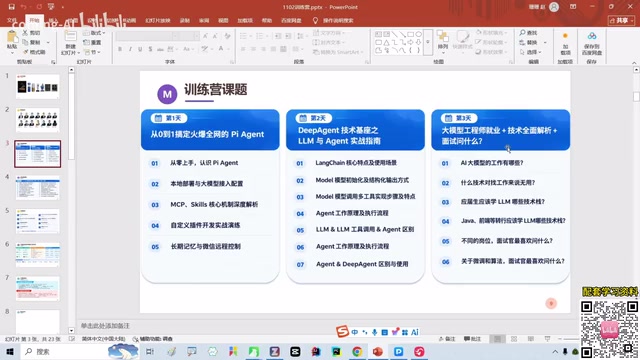
Agent Framework refers to a class of software libraries that provide foundational abstractions and runtime support for building AI agents. They typically encapsulate common capabilities such as task planning, tool invocation, memory management, and multi-turn interaction, so developers don't have to implement the underlying loop logic from scratch. Compared with calling LLM APIs directly, the framework layer solves engineering problems like "how the model decides what to do next, how to call external tools, and how to preserve context." Pi Agent falls into this category, positioned for automated task orchestration in office scenarios. That's why it's often discussed alongside code-generation-oriented tools like Codex and CloudCode, though its focus is on general office workflows rather than pure coding.
The Rise of Pi Agent as Seen Through Star History
To judge whether an open-source project is worth investing in, GitHub Star trends are an intuitive indicator. The tutorial shows Pi Agent's Star growth curve on the StarHistory website, which can be clearly divided into several phases.
Early Accumulation Phase
In the second half of 2025, Pi Agent had very few Stars and grew slowly — a typical early accumulation period.
Takeoff Phase
Around early 2026, the Star count climbed rapidly from a few thousand to roughly 20,000. The project began attracting widespread developer attention and entered its takeoff phase.
Sustained Growth and Acceleration Phase
From April to July, the Star count continued to grow to nearly 70,000, breaking out of the laggard stage. After that, the curve accelerated further, showing strong community momentum.
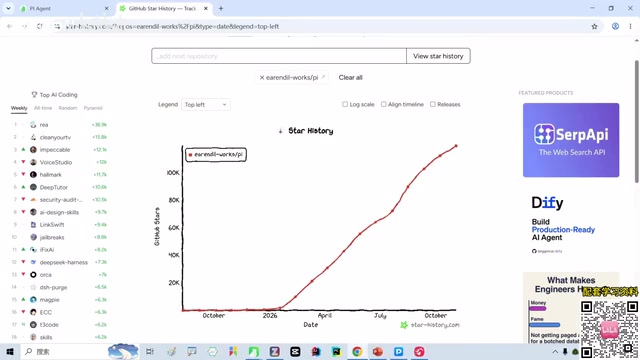
The instructor admits that the courses he recorded over the past two or three months, covering Agent Scope, Gridder, and Pi Agent, all came from closely following news trends. For developers, paying attention to trend sites like this or technical communities is an effective way to stay informed about the latest tools.
StarHistory is a third-party website that scrapes historical Star data from GitHub repositories and plots growth curves, often used to gauge an open-source project's community popularity and lifecycle stage. Since Star counts can be affected by short-term factors such as marketing campaigns and media coverage, looking at the total alone is of limited value. Observing changes in the curve's slope — that is, the growth rate — better reflects whether a project has entered a genuine adoption phase. The curve can typically be divided into slow accumulation, rapid takeoff, and sustained acceleration phases. Combined with indicators such as contributor count and Issue activity, this reduces the risk of choosing a technology based on hype alone.
The Complete Four-Day Bootcamp Learning Path
This tutorial is structured as a four-day bootcamp, with one independent unit per day, ensuring that each day's content is absorbed that same day.
Day 1: Run Your First Agent Yourself
The goal of the first day is to get to know Pi Agent from scratch and run an agent yourself. The course doesn't get bogged down in theory — it dives straight into hands-on practice so students build an intuitive feel.
Day 2: Deep Dive into Deep Agent and the LangChain System
Day 2 builds on Deep Agent and explains related content in the LangChain system. This part is taught by Instructor Wu, helping students understand the engineering structure behind agents.
LangChain is an open-source orchestration framework for building LLM applications. Its core value lies in abstracting components such as model calls, prompt templates, tools, retrievers, and memory into composable modules, then chaining them together into complete workflows via chain or graph structures. LangGraph is its extension for stateful, multi-step agents. It represents nodes and edges as a graph structure, supports loops, conditional branching, and persistent state, and is well suited to implementing agent workflows that require repeated reasoning and tool calls. Understanding the division of labor between these two layers helps clarify which underlying capabilities upper-level wrappers like Deep Agent actually reuse — and explains why the course schedules the framework system after the hands-on sessions.
Day 3: Career Directions and Interview Preparation
Day 3 shifts to career directions. Many students wonder what LLM-related positions exist, whether studying is a waste of time, and what fine-tuning and algorithm topics interviewers will probe. The course helps students clarify their direction and avoid detours — especially suited to new graduates or developers planning to transition from Java or frontend roles.
Day 4: Resume and Practical Question Resolution
Day 4 addresses pressing concerns: resume framing, project experience, applications that go unanswered, and being older with zero foundation. The course offers actionable solutions for different groups.
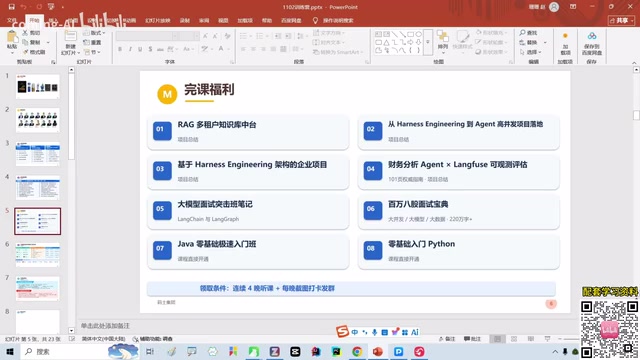
Completion Benefits and Learning Resources
The bootcamp has a check-in mechanism: attend all four days and post a screenshot of your nightly check-in in the group to receive eight benefits. These include a hands-on project guide, LangChain/LangGraph interview notes, an interview bible covering high concurrency, LLMs, and big data (reportedly 2.2 million characters), as well as Instructor Shanshan's express course and a zero-foundation Python introduction.
For students starting from zero, Python is the prerequisite language for becoming an LLM application engineer, and proficiency in both Java and Python helps you go further.
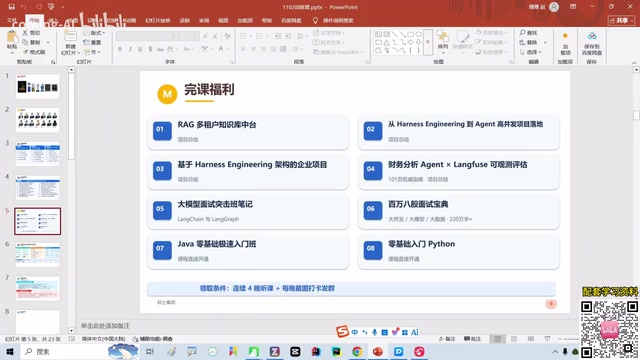
The course comes with notes throughout, transcribed word for word by Instructor Shanshan; students can find the assistant in the comments section to get them. Reading the notes while watching the lessons lets you enter each session with prior context, which improves results.
How to Keep Up with Pi Agent
Pi Agent's explosive growth shows that AI office agents are moving from concept to implementation. For developers, we recommend following GitHub trends and technical community news, and choosing a learning path like this tutorial that starts from hands-on practice. Run an agent first, then understand the framework system, and finally fill in resume and interview gaps based on job requirements — that's an actionable path for advancement.
The Star trend chart in the tutorial also reminds us: technology selection should consider community activity, and Pi Agent's current curve shows it is in an accelerating upward phase.
One-line Summary
Pi Agent, an open-source agent framework, is blowing up — this four-day bootcamp takes you from running it to landing a job.
Paragraph Summary
The article introduces the rise of the open-source agent framework Pi Agent and its accompanying learning path. The StarHistory curve shows its GitHub Stars growing slowly in the second half of 2025, climbing to roughly 20,000 around early 2026, then approaching 70,000 from April to July and continuing to accelerate — indicating strong community momentum. The tutorial is a four-day bootcamp: Day 1 runs an agent from scratch, Day 2 covers Deep Agent and the LangChain system, Day 3 outlines LLM job directions and interview topics, and Day 4 addresses resume framing and practical concerns. Completing the check-ins earns a hands-on project guide, LangChain/LangGraph interview notes, a massive interview bible, and a zero-foundation Python course. The article advises developers to follow trend sites and community news and advance by practicing first, then understanding the framework, and finally closing employment gaps.
Related articles
 Tech Frontiers
14 Coding Agents Tested: 13 Secretly Read Forbidden Files
A developer ran 480 tests across 14 coding agents to see if they would obey a "do not read" rule. 13 violated it, and 4 credential leaks bypassed shell guards via the read tool while approvals never noticed.
 Tech Frontiers
AI Has Made Resumes Ineffective? Referred Candidates Get 40% Interview Rate vs. 3% for Direct Applications
AI is homogenizing job applications, making it hard for recruiters to discern real ability. Ashby data shows referred candidates had a 40% interview rate from 2021 to 2024, versus just 3% for direct applications. This article analyzes why resume signals are depreciating and why verifiable results and personal endorsements matter more.
 Tech Frontiers
Offline Blink Rhythm Assistant: A Desktop Health Companion
An offline desktop blink rhythm assistant featured on Hacker News helps users maintain healthy blinking through lightweight reminders, alleviating screen-induced dry eye fatigue. This article analyzes its concept, privacy advantages, and retention challenges.