Pi Agent's Minimalist Design Philosophy: Let Developers Write Their Own Plugins to Intercept Dangerous Commands

Pi Agent takes a lightweight, controllable path distinct from Codex through a minimalist core plus plugin extensions.
The article examines Pi Agent's four-phase continuous GitHub star growth and asks why it still attracts attention alongside mature tools like Claude Code, Codex, and Cursor. The answer is that it "has less": the core stays simple and stable, externalizing complex capabilities like tool calls, MCP, Skills, and sandboxes into extensible mechanisms, reducing context cost and speeding up requests. The second difference is control—developers can write their own plugins, customize tools and command events, intercept and validate shell commands before execution, and persist project memory. The author notes the content comes from a single creator's explanation and lacks code examples and performance data; it suits developers seeking control and customization rather than out-of-the-box use.
Why Pi Agent Is Worth Watching
On GitHub star history tracking sites, Pi Agent's star curve shows a clear four-phase growth pattern: slow early accumulation, then a jump from a few thousand to around twenty thousand, then close to seventy thousand, and it's still accelerating today. According to observations from a Bilibili creator in the video, this growth isn't a single viral spike but the result of consistently attracting developers.
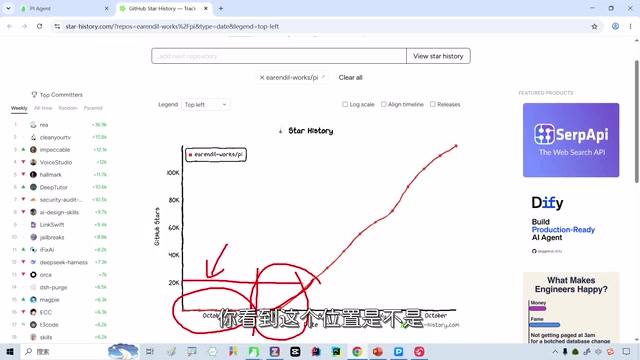
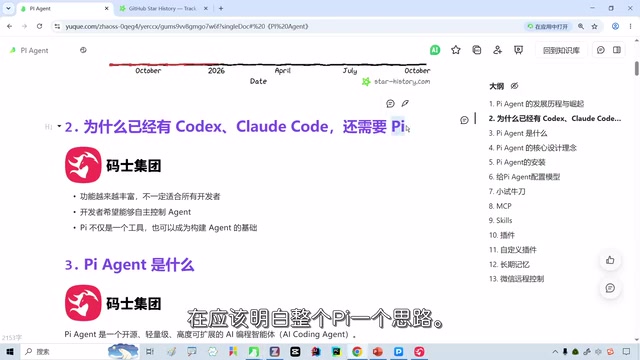
This raises a question: with mature AI coding tools like Claude Code, Codex, and Cursor already available, why does Pi Agent still attract so much attention? The answer lies precisely in the fact that it "has less."
Minimalist Core: Fewer Features Doesn't Mean Weaker Capabilities
The creator repeatedly emphasizes one point in the video: Pi Agent gained attention not because it has more features than Codex or Claude Code, but rather the opposite—it chose a highly extensible design path. The core stays simple, and developers extend whatever capabilities they need on demand.
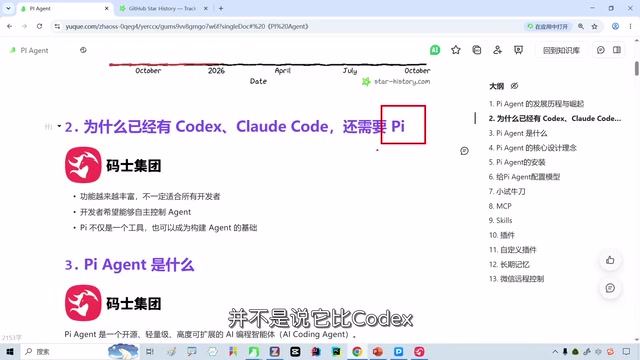
The logic behind this is context cost. As AI coding tools keep stacking tool calls, MCP, Skills, task planning, sandboxes, and other capabilities, the context for each interaction grows larger and requests slow down accordingly. For lightweight scenarios that only need to call the model, read files, modify code, and execute commands, an overly heavy Agent becomes a burden instead.
Pi Agent's approach is to provide a core that is simple, reliable, and stable enough, while moving complex capabilities into external extensibility mechanisms. In the creator's words, "minimalism doesn't mean weak functionality—it means moving complex things out of the core into external extensible capabilities."
Context window and context cost: Every request to a large language model is constrained by a fixed context window—the upper limit of tokens the model can process at once. Every tool definition, system prompt, MCP description, or Skills declaration an Agent adds consumes window budget and drives up token consumption and inference latency per request. The more tools there are, the more room the model has to choose "which tool to call," and the probability of errors rises accordingly. Therefore, the core requirement for a lightweight Agent isn't fewer features, but rather reserving the limited context budget for code and conversation content that's truly relevant to the task, while still meeting the basic requirements of reading, writing, and execution.
Developer Autonomy: The Value of the Plugin Mechanism
The second design difference is control. When using mature tools like Codex, developers must follow its preset rules and extension methods. Pi Agent, by contrast, emphasizes developers' ownership of the Agent—they can write their own plugins, customize tools, and even use custom commands to handle specific events or workflows, without relying on the product's preset capabilities.
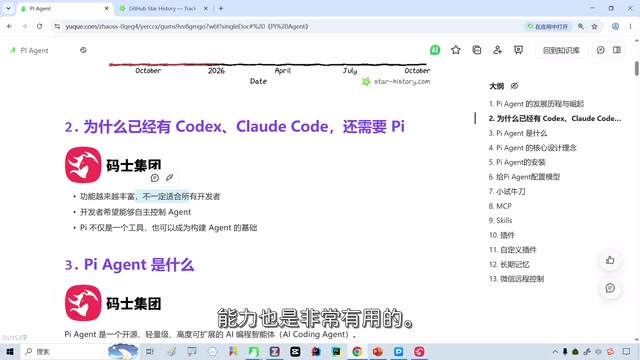
This explains the meaning of the title "Let it write its own plugins to intercept dangerous commands": when the Agent executes shell commands, developers can use the plugin mechanism to intercept and validate commands before they actually run, keeping security policies in their own hands rather than waiting for the product vendor to provide a toggle. Similarly, project memory can be persisted to the next session, letting the Agent maintain understanding of project context during long-term collaboration.
MCP (Model Context Protocol): MCP is an open protocol proposed by Anthropic for connecting external data sources and tools to large model applications in a standardized way. It's often compared to the "USB-C port for AI applications"—the Agent acts as a client, discovering and calling capabilities provided by various MCP Servers through a unified protocol description, without writing separate adapter code for each tool. For a minimalist core like Pi Agent, MCP is exactly the typical path for externalizing complex capabilities: the core is only responsible for protocol integration, while specific capabilities are provided on demand by external services, avoiding hardcoding a large number of tools into the core.
Skills and hook mechanisms: Skills generally refer to reusable capability packages packaged in declarative files (such as Markdown plus metadata), which the model loads by description when needed, avoiding having all capabilities permanently resident in context. Hooks are extension points that trigger developer-defined logic at specific nodes in the Agent lifecycle—such as before tool calls, before command execution, or at session end. What Pi Agent calls "plugin interception of dangerous commands" is essentially using the pre-command-execution hook for policy validation; project memory persistence can be achieved by writing to storage in the session-end hook and injecting context at startup. Such mechanisms give control to developers rather than relying on built-in product toggles.
Consensus and Divergence Across Multiple Perspectives
It should be noted that this video mainly comes from a single creator's explanation, representing a unique insight that hasn't yet been cross-validated across multiple sources. Its core argument—minimalist core plus plugin extension—aligns with the community's discussion direction on lightweight Agents, but the video doesn't provide specific plugin code examples or performance comparison data.
For developers who want to go deeper into practice, the video suggests paying attention to extension directions such as tool calling, MCP, Skills, long-term memory, and multi-agent systems. However, specific implementation details still need to be verified against official documentation and actual projects.
Who Should Use It
Pi Agent is better suited for developers who need something lightweight, controllable, and customizable—especially scenarios where they want to control security policies and project memory themselves. If you're after a ready-to-use, fully featured mature experience, Codex or Claude Code remain more direct choices. The two aren't substitutes for each other but rather represent a divergence in design paths.
Agent sandbox: A sandbox is an isolated execution environment that lets code or shell commands generated by the Agent run within restricted file system, network, and permission boundaries, so that even destructive commands won't affect the host machine. Common implementations include containers, namespace isolation, and OS-level permission restrictions. Sandboxes are a typical "heavy capability" that isn't necessary for lightweight read/write scenarios, which is why Pi Agent places it outside the core for on-demand integration. Teams that need to run untrusted code, however, should combine sandboxes with plugin interception to form defense in depth.
Related articles

RePlan-VLA: Progress-Aware Replanning Breakthrough for Long-Horizon Robotic Manipulation
The RePlan-VLA framework converts VLA models' short-horizon capabilities into reliable long-horizon execution through progress-aware adaptive replanning, improving success rates by 21.9% and 10.4% on RoboCasa365 and CALVIN, and validating real-world deployment on a Franka Research 3 robot.

Geometric Bridge Flow Matching: A New Breakthrough in Blind Rigid Motion Correction
Geometric bridge flow matching enables blind rigid motion correction in head CBCT, achieving 37.1 dB PSNR and 0.27 mm RPE on simulated data in ~9.1 minutes, outperforming existing methods.

Google Releases Gemini 4 Hydrogen: 2.5x Faster Without Sacrificing Intelligence
Google releases the lightweight Gemini 4 Hydrogen: 2.5x faster task completion, AA Intelligence Index of 54 beating its flagship sibling, 7.3s single-step on Agent Arena faster than Claude and GPT rivals, four thinking levels with pay-as-you-need pricing, now available across AI Studio and more.