Pi MCP Adapter: A Bridge Tool for Seamlessly Connecting Pi Agent to the MCP Ecosystem

Pi MCP Adapter bridges Pi Agent to the MCP ecosystem via a lightweight open-source adaptation layer.
Pi MCP Adapter is an open-source bridge tool that solves the incompatibility between Pi Agent and the MCP (Model Context Protocol) standard. By inserting a lightweight adaptation layer, it enables Pi Agent to discover and invoke tools from MCP Servers without modifying the underlying framework. This article covers its core positioning, integration workflow, and practical use cases, helping developers quickly connect Pi Agent to the rich resources available in the MCP ecosystem.
Introduction: Why Pi Agent Needs an MCP Adapter
As MCP (Model Context Protocol) gradually becomes the universal standard protocol for AI Agents to interact with external tools and data sources, more and more Agent frameworks are exploring how to connect to the MCP ecosystem. MCP is an open protocol standard introduced by Anthropic in late 2024, designed to establish unified interaction specifications between AI models and external data sources and tools. Before MCP emerged, each AI Agent framework typically needed to write dedicated integration code for different external services, leading to massive redundant work and a fragmented tool ecosystem. Drawing inspiration from how USB interfaces unified hardware connections, MCP defines standardized communication methods between Servers (the party providing tools and resources) and Clients (the Agent party consuming tools), including complete interaction flows such as tool discovery, parameter passing, and result retrieval. Currently, MCP has gained support from multiple mainstream AI products including Cursor, Claude Desktop, and Windsurf, with hundreds of MCP Server implementations emerging in the community, covering common scenarios like database queries, file operations, web scraping, and API calls.
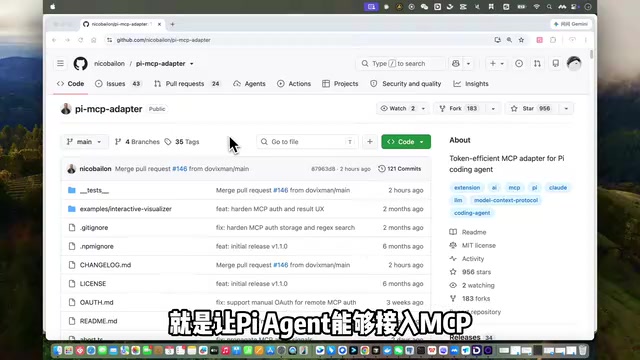
Bilibili content creator Moxian shared a practical open-source project in their "Opening Power" video series — Pi MCP Adapter, whose core goal is to enable Pi Agent to smoothly connect to and invoke MCP Servers.
According to the video author, the original Pi Agent was not designed to natively support the MCP protocol. Pi Agent is a lightweight AI Agent development framework focused on enabling developers to quickly build intelligent agents with autonomous reasoning and tool-calling capabilities. Compared to more well-known Agent frameworks like LangChain and AutoGPT, Pi Agent pursues simplicity and modularity in its design, making it suitable for small to medium-scale Agent application development. However, Pi Agent's original design predates the widespread adoption of the MCP protocol, so its tool-calling mechanism uses a proprietary interface specification that is not directly compatible with the MCP standard. This means that developers using native Pi cannot directly invoke server-side resources that conform to the MCP specification. Pi MCP Adapter was born precisely to fill this gap as an adaptation layer tool.
What Is Pi MCP Adapter
Core Positioning: A Bridge Between Pi Agent and MCP Protocol
Simply put, Pi MCP Adapter is a bridge layer (Adapter) that connects Pi Agent with the MCP protocol, giving the originally MCP-incompatible Pi Agent the ability to access MCP Servers. The author vividly describes it as "the version that lets Pi Agent enter the MCP world."
This adapter pattern is very common in software engineering — when protocol incompatibility exists between two systems, a middle adaptation layer performs the conversion, preserving the stability of the original system while extending new capabilities and avoiding invasive modifications to the underlying framework. From a technical perspective, the Adapter Pattern is one of the 23 classic design patterns from the GoF (Gang of Four), belonging to the structural pattern category. Its core idea is: when an existing system's interface doesn't match what the client expects, an intermediate layer is introduced to perform interface conversion, enabling systems that otherwise couldn't work together to seamlessly integrate. The greatest advantage of this pattern is adherence to the "Open-Closed Principle" — open for extension, closed for modification. Developers don't need to modify Pi Agent's underlying source code or alter the MCP Server's implementation; they simply insert a conversion layer between the two. This approach is widely used in large-scale system integration, legacy system migration, and multi-protocol compatibility scenarios — for example, JDBC drivers are essentially adapters for database protocols.
Project Status and Ecosystem Support
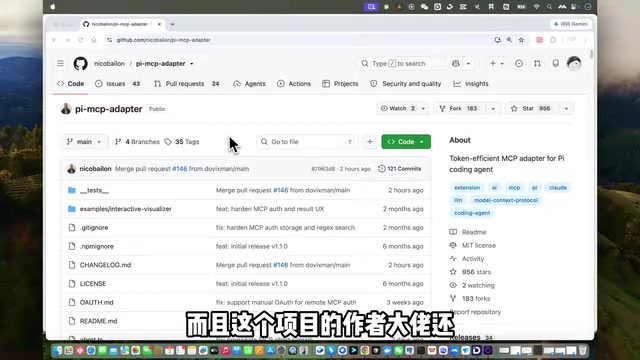
According to the video content, the project has completed its foundational setup and has been evaluated by the author as "a very useful Pi project." Currently, Pi MCP Adapter has gone through the relevant processes in the MCP repository and can directly connect MCP services to Pi Agent for use.
For developers who want to reuse Agent capabilities across multiple scenarios, the value of such adaptation tools lies in reducing the cost of protocol integration — you don't need to rewrite the Agent's core logic; simply introducing the adapter gives you access to the rich tool support of the MCP ecosystem.
Hands-On: How to Connect to MCP Server via Pi MCP Adapter
Basic Integration Flow
The video demonstrated how to use Pi MCP Adapter. The overall approach can be summarized in the following steps:
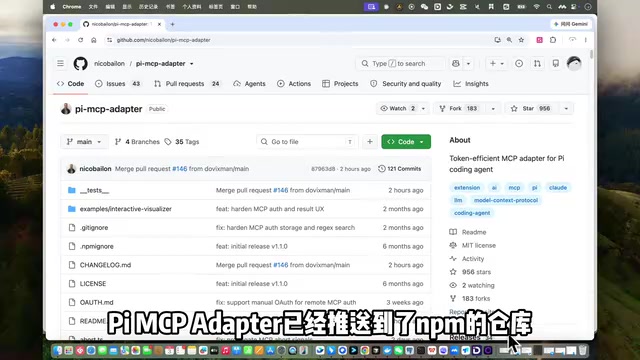
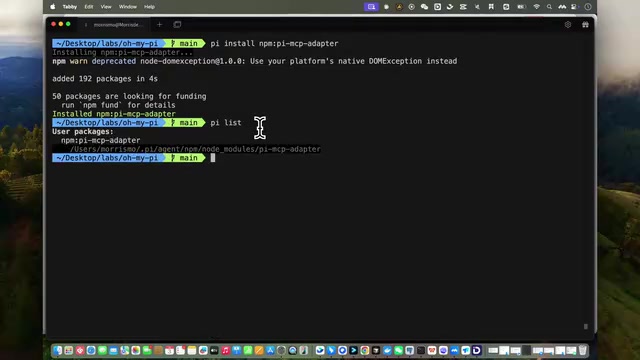
- Install the adapter: Pi MCP Adapter has been published through the MCP repository and can be installed directly into your local environment.
- Connect to MCP Server: Once installed, the adapter handles sending and exposing MCP service capabilities to Pi Agent. The author mentioned "directly sending MCP to Pi Agent."
- Invoke from Pi Agent: After integration is complete, Pi Agent can use tools and resources from MCP Servers as if calling native functionality.
To understand the technical mechanism behind this flow, you need to understand MCP's Server-Client interaction model. The MCP protocol uses a Server-Client architecture, where the MCP Server is responsible for exposing three types of capabilities: Tools — similar to function calls, where the Agent can pass parameters and receive execution results; Resources — similar to data reading, providing access to structured or unstructured data; Prompts — providing predefined interaction templates to simplify common tasks. The MCP Client runs on the Agent side and is responsible for discovering and invoking capabilities provided by the Server. Communication supports two transport layers: one is local inter-process communication based on standard input/output (stdio), suitable for locally deployed Servers; the other is remote communication based on SSE (Server-Sent Events) or HTTP Streaming, suitable for cloud-deployed services. In the Pi MCP Adapter scenario, the adapter essentially plays the role of an MCP Client, translating tool capabilities discovered from MCP Servers into a format that Pi Agent can understand and invoke.
Extending Use Cases
The author repeatedly emphasized one point: after connecting to MCP, Pi Agent can be used anywhere else. This means that once the MCP channel is opened through the adapter, Pi Agent's application boundaries are greatly expanded — it's no longer limited to its original closed environment but can leverage various Servers in the MCP ecosystem to access databases, file systems, external APIs, and other rich resources.
Here are a few concrete examples to illustrate this extensibility: by connecting to a database MCP Server (such as PostgreSQL MCP Server), Pi Agent can directly query and analyze data in databases; by connecting to a file system MCP Server, Pi Agent can read and write local or remote files; by connecting to a GitHub MCP Server, Pi Agent can manage code repositories and view Issues and PRs. Before the MCP adapter, all these capabilities required developers to write integration code for Pi Agent one by one, but now you simply need to install the corresponding MCP Server and connect through the adapter.
Value Analysis: The Significance of the Adapter Pattern for the AI Agent Ecosystem
Protocol Standardization Drives Ecosystem Prosperity
The emergence of Pi MCP Adapter reflects an important trend in the current AI Agent field: protocol standardization is becoming a prerequisite for ecosystem prosperity. As a universal protocol connecting Agents with the external world, MCP's value lies in "integrate once, use everywhere." Adaptation tools like Pi MCP Adapter are the critical bridges that enable existing Agent frameworks to quickly integrate into this standard ecosystem.
From a broader industry perspective, protocol standardization in the AI Agent field is evolving from a "hundred flowers blooming" phase toward "convergence on unified standards." Besides Anthropic-led MCP, Google also launched the A2A (Agent-to-Agent) protocol in 2025, focusing on collaborative communication between Agents. The two are complementary — MCP solves the connection problem between Agents and tools, while A2A solves the collaboration problem between Agents. Meanwhile, OpenAI has also announced MCP protocol support in its Agents SDK, further solidifying MCP's industry position as a tool integration standard. This trend means that in the future, developers only need their Agent to support standard protocols to access the entire ecosystem's tool library, without writing separate integration code for each tool. For small to medium-sized frameworks like Pi Agent, quickly connecting to standard protocols through adapters is an important strategy for maintaining relevance in ecosystem competition.
For the developer community, such open-source adaptation projects mean lower migration barriers. You don't need to wait for the native framework to support a new protocol — community adaptation layers can often fill the gap faster.
Practical Recommendations for Developers
If you're using Pi Agent and want it to invoke a broader range of external tools, Pi MCP Adapter is worth your attention. Before getting hands-on, it's recommended to first understand the basic concepts of the MCP protocol — understanding the Server-Client interaction model will make you much more comfortable when configuring the adapter. Specifically, focus on the following points:
- Understand MCP's three types of capabilities: Tools, Resources, and Prompts — clarify which type of capability you need from the MCP Server.
- Choose the appropriate transport method: If the MCP Server is deployed locally, stdio mode is typically simpler and more efficient; for remote services, you'll need to configure HTTP/SSE transport.
- Follow the community MCP Server repository: The MCP community currently maintains an official Server directory covering numerous MCP implementations of commonly used tools that can be directly used with Pi MCP Adapter.
It should be noted that this article's content is primarily based on a single video source from Bilibili creator Moxian, and some technical details (such as specific installation commands and configuration parameters) are somewhat brief in the original material. Readers are advised to verify through actual operation by consulting the project's official repository documentation.
Conclusion
Pi MCP Adapter opens the door to the MCP ecosystem for Pi Agent. Through a lightweight adaptation layer, the originally MCP-incompatible Pi Agent gains the ability to invoke standardized external tools, enabling it to function in more scenarios. In today's rapidly evolving landscape of AI Agent and tool protocols, the practical value of such bridge tools should not be underestimated. More importantly, the adapter approach represented by Pi MCP Adapter — enabling existing frameworks to quickly embrace new protocol standards through an intermediate layer — provides the entire AI Agent developer community with a pragmatic and efficient path to ecosystem integration.
Related articles

Felix Rieseberg Personal Homepage
Felix Rieseberg's personal homepage sparks attention on Hacker News. This article covers the Slack engineer's technical background, the rise and fall of nativefier, and the value of a developer homepage as a tech calling card.

@ai-sdk/vue 3.0.306 Patch Release Syncs with [email protected] Update
@ai-sdk/vue 3.0.306 released, synced with [email protected]. A routine patch release for the Vercel AI SDK ecosystem with no public API changes; the Vue adapter layer stays version-aligned with the core package.

Gemini 4 Argon API Launches: The Era of Million-Token Output Begins
Google launches Gemini 4 Argon with sparse MoE architecture, up to 1M output tokens, and a 68.90% Vals Index score, available across API, AI Studio, and the Gemini app.