PILAPS Bilingual Benchmark: Cross-Lingual Challenges in LLM Pragmatic Inference

PILAPS bilingual benchmark reveals LLM pragmatic inference struggles to generalize across languages; open-source models weak in humor understanding.
A new study introduces PILAPS—a bilingual English-Chinese pragmatic inference benchmark covering eight pragmatic phenomena with authored and conversation-derived data—to test LLM cross-lingual generalization. Evaluating eight models from four families, it finds open-source models consistently underperform on humor, and cross-lingual performance varies by model origin, showing strong English performance doesn't transfer to Chinese. Error analysis reveals models are more literal than humans; ToM prompting reduces literal errors while CoT prompting slightly increases them. The study warns multilingual deployers that high scores in one setting are insufficient to infer cross-lingual pragmatic ability.
Large language models perform impressively on English pragmatic inference tasks, but can this ability generalize across languages and scenarios? The latest research offers a less than optimistic answer.
A New Benchmark for Pragmatic Inference Evaluation: PILAPS
A recent paper introduces PILAPS, a bilingual pragmatic inference benchmark for English and Chinese. The benchmark covers eight pragmatic phenomena, with data sourced from both specially authored questions and samples extracted from conversations, and distinguishes between culturally adapted versions and independently collected versions.
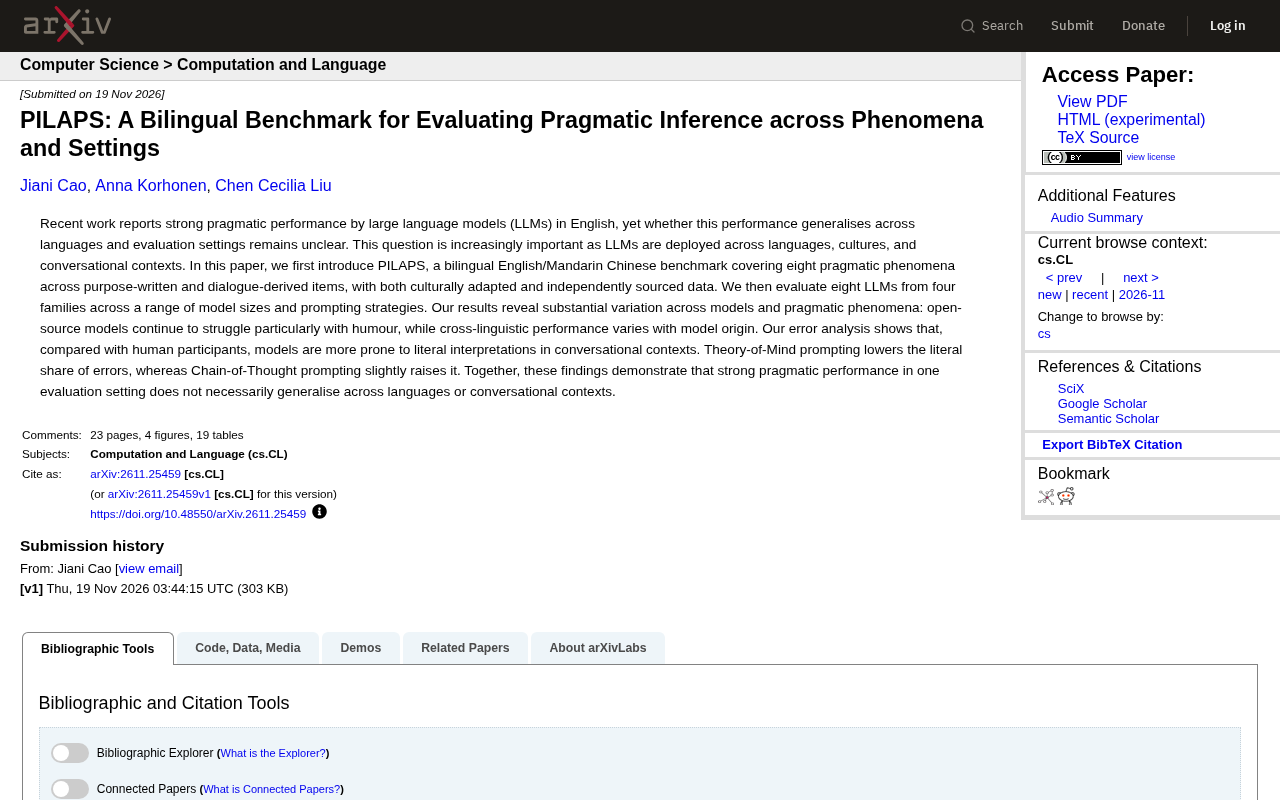
The research team notes that existing work mostly reports strong performance of large language models on English pragmatic tasks, but generalization across languages and evaluation settings remains unclear. As models are deployed across different languages, cultures, and conversational scenarios, this issue becomes particularly critical.
Pragmatic inference is a core concept in linguistics and cognitive science, referring to the listener/reader's ability to infer the speaker's intent beyond literal meaning. Typical scenarios include understanding irony, metaphor, indirect requests, presupposition, conversational implicature (such as the "implicature" in Grice's cooperative principle), and more. This contrasts with semantic understanding—the interpretation of a sentence's literal truth value. The difficulty of pragmatic inference lies in its heavy dependence on context, shared knowledge, and cultural conventions; the same sentence may convey completely different implicatures in different cultures. This also explains why large language models, despite strong semantic capabilities, may still make errors in pragmatic judgments, and why cross-lingual transfer is particularly difficult.
Eight Models, Four Families: Evaluation Design
The authors evaluated eight large language models from four model families, covering different model scales and prompting strategies. This design allows researchers to simultaneously examine the impact of model scale, origin (open-source/closed-source), and prompting methods on pragmatic inference.
The pragmatic phenomena evaluated cover multiple dimensions including humor and implicature, with test scenarios including both specially authored questions and items derived from real conversations. This dual-source design helps test differences in model performance between controlled environments and natural contexts.
Key Findings: Open-Source Models Show Clear Weaknesses in Humor Understanding
The results reveal significant differences between models and across pragmatic phenomena. Open-source models consistently underperform on humor understanding, while cross-lingual performance varies with model origin—indicating that linguistic and cultural biases in training data directly affect models' pragmatic judgments in non-English contexts.
This finding echoes recent research on LLM cultural bias: excellent performance on English does not necessarily transfer automatically to Chinese or other language environments.
The Literal Interpretation Trap and the Unexpected Effects of Prompting Strategies
Error analysis shows that, compared to human participants, models are more inclined toward literal interpretation in conversational contexts. In other words, models tend to ignore implicature, irony, or indirect expressions, and instead understand things directly by their literal meaning.
More interesting are the effects of prompting strategies: Theory-of-Mind prompting reduces the proportion of literal errors, while Chain-of-Thought prompting actually slightly increases the proportion of literal errors. This counterintuitive finding suggests that not all strategies that "make models think longer" are suitable for pragmatic inference—understanding implicature may require different cognitive guidance.
Theory of Mind (ToM) prompting refers to guiding the model in the prompt to explicitly reason about the beliefs, intentions, and knowledge states of conversation participants (e.g., "Please think about what the speaker really wants to express" or "Does the other party know this information?"), thereby activating the model's modeling of mental states. Chain-of-Thought (CoT) prompting requires the model to unfold its reasoning process step by step, typically improving performance on mathematical and logical tasks. The difference lies in: ToM prompting focuses on "others' mental states," a key variable in pragmatic inference, while CoT leans toward formalized, step-by-step explicit reasoning, which may lead the model toward over-analysis of literal propositions in pragmatic scenarios, thereby raising the proportion of literal interpretations.
Conclusion: Performance in a Single Scenario Does Not Equal Cross-Lingual Ability
Overall, the evaluation results of PILAPS indicate that strong pragmatic performance under one evaluation setting does not necessarily generalize to other languages or conversational contexts. This serves as a reminder for practitioners of multilingual deployment: inferring a model's cross-lingual pragmatic ability solely from high scores on English benchmarks is unreliable; independent validation for the target language and scenario is needed.
The introduction of this benchmark also provides a reusable evaluation framework for future research, particularly filling a gap in systematic assessment of Chinese pragmatic ability.
One-line Summary
PILAPS bilingual benchmark reveals that LLM pragmatic inference struggles to generalize across languages, with open-source models weak in humor understanding.
Paragraph Summary
A new study introduces PILAPS—a bilingual English-Chinese pragmatic inference benchmark covering eight pragmatic phenomena with both specially authored and conversation-derived data—to test large language models' cross-lingual and cross-scenario generalization. The study evaluated eight models from four model families and found that open-source models consistently underperform on humor understanding, with cross-lingual performance varying by model origin, indicating that strong English performance does not necessarily transfer to Chinese. Error analysis shows models are more prone to literal interpretation of conversations than humans, and that Theory-of-Mind prompting reduces literal errors while Chain-of-Thought prompting slightly increases them. The study concludes by reminding multilingual deployers: high scores under a single evaluation setting are insufficient to infer cross-lingual pragmatic ability; independent validation for the target language is needed.
Related articles
GLM-5.4 vs. Opus and Neon: How Far From the Top?
No official benchmarks for GLM-5.4. Based on a YouTube deep test and developer trials, we analyze its gap vs. Claude Opus 5.5 and Gemini Neon, the speed bottleneck from marathon-style thinking, and its real position in enterprise agent scenarios.

From Gobbler to Sloppy Joe: The Hit-Making Playbook of a New Jersey Deli Institution
NYT Cooking visits Milburn Deli in New Jersey to break down the hit logic behind the Gobbler turkey sandwich and the local Sloppy Joe: bread sliced to order, house-made sauces, a group shout culture, and customer co-creation behind six locations.
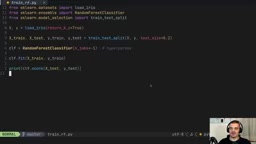
In the Age of AI Programming, When Do You Still Need to Write Code by Hand?
Is handwritten code still valuable once AI programming agents are widespread? This article outlines three scenarios where handwriting is essential—learning, style development, and prototype validation—and provides a division-of-labor framework between AI and humans to help developers balance efficiency and skill growth.