Pine Computer: A Cloud Computer Built for AI Agents to Actually Get Things Done

Pine Computer gives AI agents a dedicated cloud PC to operate apps, fill forms, and access systems without APIs.
Pine Computer is a developer-facing cloud execution environment designed to let AI agents handle research, form-filling, and no-API portal operations. Its core differentiator is reading application UI structure rather than screen pixels, notifying the AI when interfaces change for more stable automation. It delivers multi-tenant isolation via a single SDK (one independent cloud machine per customer), supports bring-your-own LLM, and includes human takeover for sensitive steps like login and approvals. Currently in invite-only beta, it represents a concrete product form in the emerging AI agent runtime category.
When AI Needs Its Own Computer
As AI agents move from concept to real-world deployment, a practical question has emerged: where do these agents actually run? How do they access systems without open APIs, fill out forms, work with spreadsheets, or log into various portals? A recent Product Hunt launch called Pine Computer offers one answer — a cloud computer designed specifically for AI.
The product earned 82 upvotes on Product Hunt, ranking 12th, and is categorized under APIs, Developer Tools, and Artificial Intelligence. Its core positioning is unambiguous: this isn't a cloud PC for humans — it's a cloud PC for AI.
What Problem Does It Solve
Pine Computer's product logic can be summed up in one sentence: your product hands it a task, and it hands back the finished result. Those tasks include research, form-filling, spreadsheet processing, and operating web portals that have no API.
This directly addresses one of the biggest pain points in real-world AI automation. Countless legacy enterprise systems, government portals, and third-party platforms offer no APIs. Traditional automation relies on brittle screen scraping or RPA scripts that break the moment an interface changes. Pine Computer aims to wrap this kind of "dirty work" into a stable execution environment that AI can reliably call into.
Reading Structure, Not Pixels
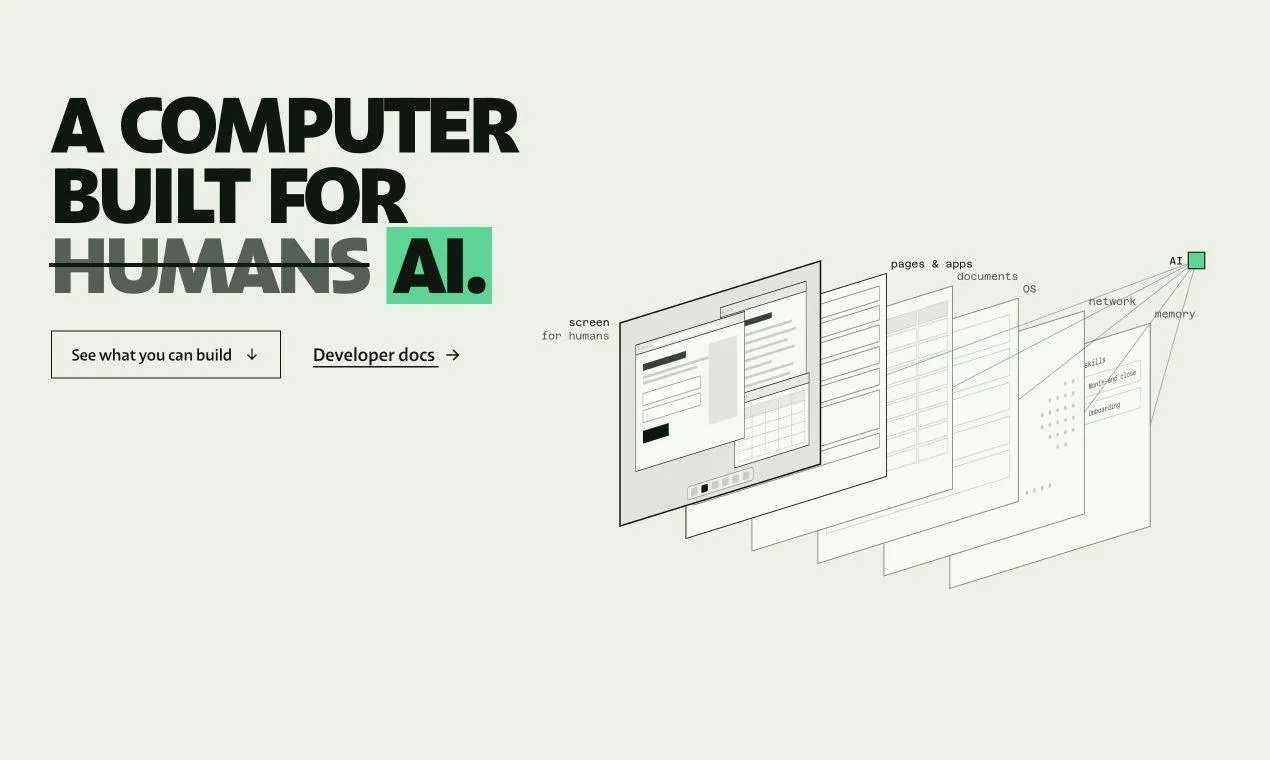
One of Pine Computer's key technical choices is having AI read each application's structure rather than recognizing screen pixels. This is the fundamental distinction from traditional vision-based automation approaches.
Pixel-based approaches require AI to "look at the screen and find the button" like a human would — computationally expensive, and highly susceptible to changes in resolution, themes, and dynamic layouts. Reading structure means the AI directly understands how the interface is organized: where the input fields are, where the submit button is, how data is arranged. More importantly, Pine Computer proactively notifies the AI when the interface changes — solving the most common failure mode in automation workflows: "the UI changed, so the script broke."
The technical path for reading structure typically leverages accessibility trees exposed by the operating system or application framework. Whether it's Windows UI Automation, macOS Accessibility API, or the browser's DOM tree, these provide structured data describing the hierarchy, roles, and attributes of UI elements — no pixel-level screen analysis required. With this "skeleton" in hand, AI can locate elements and execute actions with near-programmatic precision, conceptually similar to how automation tools like Selenium or Playwright work, but with an LLM interpreting task semantics and dynamically determining the action path. The tradeoff: the quality of structural data depends heavily on how well the application itself implements accessibility. Some legacy desktop software or custom web frameworks have incomplete accessibility annotations, requiring a fallback to visual recognition.
Elastic Virtual Screens
The product also mentions that AI can have "as many virtual screens as it needs." For AI agents, this means parallel processing across multiple task windows, unconstrained by physical screen counts. This design aligns with how AI actually works — it doesn't need to stare at one window at a time like a human, but can coordinate multiple operation contexts simultaneously.
How Developers Integrate It
The product categories (API, Developer Tools) make clear that Pine Computer targets developers rather than end users. Several design decisions stand out:
One SDK, one machine per customer. Developers can use a single SDK to dynamically spin up an isolated cloud computer for each customer. This isolation model is especially valuable for multi-tenant SaaS products — it guarantees data isolation and prevents one customer's AI tasks from interfering with another's.
Bring your own model or use theirs. Pine Computer lets developers bring their own LLM, or use the models it provides. This flexibility means enterprises can stick with their existing LLM choices while Pine handles the execution environment layer.
Human takeover mechanism. The product explicitly supports handing control back to a human during sensitive steps like login or approval flows. This is a pragmatic design choice — fully autonomous AI operation is neither safe nor compliant when identity verification and permission authorization are involved. Keeping a human "escape hatch" actually makes the product more viable for enterprise deployment.
Multi-tenant isolation is an unavoidable engineering challenge when building AI automation into SaaS products. If multiple customers' AI tasks share the same runtime environment, risks include session state bleed, browser cookie leakage, and mixed operation logs — particularly acute in compliance-sensitive industries like finance and healthcare. Pine Computer's "one machine per customer" design raises the isolation boundary to the OS level. The cost is higher resource overhead, but the payoff is cleaner audit boundaries and reduced security liability. This contrasts architecturally with products like Browserbase, which sets isolation at the browser session level — lighter-weight, but requiring additional session management. The former is heavier but cleaner; the latter is leaner but demands more careful management.
A Market Category Taking Shape
Pine Computer is currently in an invite-only beta with limited public information, but the direction it represents is worth watching.
The concept of "a computer for AI" aligns with recent industry conversations around "Computer Use" and "agent runtime environments." Whether it's AI operating a browser, filling out forms, or interfacing with legacy systems, the underlying need is the same: AI needs a stable, programmable, observable, and intervenable execution foundation.
Pine Computer's differentiation lies primarily in its emphasis on "structure awareness" and its attention to engineering details like multi-tenant isolation and human takeover. These details often determine whether an AI automation product can move from demo to production. That said, since it's still in beta, its real-world stability, supported application range, and the structural-reading approach's coverage in complex real-world scenarios all remain to be proven through practice.
For developers building AI agent products, Pine Computer offers a compelling framing: rather than letting AI "brute-force" operations in an uncontrolled environment, why not give it a dedicated computer that genuinely understands it — and that you can control?
This space already has multiple players. Anthropic's Computer Use feature, launched in late 2024, lets Claude directly control desktop environments. Microsoft continues deepening Copilot's system-level integration in Windows 11. Among startups, Browserbase focuses on managed browser infrastructure for AI, while Mulligan targets enterprise RPA scenarios. At the framework level, OpenAI's Operator and Google's Project Mariner are both exploring "AI operating real interfaces" as a product paradigm. Pine Computer's strategy of delivering an "independent cloud computer per customer" as the unit of deployment, focused on multi-tenant SaaS integration, is a bid for differentiated positioning in a crowded field — but it also means finding a sustainable balance between infrastructure costs and task success rates.
Related articles

Random Pruning of the DPO Computation Graph: 1.4x Training Speedup and Lower Peak Memory
DPO training too slow and memory-hungry? This paper proposes a random pruning framework for the DPO computation graph, sampling independently across position, sequence, and branch dimensions; branch pruning achieves a 1.426x step-time speedup and cuts training time by about 30%, with in-depth attribution of memory and time gains.

Why Does JEPA Underperform MLM in Longitudinal EHR Representation Learning?
New study compares JEPA and MLM for longitudinal EHR representation learning on MIMIC-IV: three JEPA variants train stably without collapse but underperform MLM; target size, not heterogeneity, drives prediction error.

Transfer Learning + Visible Light Communication: A New Approach to Energy-Efficient Indoor Positioning
A study proposes a transfer learning-based visible light communication indoor positioning method, achieving 47% accuracy improvement on the BOSCH factory dataset, 67.5% model efficiency under high noise, and introducing the ME composite metric for energy-efficient positioning in energy-constrained industrial IoT scenarios.