Pinecall: An Open-Source Voice AI Agent Platform

Pinecall is an open-source voice AI agent platform focused on testable, verifiable voice agent development.
Pinecall is an open-source voice AI agent platform built on LiveKit under the Apache-2.0 license, advocating "Voice agents you can prove." It offers three build paths—form configuration, coding, and MCP—and differentiates through simulated caller testing, per-call recording and judging, and one-click human takeover, deployable on cloud or self-hosted Kubernetes.
What Kind of Development Platform Do Voice AI Agents Need?
Voice AI is evolving from simple Q&A bots into agents capable of handling complex tasks. But developers face an obvious pain point: how do you build, test, and monitor a voice agent to ensure it runs reliably in real calls? On Product Hunt, Pinecall offers its answer—an open-source voice AI agent platform built around the idea of "Voice agents you can prove," meaning voice agents that are verifiable and demonstrable.
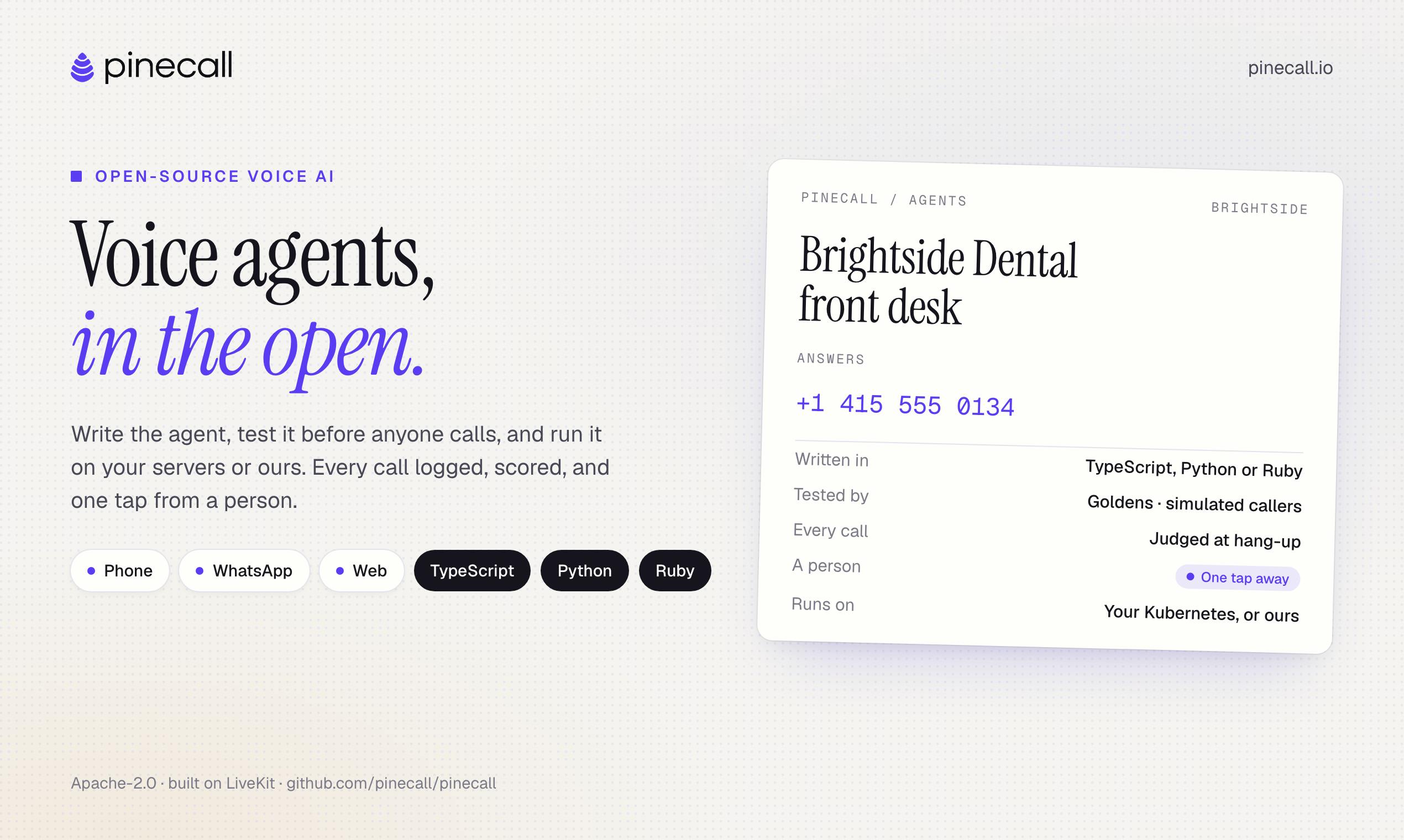
This project received 93 upvotes and ranked 13th for the day, categorized under open source, developer tools, and artificial intelligence. Positioned not merely as a voice app scaffold, it aims to cover the full lifecycle from building and testing to post-launch monitoring.
Three Ways to Build, Lowering the Barrier to Voice AI Development
Pinecall offers three paths to create voice applications: configuring through forms, writing code directly, or having an AI assistant build it via the MCP protocol. This layered design accommodates users with different technical backgrounds—product managers can quickly build prototypes with forms, developers can achieve fine-grained control with code, and those accustomed to AI-assisted programming can complete the build directly in conversation.
This multi-entry strategy is becoming increasingly common in developer tools today, but Pinecall combines it with voice scenarios, meaning creating a voice agent is no longer limited to engineers familiar with real-time audio protocols. According to its Product Hunt page, the platform is built on top of LiveKit, open-source real-time audio/video infrastructure, which provides a foundation for the latency and stability of voice calls.
MCP (Model Context Protocol) is a protocol proposed and open-sourced by Anthropic for letting AI assistants connect to external tools, data sources, and services in a standardized way. In Pinecall's context, MCP acts as a bridge between AI coding assistants and the voice agent building platform: developers simply describe their needs in conversation, and the AI assistant can call the platform's interfaces via MCP to complete the agent's configuration and generation. Compared with traditional forms or hand-written code, the MCP path turns "building" itself into a tool-calling workflow that AI can understand and execute—which is why developer tools have increasingly begun supporting MCP in recent years: it extends AI-assisted programming from generating code snippets to directly operating real systems.
LiveKit is an open-source real-time audio/video and data transmission infrastructure built on WebRTC, offering room management, audio/video track subscription, low-latency data channels, and more. Voice agents are extremely sensitive to latency; if end-to-end response exceeds a few hundred milliseconds, the conversation feels sluggish. LiveKit's value lies in encapsulating the underlying challenges of signaling, media transmission, and network adaptation, letting higher-level developers focus on conversation logic and agent orchestration. By choosing to build on it, Pinecall effectively reuses a real-time communication foundation validated at scale, without having to handle engineering details like audio capture, codecs, and jitter buffering from scratch.
Testing and Observability: Simulated Callers and Call Judging
Pinecall's core differentiator lies in testing and verification. The platform supports testing with simulated callers, and every call is recorded and judged. This is especially critical for voice agents—voice interaction is far more non-deterministic than text, and the same prompt may perform very differently under different accents, speaking rates, and background noise.
Without systematic simulated testing and call log judging, developers would find it hard to determine whether a voice agent is truly ready to face real users. Pinecall productizes this process, making "provable" the platform's core selling point. In addition, the platform emphasizes "always one click to a human," meaning it retains the ability for human takeover within automated voice workflows—a pragmatic design for high-stakes scenarios like customer service and appointments.
Observability in the context of voice agents refers not just to logging, but to reconstructing why a conversation succeeded or failed through multi-dimensional signals such as call recordings, transcripts, latency metrics, interruptions, and turn structure. Unlike text conversations, voice interaction failures often stem from timing issues—talking over each other, excessive silence, response latency, or speech recognition errors—none of which can be judged from the final text alone. Therefore, call judging needs to combine timestamp-aligned audio and transcript data to pinpoint whether the problem lies in recognition, understanding, or generation. By recording and judging every call, Pinecall is essentially establishing a traceable quality baseline for voice agents.
Deployment Flexibility and Open-Source License
Pinecall is open-sourced under the Apache-2.0 license, and developers can deploy it on the official cloud service or run it on their own Kubernetes clusters. For teams with data compliance requirements or existing cloud-native infrastructure, self-hosting capability is an important consideration when choosing a platform.
The choice of open-source license is also worth noting: Apache-2.0 permits commercial use and modification while including explicit patent grant terms, making it more suitable for enterprise adoption than some more restrictive licenses. Combined with LiveKit's technical foundation, Pinecall effectively fills in the upper-layer toolchain for voice agent development, testing, and operations on top of open-source real-time communication capabilities.
The Competitive Logic of the Voice AI Agent Space
Voice AI agents are becoming a hot area for AI application deployment, from customer service automation to voice assistants, and market demand for reliably operating voice agents is growing. Pinecall's entry point is not the model itself, but engineering tooling around models and real-time communication infrastructure—testing, logging, human takeover, and deployment orchestration.
The challenge of this positioning is that the voice agent platform space already has many commercial products competing for developers, and whether the open-source route can attract enough community contributions and ecosystem support will determine its long-term vitality. However, for teams that want to control data sovereignty and need deep customization, a platform that is Apache-2.0 licensed, self-hostable, and built on a mature open-source real-time communication project does offer an alternative to commercial SaaS.
Pinecall is still in its early stages, with few comments on Product Hunt, and its actual user experience and community activity remain to be seen. But its concept of "verifiable voice agents" hits the most easily overlooked link as voice AI moves from demo to production.
One-line Summary
Pinecall is an open-source voice AI agent platform focused on testable, verifiable voice agent development.
Paragraph Summary
Pinecall is an open-source voice AI agent platform built on LiveKit under the Apache-2.0 license, advocating "Voice agents you can prove"—making voice agents verifiable. It offers three build paths—form configuration, coding, and the MCP protocol—covering needs from product managers to professional developers. The platform's core differentiator is testing and observability: it supports simulated callers for testing, records and judges every call, and retains a one-click human takeover mechanism, suitable for high-stakes scenarios like customer service and appointments. For deployment, it offers both an official cloud service and self-hosting on Kubernetes, meeting data compliance and deep customization needs. It received 93 upvotes on Product Hunt and is still in its early stages, but it hits the verification link most easily overlooked as voice AI moves from demo to production.
Related articles

The 15-Year Programmer Who's Been Unemployed for Two Years: The Tech Worker's Dilemma in the AI Era
A US senior software engineer with 15 years of experience has been unemployed for two years, exhausted his savings, and sought help on Hacker News. This article analyzes the structural causes of long-term unemployment among tech workers, strategies for addressing resume gaps, and the redefinition of experience value in the AI era.

Soundcore Liberty 5 Pro Drops to All-Time Low: The Go-To True Wireless Earbuds for Commutes and Calls
Soundcore Liberty 5 Pro drops to an all-time low of $129.99 (from $169.99). These Anker true wireless earbuds excel at call quality and are on sale at Amazon, Best Buy, and Walmart in four colors—ideal for commutes and online meetings.

After Anthropic's IPO, How Far Can Safety-First Go?
The Verge podcast explores Anthropic's post-IPO core tension: can a public company stay safety-first? How public market pressure reshapes AI lab safety decisions.