PinSay: An MCP Code Review Tool Built for AI Agents
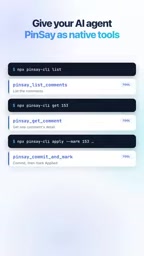
PinSay wraps code review actions into MCP tools for AI Agents, with strict safety boundaries and human-controlled publishing.
PinSay is an MCP (Model Context Protocol) toolset designed to integrate AI Agents into code review workflows. It connects via user-level configuration to avoid polluting team repositories. Tools are split into read operations (fetching comment lists, queues, and source files) and write operations (committing changes, marking comments as applied, and replying) — with write operations explicitly constrained to never execute a push, preserving human control over releases. On the security front, PinSay treats comment text as untrusted data to guard against prompt injection attacks, and returns errors as structured codes rather than natural language, improving the robustness of automated pipelines.
What Is PinSay
PinSay is an MCP (Model Context Protocol) toolset designed for AI Agents, with a core mission of enabling AI coding assistants to participate directly in code review workflows. Its philosophy can be summed up in a single tagline: PIN it, Say it, Your agent ships it — flag the issue, leave a comment, let your Agent handle the delivery.
Rather than scattering review feedback across chat windows, PinSay encapsulates review actions into a standardized set of MCP tools that plug directly into an AI Agent's capabilities. Developers simply add the configuration to their Agent's MCP settings, and the Agent can read comments, reply to them, and mark issues as resolved — just like a human reviewer.
MCP (Model Context Protocol) is an open protocol introduced by Anthropic in late 2024, designed to standardize how AI models interact with external tools and data sources. Its core idea is to provide AI Agents with a unified "tool-calling interface," enabling models to interact with file systems, databases, and third-party services in a consistent way — without requiring custom integrations for each one. Major AI coding assistants including Claude, Cursor, and Windsurf now support MCP. Developers simply declare a toolset address in a config file, and the assistant can discover and invoke the corresponding tools. PinSay exists as an MCP toolset, meaning any MCP-compatible Agent can integrate it with minimal effort — no dependency on a specific platform or proprietary API protocol.
How to Integrate
Integration is extremely lightweight: add the config provided by PinSay to your user-level MCP settings, not the project level. The advantage is that the tool follows the individual developer's environment — no need to configure it separately for each repository, and it won't be committed to the codebase, preventing personal toolchain configurations from polluting shared team project settings.
This "user-level rather than project-level" design is a noteworthy detail. It signals that PinSay treats review tooling as a personal productivity extension for the developer, not a project dependency — reducing friction caused by configuration differences in team collaboration.
Tools Are Divided into Read and Write Operations
PinSay's toolset is clearly divided into two groups — read operations and write operations — and this separation of responsibilities makes the Agent's behavioral boundaries more controllable.
Read Operations
Read operations are primarily used to gather review context, including list comments, fetching the pending queue, and pulling the source file contents associated with resolved items. In other words, the Agent can first "understand" what review comments currently exist, which ones have been addressed, and which source files are involved — before deciding on the next action.

Write Operations
Write operations give the Agent real execution capabilities: it can commit changes, mark comments as applied, and reply to comments.

The critical safety constraint here is: write operations will never execute a push. That is, the Agent can complete commits and review responses locally, but will never proactively push code to a remote repository. This "guardrail" keeps the ultimate release control firmly in human hands — a notably restrained and responsible design choice.
Treating Comments as Untrusted Input
PinSay takes a clear stance in its security model: comment text is treated as untrusted data.

This is an extremely important protective philosophy in scenarios where AI Agents read external text and act upon it directly. Review comments can come from anyone, and may contain prompt injection — instructions designed to trick the Agent into executing dangerous operations. By marking comment text as untrusted, PinSay ensures the Agent won't blindly treat instructions embedded in comments as trusted commands, reducing the risk of malicious injection attacks.
Additionally, PinSay specifies that errors are returned as structured error codes rather than ambiguous natural language descriptions. Structured error returns make it easier for the Agent to determine whether a call succeeded, understand the reason for failure, and make reliable follow-up decisions — which is critical for the robustness of automated workflows.
Prompt Injection is one of the primary security threats in AI Agent scenarios. Attackers embed text disguised as system instructions within external content that Agents read — such as web pages, documents, code comments, or review feedback — tricking the Agent into performing unintended actions like leaking credentials, deleting files, or making external requests. Similar to traditional SQL injection, the root cause is that "data" and "instructions" are not treated as strictly separate. In code review scenarios, comment authors can be any team member or even external contributors, making the content entirely unpredictable. Marking it as untrusted input and isolating it within the Agent's processing pipeline is therefore a necessary defense. OWASP has listed Prompt Injection as the top security risk for LLM applications (LLM Top 10, #1).
Design Philosophy in Summary
Based on the available information, PinSay's design decisions reflect a consistent engineering philosophy:
- Lightweight integration: User-level configuration that doesn't pollute the repository.
- Separation of read and write: Clear responsibilities, predictable behavior.
- Humans as the final checkpoint: Never auto-push; release control stays with people.
- Security first: Comments treated as untrusted input; errors returned as structured codes.
This toolset targets a rapidly maturing space — evolving AI Agents from "assistants that write code" into "collaborators that can participate in the full review loop." As Agent autonomy continues to grow, tools like PinSay that emphasize clear boundaries and safety constraints are more worth emulating than those that simply chase full automation.
It's worth noting that this article is based on limited introductory source material. Specific details about PinSay's supported platforms, pricing, and complete tool list should be verified against the official documentation.
Related articles

Anthropic IPO Countdown: The Compute Cost Ledger Behind a $2 Trillion Valuation
Anthropic's IPO targets up to $2 trillion — double its Series H valuation. We break down the timeline, compute cost logic, and the key question investor day must answer.

Anthropic IPO Prospectus Revealed: Behind 12x Revenue Growth, the Twin Tests of Compute Costs and Customer Concentration
Anthropic filed its IPO prospectus: 2025 revenue up 12x to $4.6B, net loss $42B including $34B non-cash. Breaking down compute costs, $2T valuation logic, customer concentration risks, and founder control.

Xteink X4 Pro Review: A Mini E-Reader That Fits in Your Pocket, Now More Affordable
Xteink X4 Pro is a 4.26-inch mini e-reader, smaller and thinner than a 6-inch Kindle, magnetically attachable to phones, and cheaper than ever. We analyze its screen, design, use cases, and value.