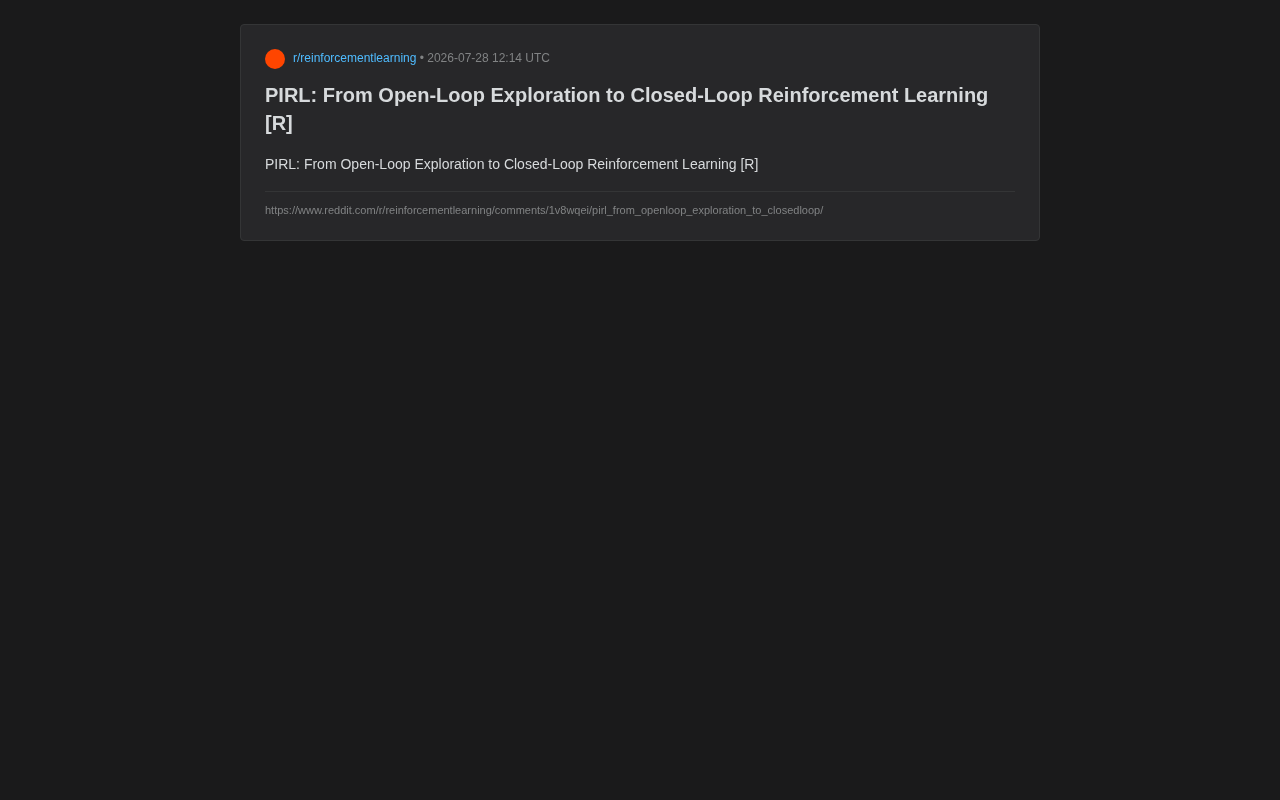
PIRL Framework Explained: A Smooth Transition from Open-Loop Exploration to Closed-Loop Reinforcement Learning

PIRL bridges open-loop exploration and closed-loop RL through a smooth annealing-style transition mechanism.
PIRL is a reinforcement learning framework that addresses the exploration-exploitation dilemma by designing a smooth transition from open-loop exploration to closed-loop reinforcement learning. In early training, the agent explores broadly without relying on reward feedback; as understanding grows, it gradually shifts to reward-driven closed-loop optimization. This paradigm-level scheduling improves sample efficiency and aligns with modern RL trends like offline RL and model-based methods.
Introduction: The Exploration Dilemma in Reinforcement Learning
Reinforcement Learning (RL) has achieved remarkable progress in recent years across domains such as gaming, robotic control, and large language model alignment. However, one of its core challenges has never been fully resolved—Exploration. How an agent can efficiently discover valuable behaviors in vast state spaces remains a critical bottleneck constraining the efficiency and generalization capability of RL algorithms.
Reinforcement learning is one of the three major paradigms in machine learning (alongside supervised learning and unsupervised learning). Its core idea originates from operant conditioning theory in behavioral psychology—shaping behavior through reward and punishment signals. Mathematically, RL is typically formalized as a Markov Decision Process (MDP), consisting of a state space S, action space A, transition probability P, reward function R, and discount factor γ. The agent's objective is to learn a policy π that maximizes the expected cumulative discounted reward. In recent years, Deep Reinforcement Learning (Deep RL) has introduced deep neural networks as function approximators into the RL framework, enabling it to handle high-dimensional continuous state spaces and giving rise to a series of milestone algorithms such as DQN, PPO, and SAC. It is precisely the success of these algorithms in practical applications that has made the bottleneck effect of the exploration problem even more pronounced.
The PIRL framework, which recently sparked discussion on Reddit's machine learning research board, has a very clear core proposition: how to transition from open-loop exploration to closed-loop reinforcement learning. This proposition touches on a fundamental trade-off in RL algorithm design.
Open-Loop vs. Closed-Loop: The Essential Differences Between Two Exploration Paradigms
Definition and Characteristics of Open-Loop Exploration
Open-loop exploration refers to an agent pre-planning or randomly generating a sequence of actions for exploration without relying on real-time environmental feedback. The advantage of this approach lies in the diversity and coverage of exploration—the agent can boldly try various possible behavioral paths without being "hijacked" by immediate reward signals, avoiding premature convergence to local optima.
Open-loop exploration is commonly found in curiosity-driven and intrinsic motivation methods. Representative works in curiosity-driven exploration include ICM (Intrinsic Curiosity Module) proposed by Pathak et al. in 2017, which uses prediction errors as intrinsic reward signals to motivate agents to explore unknown regions; and the RND (Random Network Distillation) method, which uses the prediction uncertainty of random networks to measure state novelty. Intrinsic motivation theory originates from Deci and Ryan's Self-Determination Theory in psychology, and has been concretized in RL as various mathematical forms including information gain, state counting, and prediction error. The common characteristic of these methods is that they do not rely on external task rewards to drive exploration, thus naturally possessing open-loop exploration features—they focus on covering the state space itself rather than immediate task returns.
The problems with open-loop exploration are also apparent: due to the lack of real-time response to environmental states, the exploration process is often inefficient, with many attempts being ineffective or even harmful, especially in dynamic or high-risk environments.
The Working Mechanism of Closed-Loop Reinforcement Learning
Closed-loop reinforcement learning is the core working mode of classical RL: the agent selects actions in real-time based on the current state, the environment returns rewards and new states, and the agent continuously updates its policy accordingly. This "perception—decision—feedback" loop ensures convergence and stability of the policy, but is also prone to problems such as reward sparsity and insufficient exploration.
In simple terms, open-loop emphasizes "casting a wide net" style exploration, while closed-loop emphasizes "intensive cultivation" style exploitation. Each has its strengths and weaknesses, and how to bridge the gap between them is precisely the core problem PIRL aims to solve.
PIRL's Core Approach: A Smooth Transition Between Exploration and Exploitation
The methodological value of PIRL lies in the fact that it does not treat open-loop exploration and closed-loop learning as two opposing phases. Instead, it designs a mechanism for smooth transition from open-loop to closed-loop. The intuition behind this is:
- In the early stages of training, the agent knows almost nothing about the environment. At this point, open-loop exploration should dominate, maximizing coverage of the state space and accumulating diverse experience data;
- As training progresses, the agent gradually builds an understanding of the environment dynamics. At this point, the weight of closed-loop feedback should be gradually increased, allowing real-time reward signals to guide the policy toward optimality;
- Ultimately, in the later stages, training transitions to fully closed-loop reinforcement learning, focusing on policy refinement and convergence.
This "annealing-style" transition strategy is conceptually analogous to learning rate scheduling and epsilon-decay in deep learning. Learning Rate Scheduling is a standard technique in deep learning training, with common strategies including Cosine Annealing, Warmup-Decay, and Cyclic LR. The core idea is to use a larger learning rate in the early stages to promote rapid convergence to a reasonable region, then reduce the learning rate for fine-tuning later. Simulated Annealing originates from the physical process of metal annealing in metallurgy, gradually lowering a "temperature" parameter to transition the optimization process from global random search to local refinement. PIRL applies a similar progressive philosophy to the scheduling of the exploration paradigm itself—essentially implementing the "coarse-to-fine" optimization philosophy at a higher level of abstraction. It is not merely a hyperparameter adjustment, but elevates it to the level of exploration paradigm scheduling.
Why PIRL Deserves Attention
Effectively Mitigating the Exploration-Exploitation Dilemma
The trade-off between Exploration and Exploitation is a classic challenge in reinforcement learning. The most classic formalization of this dilemma is the Multi-Armed Bandit problem, for which comprehensive theoretical analysis exists within this framework. The UCB (Upper Confidence Bound) algorithm achieves a near-theoretically-optimal regret bound by following the "optimism in the face of uncertainty" principle; Thompson Sampling naturally balances the two by maintaining posterior distributions. However, in the full RL setting (with state transitions), theoretically optimal exploration requires exponential computational complexity, so practice typically employs heuristic methods such as ε-greedy, Boltzmann exploration, posterior sampling, or count-based reward bonuses.
Traditional methods often rely on fixed exploration strategies or simple decay mechanisms, making it difficult to achieve ideal balance in complex tasks. By introducing paradigm-level dynamic scheduling, PIRL elevates the exploration-exploitation balance from the action selection level to the overall training paradigm scheduling level, providing a more structural solution to this classic problem.
Significantly Improving Sample Efficiency
The diverse data accumulated during the open-loop exploration phase can provide high-quality initialization for subsequent closed-loop learning, potentially reducing the number of samples required for convergence. This advantage is particularly valuable in scenarios with high sample costs, such as real-world robot training and autonomous driving simulation. Each interaction with the real environment may mean seconds to minutes of physical time consumption, equipment wear risks, and even safety hazards, making any method that can reduce the necessary number of interactions extremely valuable from an engineering perspective.
Highly Aligned with Modern Reinforcement Learning Research Trends
Current RL research hotspots are gradually shifting from purely online learning toward Offline RL, Model-based RL, and explicit modeling of exploration mechanisms. Offline RL refers to learning policies entirely from pre-collected static datasets without additional interaction with the environment. Representative algorithms include CQL (Conservative Q-Learning), IQL (Implicit Q-Learning), and Decision Transformer. Its core challenge is the distribution shift problem—the learned policy may visit state-action pairs not covered by the training data, leading to severe bias in value function estimates. Model-based RL learns an approximate model of the environment dynamics (i.e., the transition function and reward function) and optimizes the policy on imagined trajectories, with representative methods including the Dreamer series and MBPO.
Both directions reflect the RL community's pursuit of sample efficiency. PIRL's approach of transitioning from open-loop to closed-loop sits precisely at the intersection of these trends—data accumulated during the open-loop exploration phase can naturally be combined with offline RL methods, and the progressive understanding of environment dynamics is complementary to the model learning process, offering strong extensibility.
Limitations and Open Problems to Be Resolved
As a piece of research still under discussion, PIRL also faces several issues requiring further validation:
Determining the transition timing is the primary challenge. When to switch from open-loop to closed-loop and at what rate to transition often requires task-specific hyperparameter tuning, which may undermine the method's generality. Ideally, the transition schedule should be adaptive—automatically deciding which exploration paradigm the current training phase should emphasize based on some metric (such as state space coverage rate, model prediction accuracy, or policy improvement speed).
The lack of theoretical guarantees is also noteworthy. Whether the smooth transition from open-loop to closed-loop can always guarantee policy convergence, and whether it outperforms pure closed-loop methods in all types of environments, still requires more rigorous theoretical analysis and large-scale experimental support. Particularly in non-stationary environments or adversarial environments, data accumulated during the open-loop exploration phase may quickly become outdated, leading to negative transfer effects.
Computational overhead should not be overlooked either. Maintaining the coordinated operation of open-loop exploration mechanisms and closed-loop learning mechanisms may introduce additional computational and engineering complexity, requiring careful consideration in resource-constrained scenarios.
Conclusion
The research direction represented by PIRL—"from open-loop exploration to closed-loop reinforcement learning"—captures a long-standing and highly valuable problem in reinforcement learning. It reminds us that exploration and exploitation need not be an either-or choice, but can be organically unified through carefully designed transition mechanisms.
For researchers and engineers following the frontiers of reinforcement learning, PIRL not only provides a specific algorithmic framework but, more importantly, offers a new perspective on the exploration problem. As more experimental data and theoretical analyses are supplemented, this approach has the potential to deliver substantive breakthroughs in sample efficiency and generalization capability.
Related articles
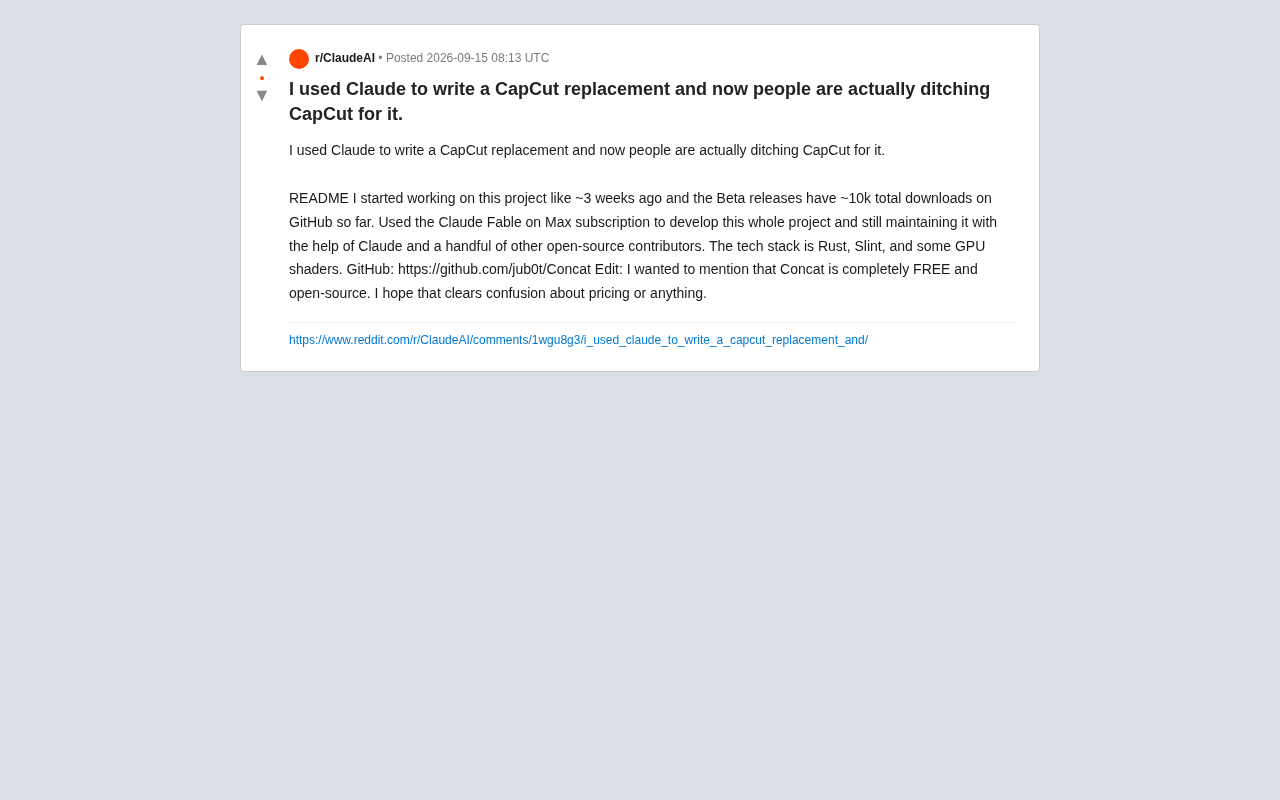
Building Open-Source Video Editor Concat with Claude: A Free Alternative to CapCut
A developer used Claude to build Concat, an open-source CapCut alternative, in just three weeks. With nearly 10K downloads, it's a striking example of AI-assisted solo development.
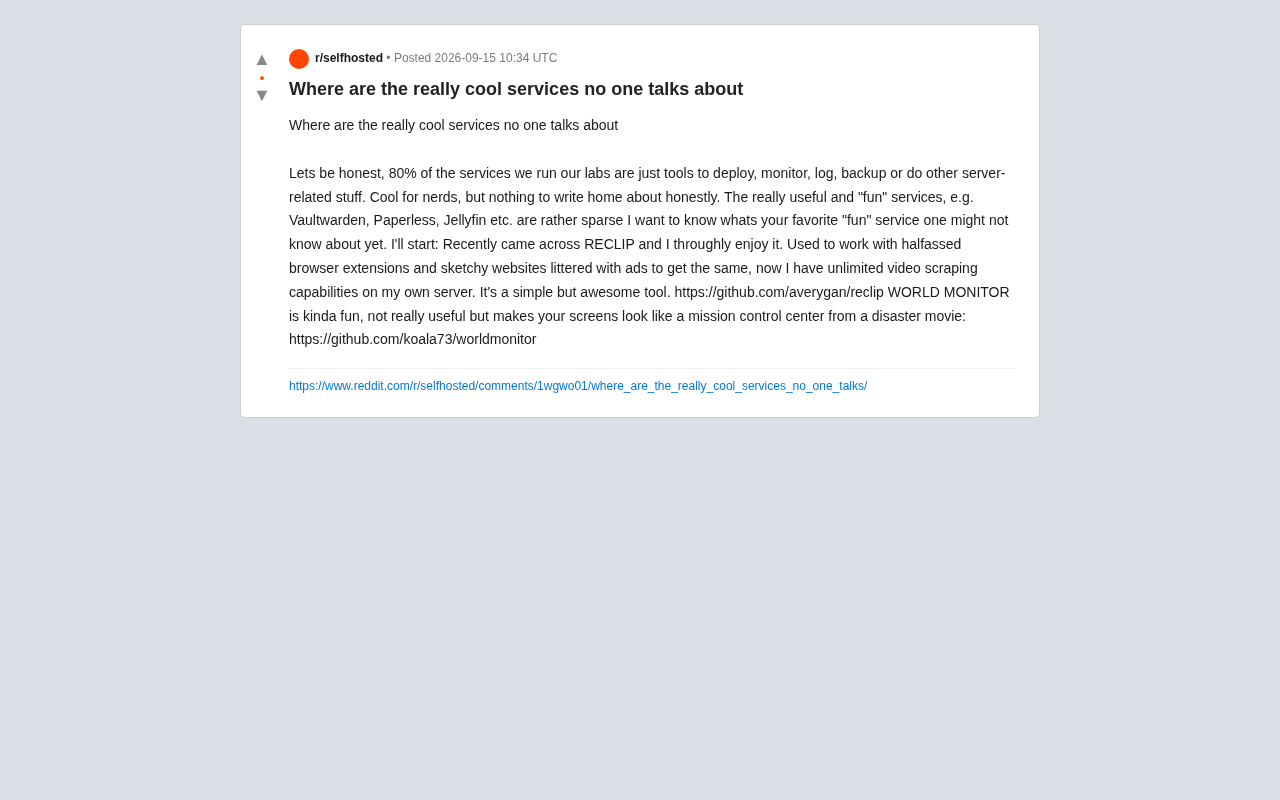
The Overlooked Gems of Self-Hosting: Fun and Useful Services Nobody Talks About
From a Reddit thread, we explore overlooked self-hosted services — including video scraper RECLIP and data viz project WORLD MONITOR — and why fun services are so rare.
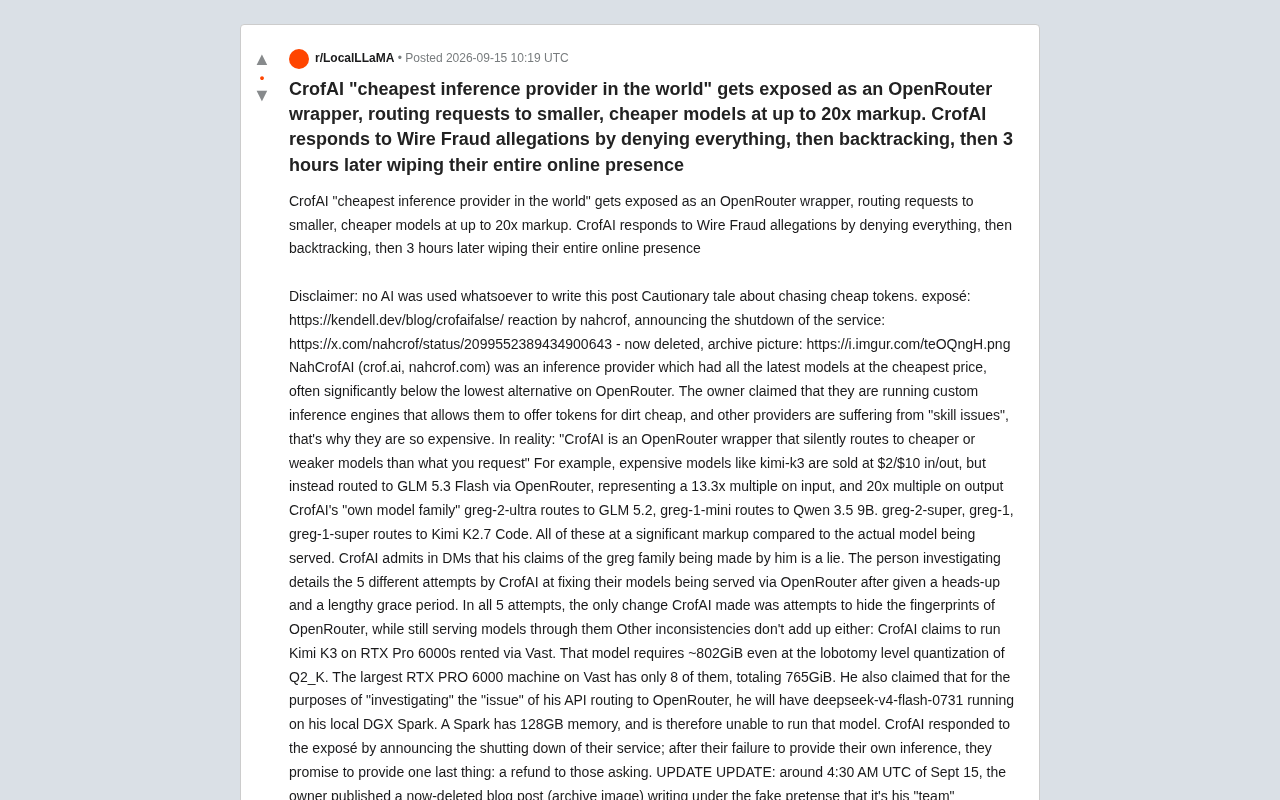
CrofAI Fraud Exposed: 'World's Cheapest AI Inference' Turns Out to Be an OpenRouter Wrapper Scam
CrofAI claimed to offer the world's cheapest AI inference, but was exposed as an OpenRouter wrapper silently rerouting requests to cheap models at up to 20x markups.