Plagiarism Accusations in AI: The Trust Crisis Behind a Single Tweet

A tweet calling on Anthropic to address a plagiarism accusation exposes AI's attribution and governance gaps.
A tweet expressing frustration that someone named Levent continues to push a plagiarism accusation has gone viral, with the poster publicly urging Anthropic insiders to speak up. The article examines why plagiarism is such a damaging charge in AI — touching on academic integrity, open-source license compliance, and commercial reputation — and why "independent discovery" makes such cases hard to resolve. The original tweet provides little context about Levent's identity, the specific accusation, or Anthropic's role. At a deeper level, the incident highlights that the AI industry lacks mature dispute arbitration mechanisms, leaving conflicts to play out as social media battles rather than being resolved through authoritative channels.
Background
A tweet from the tech world has recently attracted attention. The poster expressed disappointment that someone named Levent continues to double down on a plagiarism accusation, and publicly called on friends inside Anthropic to speak up internally to clarify the truth. The original post read: "Sad to see Levent double down on the plagiarism accusation. I wish my Anthropic friends would speak up about this internally. By now, the truth should be clear."
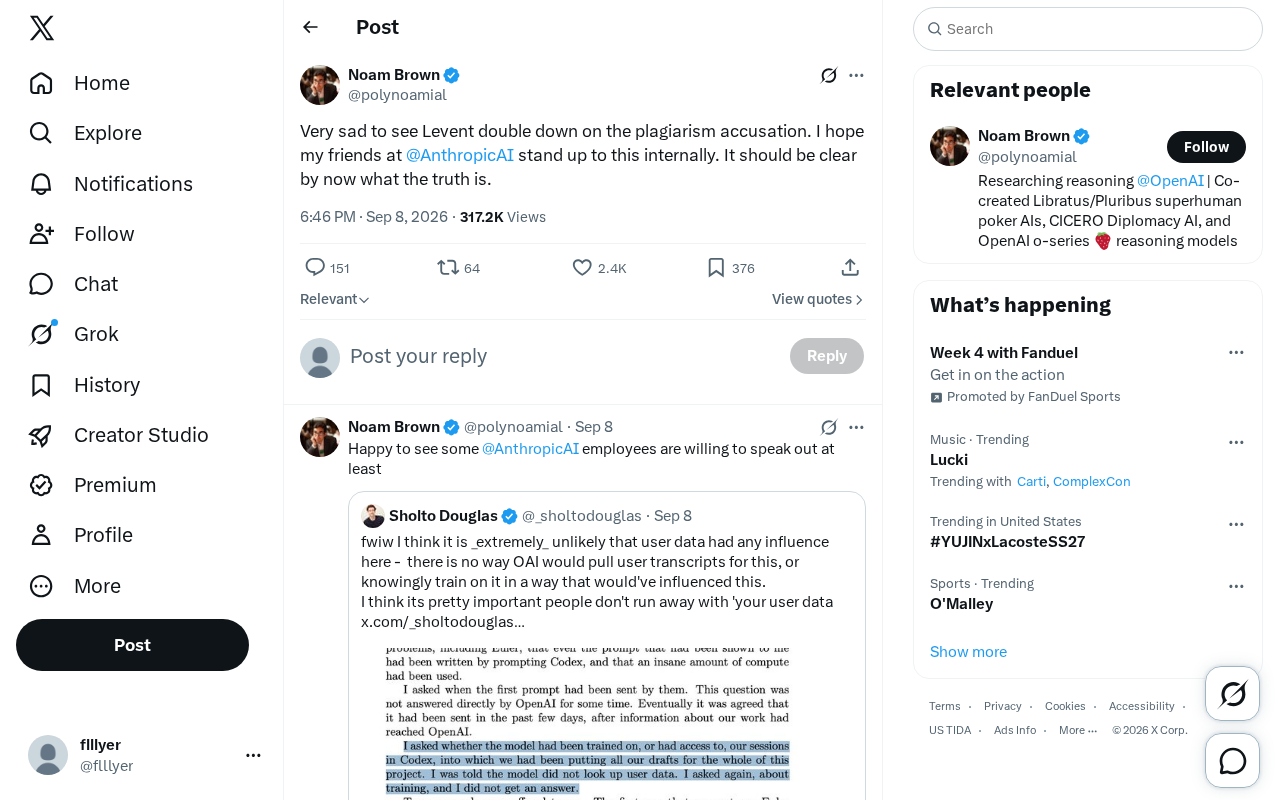
This brief statement reflects the increasingly frequent disputes and divisions emerging within the AI industry. As competition in the large language model space intensifies, debates over the origins of technology, code attribution, and credit for research findings have become ever more common.
Why Plagiarism Accusations Are So Sensitive
In AI research and engineering, "plagiarism" is an accusation that carries enormous weight. It touches not only on the academic integrity of individuals and teams, but can also implicate trade secrets, open-source license compliance, and corporate reputation.
When a researcher or engineer is publicly accused of copying someone else's work, the situation tends to rapidly escalate into a multi-party public controversy. The phrase "double down" in the original tweet suggests this isn't a one-time misunderstanding — rather, the accuser is maintaining their position in the face of pushback, causing the conflict to intensify further.
The poster's call for Anthropic to "speak up internally" implies the company may be connected to the dispute in some way — whether as a directly involved party, an employer, or a neutral authoritative voice.
The complexity of plagiarism disputes in the AI field also stems from the deep entanglement of open-source ecosystems and commercial interests. Many large model companies draw heavily from open-source community contributions in their training data, foundational architecture, and even prompt engineering. Open-source licenses (such as MIT, Apache 2.0, and GPL) impose varying restrictions on commercial use, and being accused of violating license terms can trigger both legal and ethical accountability simultaneously. At the same time, "independent discovery" is quite common in AI research — different teams may reach similar conclusions within similar timeframes, making it especially difficult to distinguish between plagiarism and coincidence. For all these reasons, once such accusations go public, they rarely resolve with a simple yes or no, and typically require multi-dimensional evidence such as code commit histories, paper timestamps, and internal communications to reconstruct the truth.
The Limitations of the Source Material
It's worth being transparent: this tweet itself contains very limited information. It does not clarify:
- Who Levent is, or their background and identity
- What specifically was allegedly plagiarized (a paper, code, or a product)
- What role Anthropic plays in all of this
- What the specific basis for the so-called "truth" actually is
Without more context, it's difficult for outside observers to make a complete judgment about the situation. This also serves as a reminder that fragmented statements on social media are often just the tip of the iceberg of complex events — drawing firm conclusions from a single tweet is ill-advised.
Reflections on Trust Mechanisms in the Industry
Setting aside the specifics of this case, such disputes reflect the governance challenges the AI industry faces amid its rapid growth. When the pace of technological iteration far outstrips the establishment of norms, debates over attribution, citation standards, and competitive boundaries become almost inevitable.
Healthy resolution typically relies on transparent fact-checking, independent third-party review, and public statements from relevant institutions — not simply on social media call-outs and taking sides. The poster's appeal for Anthropic to "speak up internally" is essentially a plea for a more authoritative and credible channel for adjudication.
For those who follow the AI industry, events like this are worth tracking — but with caution. Before official or authoritative disclosures are made, any conclusion risks being one-sided.
The AI industry has yet to develop a mature dispute arbitration mechanism comparable to academic peer review or open-source code auditing. Academia typically relies on journal or conference investigation committees to handle misconduct allegations, and open-source communities can trace code origins through Git commit histories. But the internal R&D processes of commercial AI companies are often opaque — lacking both public code records and neutral industry arbitrators. Some leading institutions (such as the Partnership on AI) have attempted to promote industry self-regulation, but their enforcement capacity is limited. This institutional gap means that disputing parties ultimately resort to social media warfare, which intensifies the emotional and irrational dimensions of the conflict and makes it even harder for the truth to surface.
Related articles

"Black October": Did AI Uncover 3% of All Critical Vulnerabilities Ever?
A Reddit post claims 3% of all critical software vulnerabilities ever were found in the past month, dubbed 'Black October.' We break down the statistical issues, how AI-assisted code auditing accelerates discovery, and how developers should respond.

Microsoft Project Gecko: Using AI to Bridge Language Gaps for African Farmers
Microsoft's Project Gecko launches PharmaChat, letting African farmers ask questions in their native language and get precise video clips and farming book chapters via AI. The project also releases three interactive manuals to advance inclusive AI.

Musk's Space Dominance: How Starlink Throttling Undermines Ukraine's Defense
SpaceX's Starshield throttling disabled Ukraine's high-speed interceptor drones, exposing how Musk's private control over low Earth orbit communications affects battlefield dynamics and national security, and highlighting the risks of commercial space militarization and space governance dilemmas.