PlayCraft: Reshaping Game Design Mastery Through AI Agent Playtesting

PlayCraft lets vision agents playtest and maker agents modify games to automatically optimize the sense of mastery.
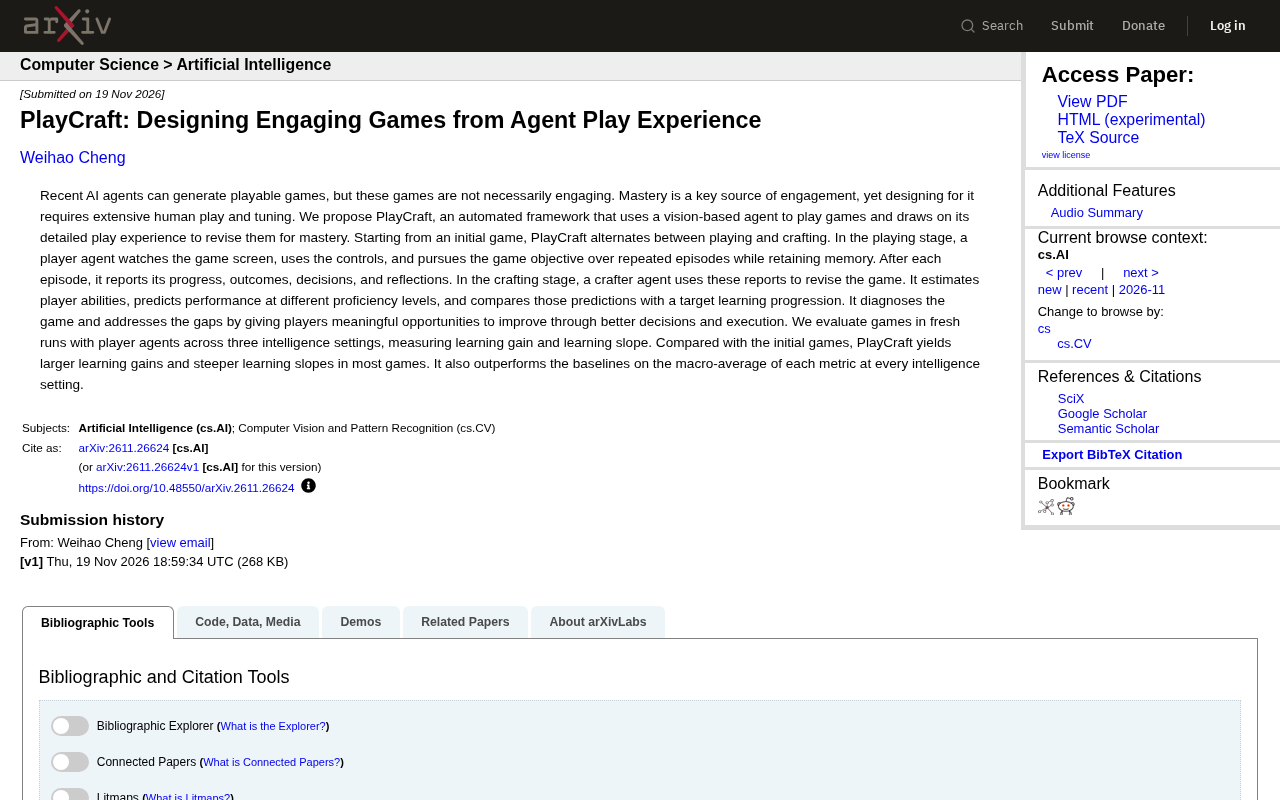
The article introduces the PlayCraft framework proposed by rss, aimed at solving the problem that AI-generated games are "playable but not fun." Starting from an initial game, the framework alternates between two phases: "play" and "make." A vision-driven player agent observes screens, operates controls, and retains memory across multiple rounds, reporting progress, decisions, and reflections after each round; the maker agent reads the reports, estimates player ability, predicts performance under different proficiency levels, compares them with the target learning progression to diagnose design gaps, and modifies the game by providing more meaningful opportunities for improvement. Experiments evaluate learning gain and learning slope under three intelligence levels; PlayCraft outperforms baselines in most games and also achieves better macro-averages. The article argues that its value lies in turning mastery into measurable, iterable design signals, but the gap between agent experience and real players still needs validation.
Why Do Games Need a "Sense of Mastery"?
Mastery is one of the core drivers of player engagement. A well-designed game lets players feel their skills improving through repeated attempts and gradually face more challenging situations. But the original article points out that designing for mastery requires extensive human playtesting and tuning—this is both a cost bottleneck and the most easily overlooked step when AI automatically generates games.
PlayCraft's starting point is precisely to automate "playtest feedback": let a vision-driven player agent repeatedly play the game, then let a maker agent modify the game based on playtest reports, bringing the game closer to a target learning curve.
How PlayCraft Works: The Loop of Playing and Making
PlayCraft starts from an initial game and alternates between two phases.
Play: Memory-Driven Visual Playtesting
In the play phase, the player agent observes game screens, operates controls, pursues game goals, and retains memory across multiple rounds. After each round, it reports its progress, results, decisions, and reflections. This "play while remembering" design gives subsequent modifications a basis rather than adjusting by feel.
Vision-driven agents refer to AI players that do not rely on internal game state (such as memory values or coordinates) but perceive the environment solely from screen pixels and output key operations. Such agents typically take screenshots or frame sequences as input, extract features through convolutional networks or vision transformers, and map them to actions, thus being closer to the information conditions of human players. Compared with "omniscient" agents that read game APIs, vision agents face challenges such as partial observability, information delay, and pixel noise, and their playtest performance better reflects the perceptual limitations of real players. This is also why PlayCraft chooses vision agents: only when perceptual conditions are similar do playtest reports have reference value for "human difficulty experience."
Make: Diagnosing Design Gaps Based on Reports
In the make phase, the maker agent reads playtest reports, estimates player ability, predicts performance under different proficiency levels, and compares these predictions with the target learning progression. Based on this, it diagnoses game design problems and closes the gap by providing players with more meaningful opportunities for improvement—allowing players to improve through better decisions and operations.
Target learning progression is the ideal ability growth trajectory set by the designer, specifying what proficiency players should reach at which level and on which attempt. The maker agent compares predicted performance with this trajectory point by point, and the difference is the "design gap": if predicted performance is higher than the target, the game is too easy and lacks challenge; if lower, the difficulty jumps too quickly and players lack practice opportunities. Modifications based on this usually include adjusting enemy strength, level layout, and the pacing of introducing items and mechanics, so that each step of challenge corresponds to a new skill players can learn, rather than simply increasing numerical difficulty.
Effect Validation: Learning Gain and Learning Slope
The research team used player agents to test new games under three intelligence level settings, measuring two indicators: learning gain and learning slope. Compared with the initial games, PlayCraft brought greater learning gains and steeper learning slopes in most games; under each intelligence setting, its macro-average for both indicators was better than baseline methods.
This shows that the automated "playtest—modify" loop can indeed improve the learnability of games, and the effect is not limited to players at a single intelligence level.
Learning gain usually refers to the extent to which a player agent's performance (such as score, completion rate, or level reached) improves relative to the initial level after repeated playtests, reflecting how much the game "can teach the player." Learning slope describes the rate at which this improvement grows with the number of rounds, that is, the steepness of the learning curve, reflecting whether game feedback is timely and whether progress is smooth. Combining the two can distinguish two types of design: "high ceiling but slow progress" and "quick to pick up but low ceiling." Macro-average means first calculating the indicator separately for each intelligence level and then averaging, which prevents players at one level from dominating the overall conclusion and is used to test whether improvements are generally effective for players of different abilities.
Implications for AI Game Generation
Current AI game generation capabilities are improving rapidly, but there is still a gap between "playable" and "engaging." PlayCraft's value lies in breaking down the subjective experience of mastery into measurable, iterable design goals: estimating player ability through agent playtest data, then using that in turn to guide level and mechanic adjustments.
The framework's limitations are also worth noting: the playtest experience of vision agents still differs from that of real human players, and whether learning curve indicators can fully represent human players' sense of engagement still needs further validation. But as an exploration of automated game design, it offers a reusable approach—letting AI not only generate content but also participate in refining the experience.
Related articles
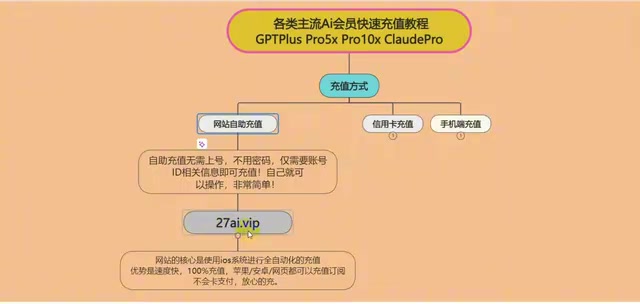
ChatGPT Plus Top-Up in China: Third-Party Website Recharge That Supports WeChat Pay and Alipay, No Overseas Card Needed
A Bilibili creator tests ChatGPT Plus top-up methods in China: comparing third-party website recharge, direct credit card, and mobile in-app purchase, with a full walkthrough of password-free WeChat/Alipay recharge and an analysis of Session credential and payment risk-control risks.

6GB Delivers Opus-Level Performance: Bonsai 2.5 27B Hands-On Test
Prism ML releases Ternary Bonsai 2.5 27B: ternary quantization brings it to just 5.9GB, runnable on a single consumer GPU while retaining 262k context and vision. Hands-on agentic benchmarks approach full-precision Qwen 3.8 27B, exceeding 150 tokens/s on a 4090, with impressive frontend and dashboard results, though game development and long tasks remain weak spots.

System Exchange Spawns an Offbeat Journey to the West: Why This Comedy Series Works
A Bilibili comedy short series reimagines Journey to the West with a system-exchange premise, as the protagonist challenges Sun Wukong, Erlang Shen, and other classics.