Playing Against Frontier AI Models at the Game Table: A Multiplayer Social Gaming Platform in Action

A platform pitting players against frontier AI in Poker, Risk, and Diplomacy — via natural language conversation.
A new multiplayer gaming platform combines Poker, Risk, and Diplomacy with frontier large language models, letting players converse, negotiate, and even deceive AI opponents in natural language. The three games cover the full spectrum from incomplete-information probability play to pure social negotiation. Beyond entertainment, the platform serves as an open capability stress test: when large numbers of players actively probe AI's strategic weaknesses, the match data forms an evaluation environment that models can't simply "memorize in advance." Specific models used, pricing, and data practices have not yet been publicly disclosed.
When Poker and Diplomacy Meet Large Language Models
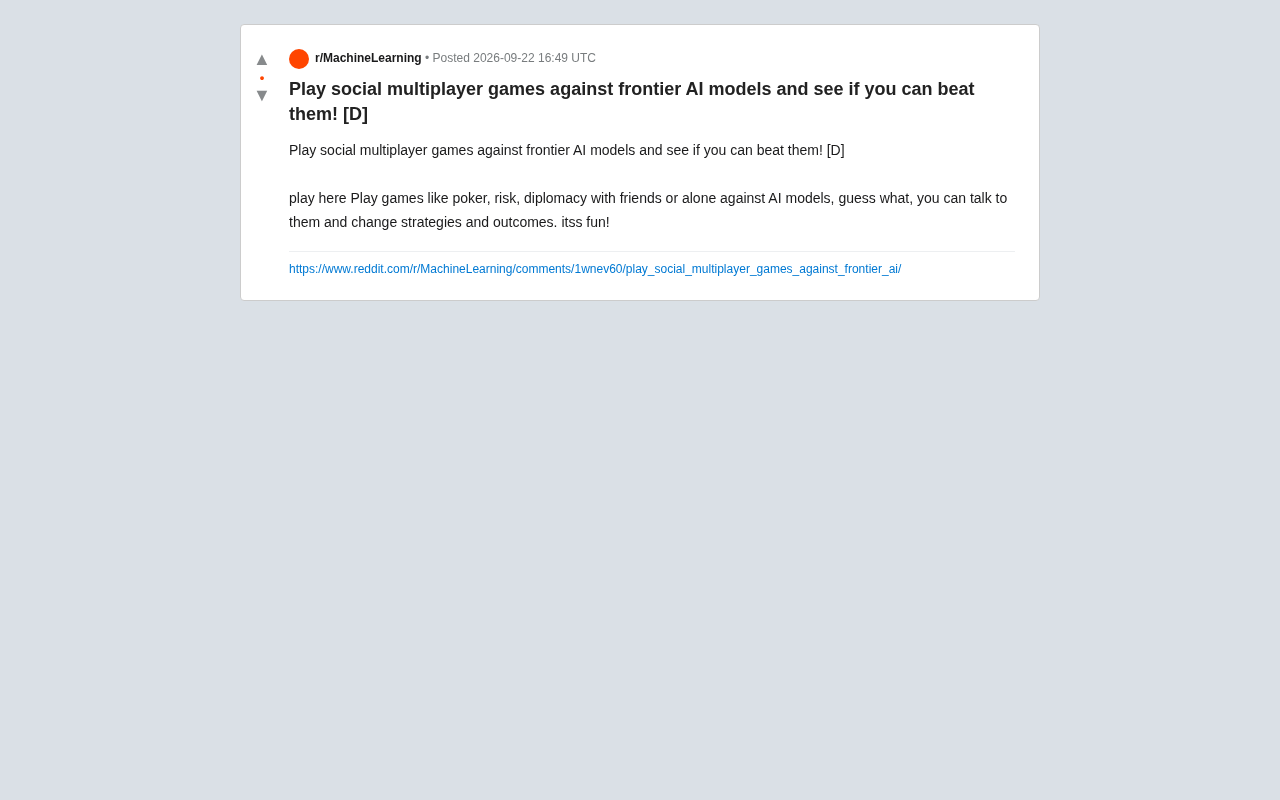
A new multiplayer social gaming platform is generating buzz in Reddit communities: players can team up with friends — or go head-to-head solo — against frontier AI models in classic strategy games like Poker, Risk, and Diplomacy.
The platform's core appeal isn't the complexity of the games themselves, but the fact that it puts today's most advanced large language models (frontier AI models) directly across the table from you. Instead of playing against NPCs running fixed scripts, you're facing an AI opponent capable of reasoning, negotiation, and strategic adaptation.
AI Opponents You Can Actually Talk To
The platform's most notable design choice is allowing players to communicate with AI in natural language. The original poster specifically highlighted: "You can talk to them and change strategies and outcomes."
This is especially significant in Diplomacy, a game that depends heavily on negotiation, alliance-building, and betrayal — and has long been considered an important benchmark for measuring AI social reasoning. Meta's CICERO previously reached human-level play in that game, demonstrating the potential of large models to persuade and negotiate in multi-party scenarios.
Bringing that capability to a consumer gaming platform means ordinary users can, for the first time, probe, mislead, or even ally with AI through conversation — and watch how it responds to human linguistic strategy. This kind of interaction is far more immersive than traditional button-based controls.
Why These Three Games?
Poker, Risk, and Diplomacy each represent distinct dimensions of strategic challenge:
- Poker: The classic incomplete-information game, testing probability calculation, betting strategy, and bluffing.
- Risk: A strategic board game involving resource allocation, territorial expansion, and long-term planning.
- Diplomacy: Nearly free of randomness — outcomes depend entirely on negotiation and trust management between players.
Together, these three games cover the full capability spectrum from numerical computation to social manipulation, making them an ideal proving ground for testing AI's all-around strategic performance.
From a game theory perspective, these three games correspond to different information structures and solution concepts. Poker is an incomplete-information game; academically, algorithms like CFR (Counterfactual Regret Minimization) have achieved near-Nash equilibrium strategies, and AI systems like Libratus and Pluribus have beaten professional players multiple times. Risk is a complete-information multi-player zero-sum game that is theoretically extremely difficult to solve, since coalition formation and dissolution create an exponential state space. Diplomacy is a multi-player non-zero-sum game with no random elements like dice — all outcomes are determined by simultaneously submitted player orders, making it theoretically the purest, yet also the hardest to formally model due to social variables. Combined, the three games form a capability gradient running from "probability calculation" to "semantic deception," giving a single platform multi-dimensional coverage as a benchmarking environment.
Dual Value: Entertainment and Capability Evaluation
From a player's perspective, this kind of platform delivers the direct experience of "can I beat the AI?" But viewed more broadly, it's actually an open crowdsourced testing environment for AI capability.
When thousands of players try to bluff AI at the poker table, or set up betrayals in diplomatic negotiations, the match data generated becomes a real-world stress test of frontier models' social and strategic abilities. Every time a player wins, they're exposing a gap in current models' game theory, psychological reasoning, or long-term planning.
For researchers, a gamified evaluation environment is closer to the real world than standardized benchmarks — it includes deception, coalition-building, and emotional manipulation that are difficult to measure with fixed question banks.
Traditional AI benchmarks (such as MMLU and HumanEval) rely on static datasets and carry the inherent flaw of "overfitting to the evaluation set" — models may have encountered similar questions during training, inflating their apparent performance. The advantage of gamified crowdtesting is that matches are highly random and adversarial: every human player is a dynamic "red team member" who will spontaneously attempt non-standardized strategies like verbal deception, false promises, and emotional pressure. This kind of data is difficult to pre-collect into training sets, making it a more authentic reflection of a model's robustness in out-of-distribution scenarios. Some AI safety researchers also view multi-party negotiation games as a natural testbed for observing whether models will actively produce deceptive outputs — with academic value no less than their entertainment appeal.
Things to Watch Out for Before You Try It
As a product still in community promotion, publicly available information remains limited. The original post did not disclose which specific models the platform uses under the hood, whether it charges fees, or how user data is handled.
For users who want to give it a try, a few questions are worth asking: Which tier of model does the AI opponent correspond to (this directly determines difficulty)? How are AI and human players mixed and matched in multiplayer matches? And will conversation content be used for future training?
Regardless, putting frontier AI at the game table and letting anyone challenge it firsthand is an intriguing way for the public to understand the real boundaries of AI capability — "testing through play" is becoming a genuinely interesting path forward.
Background
Meta's CICERO was released in 2022 as the first AI system to reach top human player performance in Diplomacy. It combined a language model with a strategic reasoning module, capable of generating persuasive diplomatic language while dynamically adjusting negotiation rhetoric in line with long-term game objectives. CICERO's emergence marked a key breakthrough for AI in scenarios combining "open-ended natural language" with "multi-party game theory" — the academic community had previously believed Diplomacy was too dependent on human social intuition to be conquered by AI. Notably, while CICERO performed excellently in the lab's controlled environment, it also exposed an inherent tension in large models between "strategic deception" and "credible commitment" — precisely the dimension most worth observing when ordinary players interact with such systems directly on a consumer platform.
Related articles

Amphibious Transforming Drone: Beyond 100x Power Savings, What Are the Real Needs?
Is the amphibious transforming drone just a gimmick? Starting from the 100x power difference of the M4 Morphobot, explore real application scenarios and thesis topic ideas, analyzing boundary conditions where pure drones and pure ground robots both fail.

Warhound Raises $200 Million: Genetically Engineered "War Dogs" Paired with Anduril Gear
Warhound raises $200M, backed by Ben Lamm and Palmer Luckey, to genetically engineer dogs for military and law enforcement use and equip them with Anduril gear. This article analyzes its technology direction, funding logic, and ethical controversy.

Claude API Comes to Google Cloud: IAM Integration and SDK Access Guide
Anthropic hosts the full Claude API on Google Cloud with IAM-controlled permissions and unified billing. This guide covers the Vertex AI and Anthropic-hosted entry points, IAM role configuration, and SDK access.