Plunger: A Lightweight Native API Tool for You and Your AI Agent
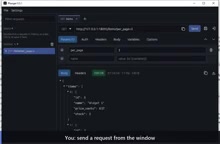
Plunger is an open-source Rust API tool for real-time observability of AI Agent MCP calls.
Plunger is a lightweight native API testing tool written in Rust and distributed via pip, designed to bring human operations and AI Agent MCP calls into a single unified interface. Its standout capability is real-time observability — every API request made by an Agent via MCP appears instantly, eliminating the black-box nature of Agent automation. For security, Plunger uses token hiding and a placeholder mechanism to ensure plaintext secrets are never persisted to disk. A CTRL-ENTER shortcut lets developers replay any Agent call instantly for human-in-the-loop debugging. As an open source project, it offers a focused engineering solution for transparent and secure Agent API interactions in the MCP ecosystem.
What Is Plunger
Plunger is a lightweight native API testing tool written in Rust, with a clear mission: to serve both the developer and the AI Agent they collaborate with. It's completely free and open source, installable with a single pip install plunger-cli command.
Compared to traditional API debugging tools like Postman or Insomnia, Plunger's key differentiator is that it brings human operations and AI Agent operations into the same unified view. You can manually send requests from the window while your AI Agent calls APIs via MCP (Model Context Protocol) — and both sets of actions are displayed in the same interface.
MCP (Model Context Protocol) is an open standard proposed and open-sourced by Anthropic in late 2024, designed to define a unified interface for interactions between AI large language models and external tools or data sources. Much like USB-C for hardware connectivity, MCP aims to solve the fragmentation problem of "every AI application having to build its own integration for every tool." Through MCP, AI Agents can access external resources like file systems, databases, and web APIs in a standardized way. Developers only need to implement an MCP Server once, and all compatible AI clients (such as Claude Desktop, Cursor, etc.) can use it directly. Plunger plays the role of an observability layer in this ecosystem — it exists as an MCP Server that proxies requests from the Agent to target APIs, capturing and displaying all call details without intruding on the Agent's own logic.
Real-Time Observability for AI Agent Calls
Plunger's most core capability is making every API call from an AI Agent visible and traceable. As the official demo puts it: "My AI agent calls the API over MCP, and every call it makes shows up here in real time."
This is especially valuable in today's environment where AI Agents are automating interactions with external services at scale. When an Agent autonomously calls various APIs, developers are often left in the dark — unaware of what requests were sent, what parameters were included, or what responses were received. Plunger exposes these calls as a live stream, essentially adding a transparent monitoring layer over the Agent's behavior.
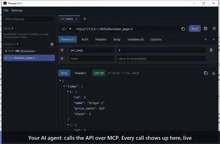
For debugging Agent workflows, investigating unexpected behavior, and understanding an Agent's decision chain, this kind of real-time observability is a genuine necessity. Developers no longer need to rely on logs or guesswork to reverse-engineer what an Agent did — they can see the complete call history directly in the interface.
Key Security: Token Hiding and Placeholder Mechanism
API calls inevitably involve authentication credentials, and Plunger has dedicated design choices for this concern. The demo highlights two key points: "The token it saved stays hidden" and "Placeholders stay, so the secret isn't saved."
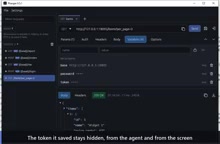
In other words, when an Agent or a developer uses a request containing a sensitive token, Plunger hides the real token and replaces it with a placeholder at the storage level. This means the request record itself never persists the plaintext secret to disk — making it convenient to replay calls while avoiding the risk of credential exposure.
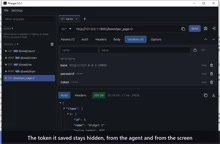
This placeholder mechanism is especially important for team collaboration and sharing recorded requests. You can freely save and share the structure and parameters of an API call without worrying about accidentally exposing production credentials. In AI Agent scenarios, it also reduces the probability of an Agent inadvertently leaking credentials during automated operations.
The placeholder mechanism isn't new to the API tooling space — Postman's "environment variables" and .env files follow a similar philosophy of separating real credentials from request structures. Plunger's distinction is extending this mechanism to AI Agent automation scenarios. In traditional tools, developers fill in variables themselves and can actively control when substitutions occur. In agentic scenarios, however, credentials may be retrieved from context by the Agent and embedded directly into requests, removing the developer's opportunity for manual review. Plunger intercepts and replaces sensitive values at the recording layer, acting as an automatic redaction firewall between the Agent and persistent storage. Even if the Agent behaves unexpectedly, the call history itself won't become a source of credential leakage.
Human-Agent Collaboration: Replay Any Agent Call in One Keystroke
Another practical feature of Plunger is enabling humans to directly take over or verify Agent operations. With CTRL-ENTER, you can personally re-run any call that your Agent made.
This design bridges "observability" and "action." When you spot an Agent call in the live view whose result doesn't match expectations, you don't need to manually reconstruct the request — you can replay it immediately. For debugging, regression validation, and workflows where a human needs to intervene and correct Agent behavior, this significantly improves efficiency. At its core, Plunger treats the AI Agent as a "collaborator" rather than a fully autonomous black box beyond human control.
Technical Choices and Open Source Value
Plunger's choice of Rust as its implementation language means it has inherent advantages in performance, memory safety, and cross-platform native experience — a claim backed by its positioning as a "native API tool." It's not yet another Electron-wrapped application, but rather a pursuit of lightweight, native performance.
As an open source project, Plunger's value also lies in providing a visible, auditable tool reference for the MCP ecosystem. As more and more development workflows incorporate AI Agents, making those Agents' external calls transparent, secure, and controllable is becoming an increasingly important engineering challenge. Plunger offers its own focused answer to that challenge through a small, purpose-built tool.
Note: The information above is sourced from Plunger's official demo video. For authoritative feature details, refer to the project's actual documentation. The demo material is a brief product preview, and some capability boundaries still need to be validated through real-world usage.
It's worth noting that while Plunger is distributed via pip install, it's written in Rust under the hood — a combination typically achieved using PyO3 or by bundling pre-compiled binaries into Python wheels, so users don't need to configure a Rust toolchain to install it. This distribution strategy balances two goals: on one hand, developers in the Python ecosystem (especially those using AI frameworks like LangChain or AutoGen) can install it with a familiar pip command; on the other hand, the native Rust binary ensures runtime performance and memory safety, avoiding the hundreds of megabytes of resource consumption typical of Electron-based tools. For a CLI/GUI hybrid tool positioned as "lightweight and native," this technical combination is a pragmatic and well-reasoned choice.
Related articles

Anthropic IPO Countdown: The Compute Cost Ledger Behind a $2 Trillion Valuation
Anthropic's IPO targets up to $2 trillion — double its Series H valuation. We break down the timeline, compute cost logic, and the key question investor day must answer.

Anthropic IPO Prospectus Revealed: Behind 12x Revenue Growth, the Twin Tests of Compute Costs and Customer Concentration
Anthropic filed its IPO prospectus: 2025 revenue up 12x to $4.6B, net loss $42B including $34B non-cash. Breaking down compute costs, $2T valuation logic, customer concentration risks, and founder control.

Xteink X4 Pro Review: A Mini E-Reader That Fits in Your Pocket, Now More Affordable
Xteink X4 Pro is a 4.26-inch mini e-reader, smaller and thinner than a 6-inch Kindle, magnetically attachable to phones, and cheaper than ever. We analyze its screen, design, use cases, and value.