Plurai Simulation: Making AI Agents Stronger by Running Them in a Simulated World
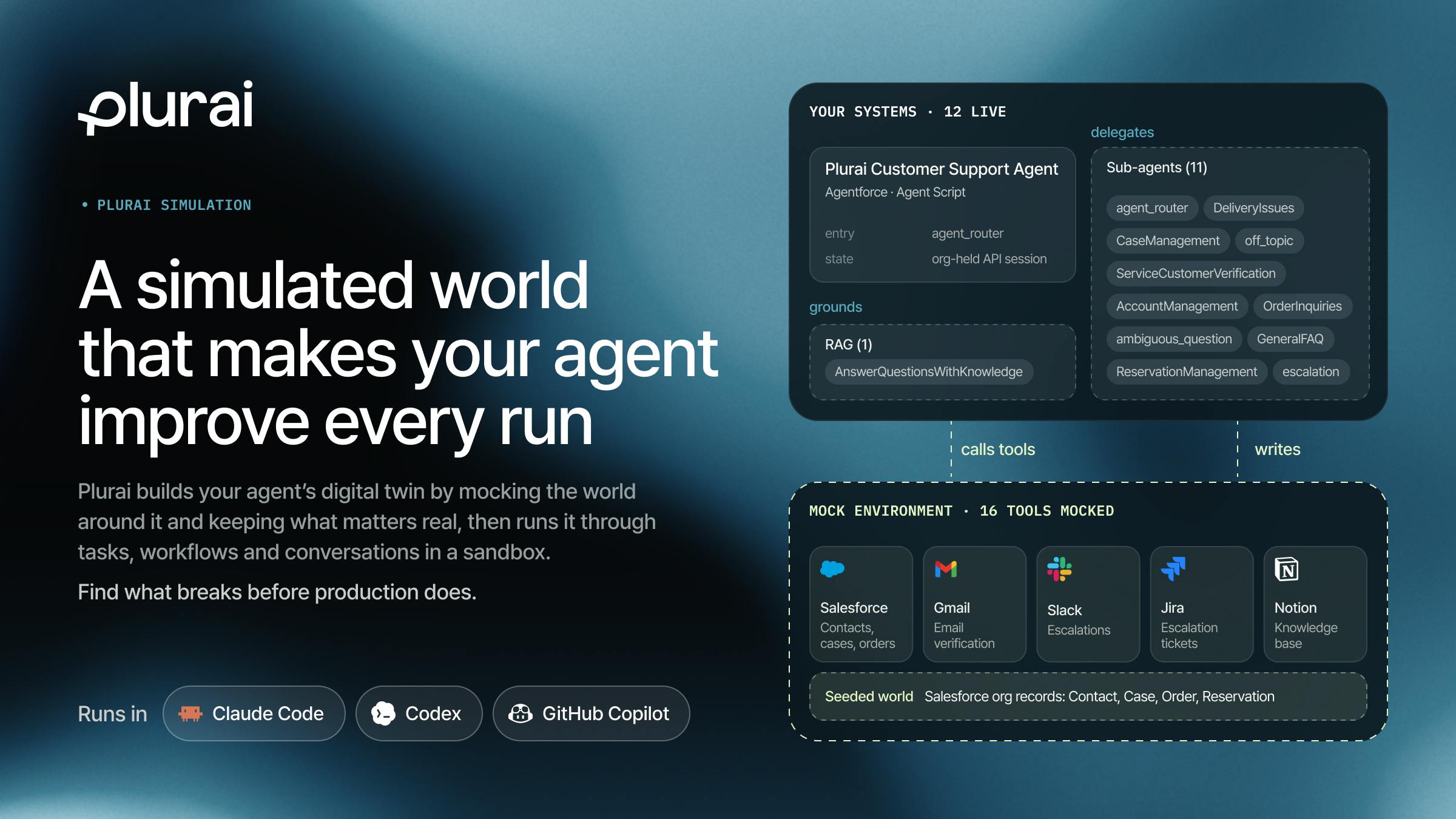
Plurai Simulation builds an isolated digital twin sandbox for Agents with one command, exposing behavioral bugs before release.
Plurai Simulation is an Agent testing tool that topped Product Hunt. Its core idea is to build a runnable "digital twin world" for Agents: synthetic personas, documents, and mocked tools, APIs, and databases, all running in a sandbox fully isolated from production. Developers run one command in Claude Code, Codex, or GitHub Copilot—no IDE migration or workflow rewrite. It targets behavioral defects like wrong advice, lost context, and tool-calling deviations. The product claims every run improves the Agent, but the mechanism and environment fidelity remain unverified.
AI Agent debugging has long been a pain point for developers: you only discover problems when real users hit bugs, and by then the cost has usually already been paid. Plurai Simulation, which topped Product Hunt, aims to change that—it builds a "digital twin world" for your Agent with a single command, exposing the worst bugs before release.
Core Idea: Give the Agent a Runnable Parallel World
Plurai Simulation positions itself as "a simulated world that makes your Agent better with every run." Rather than simply running unit tests, it builds a digital twin of the business environment the Agent operates in: synthetic personas and documents, mocked tools, APIs, and databases, all running in a sandbox fully isolated from production.
This means the Agent faces an environment that "looks real but will never pollute production." Developers can let it try and fail repeatedly with confidence, and real users will never be the first to discover a bug. The official one-liner puts it bluntly: find your Agent's worst bugs before your users do.
The value of this approach lies in the fact that Agent applications rarely fail with code errors—their failure modes are behavioral. For example, giving wrong advice to a certain type of user, losing context across multi-turn conversations, or misinterpreting parameters when calling tools. These problems are hard to cover with traditional testing; they only surface when the Agent runs in an environment close to reality.
Digital Twin in the context of Agent testing refers to a behaviorally equivalent but physically isolated mirror copy of the business systems the Agent interacts with (users, documents, tools, APIs, databases). Unlike traditional mocks, a digital twin emphasizes synchronization of the environment's structure and state: synthetic personas simulate the distribution characteristics of real users, mocked tools return responses semantically consistent with real interfaces, and the sandbox replicates the production topology. The goal is to let the Agent run in a "high-fidelity but zero-risk" environment, thereby exposing behavioral defects that only appear in real interactions. The fidelity of the digital twin directly determines the effectiveness of testing—over-simplification misses edge cases, while over-fitting to real data may introduce privacy and synchronization costs.
Synthetic Persona refers to a virtual user role generated by the system, typically including dimensions such as background information, goals and intent, language style, and behavioral preferences. In Agent testing, the value of synthetic personas lies in covering user types and interaction paths that developers find hard to enumerate manually: for example, users with different knowledge levels, questioners with ambiguous or emotional expressions, and "stress-type" roles that deliberately trigger boundary conditions. By generating personas in batches and having them converse with the Agent, behavioral-level defects can be systematically probed before release. Note that if the distribution of synthetic personas deviates from real users, the transferability of test conclusions is diminished—this is a fidelity question that must be asked when evaluating such tools.
One Command to Integrate with Mainstream AI Coding Tools
Plurai Simulation keeps the barrier to entry very low: run a single command in Claude Code, Codex, or GitHub Copilot to set up the simulated world. It doesn't require teams to migrate to a new IDE or rewrite existing workflows; instead, it embeds directly into the coding assistant ecosystem developers already use.
In terms of product categories, it is listed under API, Developer Tools, and Artificial Intelligence simultaneously, suggesting it is positioned not just as a standalone app but likely as infrastructure that can be integrated into CI/CD or Agent development pipelines. "Better with every run" implies that simulation testing can be executed routinely like regression tests, rather than as one-off manual verification.
This "command line as integration" form also explains why it earned 153 upvotes and 51 comments on Product Hunt to top the chart—it taps into a real need of the rapidly expanding Agent developer community.
Behavioral Testing differs from traditional unit and integration tests that focus on code paths and interface contracts—it examines whether the decisions and outputs an Agent exhibits across multi-turn interactions are reasonable. Typical Agent failures are often not exceptions but "silent errors": giving plausible-sounding but factually wrong advice, forgetting key constraints in long conversations, misinterpreting parameter meanings when calling tools, or taking inappropriate actions under edge-case inputs. Such problems cannot be precisely captured by assertions; they require scenario-based runs, comparison against expected behavior distributions, or human review. A simulated world provides a repeatable, batch-executable vehicle for behavioral testing, giving it the engineering form of regression testing.
Who Needs It Most: Pre-Release Insurance for Agent Developers
In terms of use cases, Plurai Simulation is most directly valuable to teams building conversational Agents, workflow Agents, or tool-calling Agents. These teams generally face two tensions: on one hand, the Agent's behavior space is enormous and manual testing cannot exhaust it; on the other hand, rolling out gradually in production may pose user experience risks.
The simulated world approach offers a middle ground between the two. Synthetic personas can cover user types developers never thought of, mocked tools and databases can safely simulate failures and edge cases, and the sandbox ensures no experiment leaks into real systems.
One detail: the team makes "better with every run" a core selling point, implying the product has a built-in iteration mechanism based on simulation results rather than merely providing a static test environment. However, the official materials don't disclose in detail how "better with every run" is achieved, so this effect still needs to be verified through actual use.
Cross-Source Information and Points to Watch
Currently, public information about Plurai Simulation mainly comes from its Product Hunt launch page, including the product tagline, feature introduction, and team roster (Maria Anosova, Tammy Wolfson, Reut Vilek, Ben Wisbih, Ilan Kadar, Arnon Mazza, Nir Aharon). Due to the lack of independent third-party reviews, all features described in this article are based on official descriptions and have not been cross-validated with external data.
For developers, several questions are worth watching: how to control the deviation between the simulated and real environments, whether synthetic data can cover enough edge cases, and whether "better with every run" could bring unexpected behavior drift. These all need to be tested in real projects. But directionally, using a simulated world to expose Agent behavioral defects in advance is an unavoidable step in Agent engineering.
As Agents move from demo to production, Plurai Simulation offers an idea worth watching: rather than waiting for users to step in pits, build the Agent a world where it can step into pits freely.
One-line Summary
Plurai Simulation builds an isolated digital twin sandbox for Agents with one command, exposing behavioral bugs before release.
Paragraph Summary
Plurai Simulation is an Agent testing tool that topped Product Hunt. Its core idea is to build a runnable "digital twin world" for Agents: including synthetic personas, documents, and mocked tools, APIs, and databases, all running in a sandbox fully isolated from production. Developers only need to run one command in Claude Code, Codex, or GitHub Copilot to get started, with no IDE migration or workflow rewrite. It targets Agent behavioral defects—such as wrong advice, lost context, and tool-calling deviations—that traditional testing struggles to cover. The product claims every run makes the Agent better, but the mechanism behind "better with every run" has not been disclosed, and the fidelity of the simulated environment still needs third-party verification.
Related articles

DevWorkflow 5.0: From Idea to Launch with the AI Five-Step Method
DevWorkflow 5.0 is a Claude Code plugin that uses a five-step process to take AI-assisted development from idea to launch. It asks you before every decision, preventing AI from adding tables and fields on its own, keeping docs and code consistent, and stopping merges before tests are written. Supports multiple platforms and languages, for individual developers and small teams.

How Do Hermes Agent's .md Files Work? A Breakdown of the Core Mechanism
Explaining Hermes Agent's .hermes directory mechanism: user.md stores personal info, memory.md records details worth remembering, soul.md defines the Agent's personality. Learn how these pure Markdown files keep the Agent consistent across sessions.

UN "Killer Robot" Talks Stall Again: Why Autonomous Weapons Regulation Is Hard to Break Through
UN Geneva talks on autonomous weapons ("killer robots") ended a week of consultations with little progress; delegates only agreed to "begin discussing options." This article analyzes the definitional disputes, conflicting security demands, and limits of multilateral mechanisms behind the stalemate.