Plural Raises $1.1B to Bet on Europe's Deep Tech Moonshots

Plural closes a €1 billion new fund, betting on European deep tech and defense AI.
Europe's venture capital market is undergoing capital concentration. Operator-led VC firm Plural has announced the close of a €1 billion (approximately $1.1 billion) new fund, becoming another European early-stage fund to cross the billion-dollar threshold. Plural was an early investor in European defense AI company Helsing, and the new fund continues the "hard tech + deep tech" line, explicitly targeting Europe's "next moonshots." Meanwhile, Mundi Ventures' Kembara fund and the EQT-managed Scaleup Europe Fund are also replenishing their ammunition, together painting a picture of upward momentum in European VC scale. This trend targets Europe's structural gap of being able to incubate but not scale: growth-stage capital supply is insufficient, and promising companies are often taken over by US funds between Series B and Series D. But deep tech investing has long return cycles, high uncertainty, and immature exit channels, and whether Plural can replicate individual successes into systematic performance remains an open question.
Europe's venture capital market is undergoing a clear wave of capital concentration. Operator-led VC firm Plural has announced the close of a new €1 billion (approximately $1.1 billion) fund, becoming another European early-stage fund to cross the billion-dollar threshold.
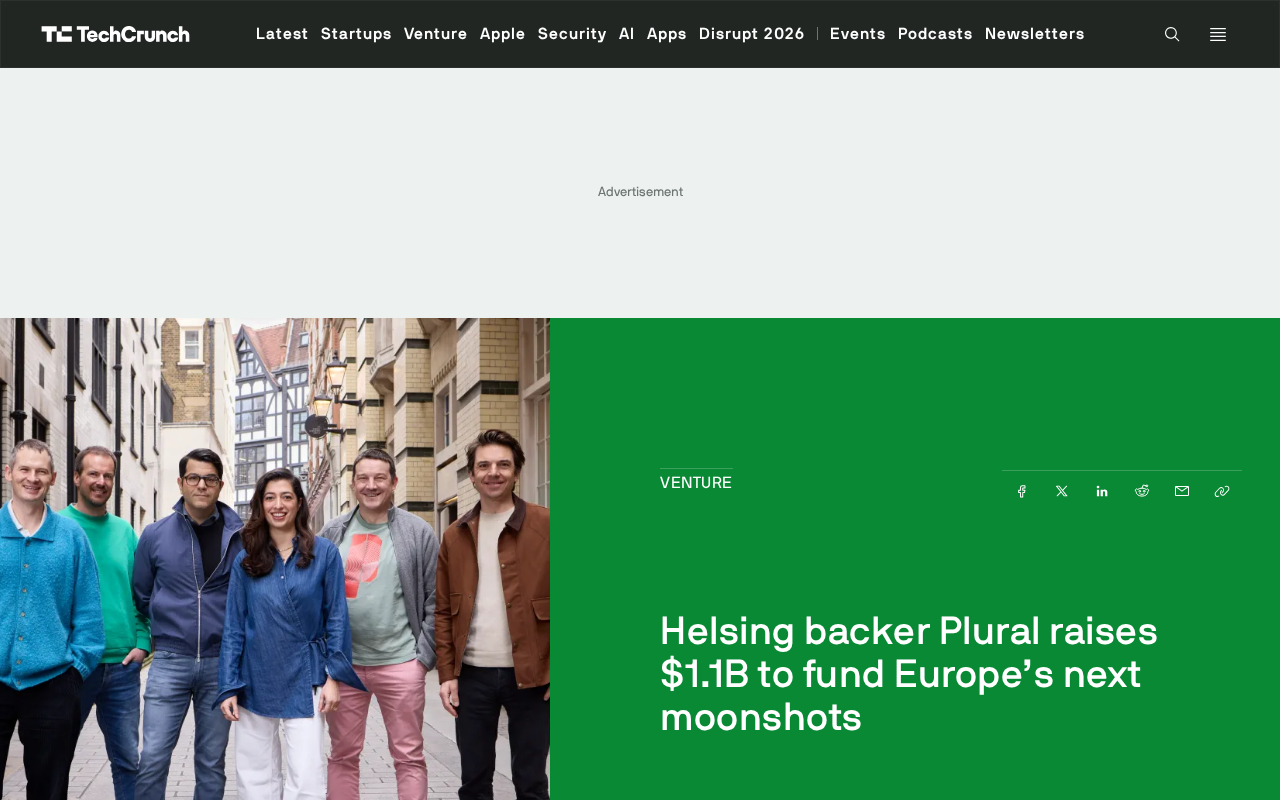
From Helsing to "Moonshots": Plural's Investment Logic
Plural is noteworthy not just for the size of its raise. The firm was an early investor in European defense AI company Helsing—now one of Europe's most highly valued AI defense startups—and its growth trajectory has in some measure validated Plural's judgment on the "hard tech + deep tech" track.
The new fund continues along this line, explicitly targeting Europe's "next moonshots": projects with long R&D cycles, high technical barriers, and the potential for global impact if they succeed. Growing European tech giants capable of competing with the US and China is the shared thesis behind this cohort of funds.
Helsing is a Germany-based European defense AI company founded in 2021, dedicated to applying artificial intelligence to national defense and security. Its products cover battlefield situational awareness, electronic warfare decision support, and related areas. The company has grown rapidly amid rising European defense demand, and after multiple funding rounds its valuation ranks among the top European AI startups, with investors including Plural and General Catalyst. Helsing's rise is seen as a landmark event signaling the heating up of defense tech investment in Europe—after the Russia-Ukraine conflict, European countries significantly increased defense budgets and began to prioritize domestic technology suppliers, giving funds focused on this track exit expectations and policy tailwinds.
Europe's VC Scaling Inflection Point
Plural's €1 billion is not an isolated case. According to the original report, Mundi Ventures' Kembara fund and the EQT-managed Scaleup Europe Fund are also replenishing their ammunition, and together these funds paint a picture of upward momentum in European VC scale.
There are structural reasons behind this trend. Europe has long been criticized for being able to incubate but not scale—early-stage projects are not short of seed capital, but growth-stage capital supply is insufficient, causing promising companies to often be taken over by US funds or even relocate between Series B and Series D. The emergence of large domestic funds directly targets this gap.
You may not have noticed that Plural adopts an "operator-led" model, meaning its partners mostly have entrepreneurial or industry operating backgrounds. In deep tech investing, this structure has practical value: judgments on technology roadmaps, regulatory pathway planning, and early customer introductions rely more on industry experience than on pure financial analysis.
Operator-led is a VC organizational model that contrasts with the traditional "financial investor-led" approach, where fund partners are mostly successful entrepreneurs or industry executives rather than pure finance professionals from investment banking or consulting backgrounds. In deep tech, this model's value lies in: more accurately judging the feasibility and engineering difficulty of technology roadmaps, helping portfolio companies plan regulatory and compliance pathways (especially in defense and biomanufacturing), and leveraging industry networks to bring in early flagship customers. The trade-off is that such partners often lack systematic portfolio management and fundraising experience, so fund governance needs to be complemented by a dedicated operations team.
The Time-Scale Challenge of Deep Tech Investing
Tracks like defense AI, quantum, and biomanufacturing have a completely different investment rhythm from consumer internet. Return cycles are measured in years, technology validation uncertainty is high, and they often involve deep engagement with governments and regulators.
For LPs, entrusting capital to a larger fund with "heavier" investments means longer lock-up periods and slower feedback loops. Whether Plural can replicate individual successes like Helsing into systematic performance remains an open question. The maturity of Europe's deep tech ecosystem and the richness of exit channels are also still under construction.
From a broader perspective, this round of fundraising reflects European capital's response to the "technological sovereignty" agenda. When defense, AI infrastructure, and advanced manufacturing are elevated to strategic levels, the scale and patience of domestic capital are themselves part of industrial policy.
Technological sovereignty refers to a country or region's ability to independently and controllably conduct R&D, production, and supply chain operations in key technologies (such as AI, semiconductors, defense equipment, and advanced manufacturing), reducing external dependence. In recent years, the EU has advanced this agenda through policy tools such as the Chips Act, the European Defence Fund, and InvestEU, and encourages domestic capital to invest in strategic technology sectors. Under this framework, the scale of domestic VCs and their "patient capital" attributes are seen as an extension of industrial policy—because tracks like defense AI and quantum have long return cycles and limited early commercial customers, market-based short-cycle capital alone cannot sustain them, making the participation of long-term LPs such as government-guided funds and pension funds crucial.
One-line Summary
Plural closes a €1 billion new fund, betting on European deep tech and defense AI.
Paragraph Summary
Europe's venture capital market is undergoing capital concentration. Operator-led VC firm Plural has announced the close of a €1 billion (approximately $1.1 billion) new fund, becoming another European early-stage fund to cross the billion-dollar threshold. Plural was an early investor in European defense AI company Helsing, and the new fund continues the "hard tech + deep tech" line, explicitly targeting Europe's "next moonshots." Meanwhile, Mundi Ventures' Kembara fund and the EQT-managed Scaleup Europe Fund are also replenishing their ammunition, together painting a picture of upward momentum in European VC scale. This trend targets Europe's structural gap of being able to incubate but not scale: growth-stage capital supply is insufficient, and promising companies are often taken over by US funds between Series B and Series D. But deep tech investing has long return cycles, high uncertainty, and immature exit channels, and whether Plural can replicate individual successes into systematic performance remains an open question.
Related articles

ReelRoom: An Android Video Editor Powered by a 1M Token Context Window
ReelRoom is an Android video editor built on Gemini 4 Neon and a 1M token context window. It scans thousands of camera roll clips, categorizes them by scene, and generates publishable videos. This article breaks down its technical logic and impact on creator tools.

Sanders Talks AI: Billionaire Tax, Superintelligence Ban, and the Democracy Crisis
Bernie Sanders discusses the democracy crisis, a 5% annual billionaire tax, Medicare reform, and his support for banning superintelligence development.

Super-Hot Rock Geothermal: A New Solution to Data Centers' Energy Woes
Super-hot rock geothermal startups target data center power demand, claiming terawatt-scale delivery almost anywhere. We analyze the technology, its fit with data centers, and real-world challenges like drilling costs and regulation.