Pocket Fit: How an AI Fitness App Uses Body Predictions to Solve the Consistency Problem

Pocket Fit uses AI body predictions and 3D avatars to make fitness progress visible and keep users motivated.
Pocket Fit is a London-based AI fitness app that tackles the common problem of users quitting by week three. Its standout features include AI-generated body predictions showing users their potential physique months ahead, a 3D avatar that evolves with training progress, photo-based food logging, and a social crew that humorously holds users accountable. By making abstract effort visually tangible, it aims to bridge the delayed gratification gap in fitness.
The "Third-Week Curse" of Fitness Apps
Most people who use fitness apps can't escape a common pattern: they give up by the third week. You train diligently for 21 days, look in the mirror, and see seemingly zero change—while the only feedback your app offers is a string of cold numbers. This frustration of "putting in effort but seeing no results" is the core pain point that makes fitness habits so hard to build.
A two-person team from London built Pocket Fit to tackle this problem. This fitness app, branded as "AI Workout & Food," recently launched on Product Hunt. While its vote count isn't particularly high yet (ranking #7), its product philosophy deserves attention—it doesn't aim to provide more data, but rather to make fitness progress visible.
Core Selling Point: AI Body Predictions Let You "See" Your Future Self
AI Body Prediction & 3D Avatar
Pocket Fit's most differentiating feature is its "future visualization" capability. Users simply take a photo, and the AI generates predicted body images showing what they'll look like in 1 month, 2 months, 3 months, and 6 months. This forward-looking presentation fundamentally addresses a key issue in fitness psychology: the lack of immediate feedback.
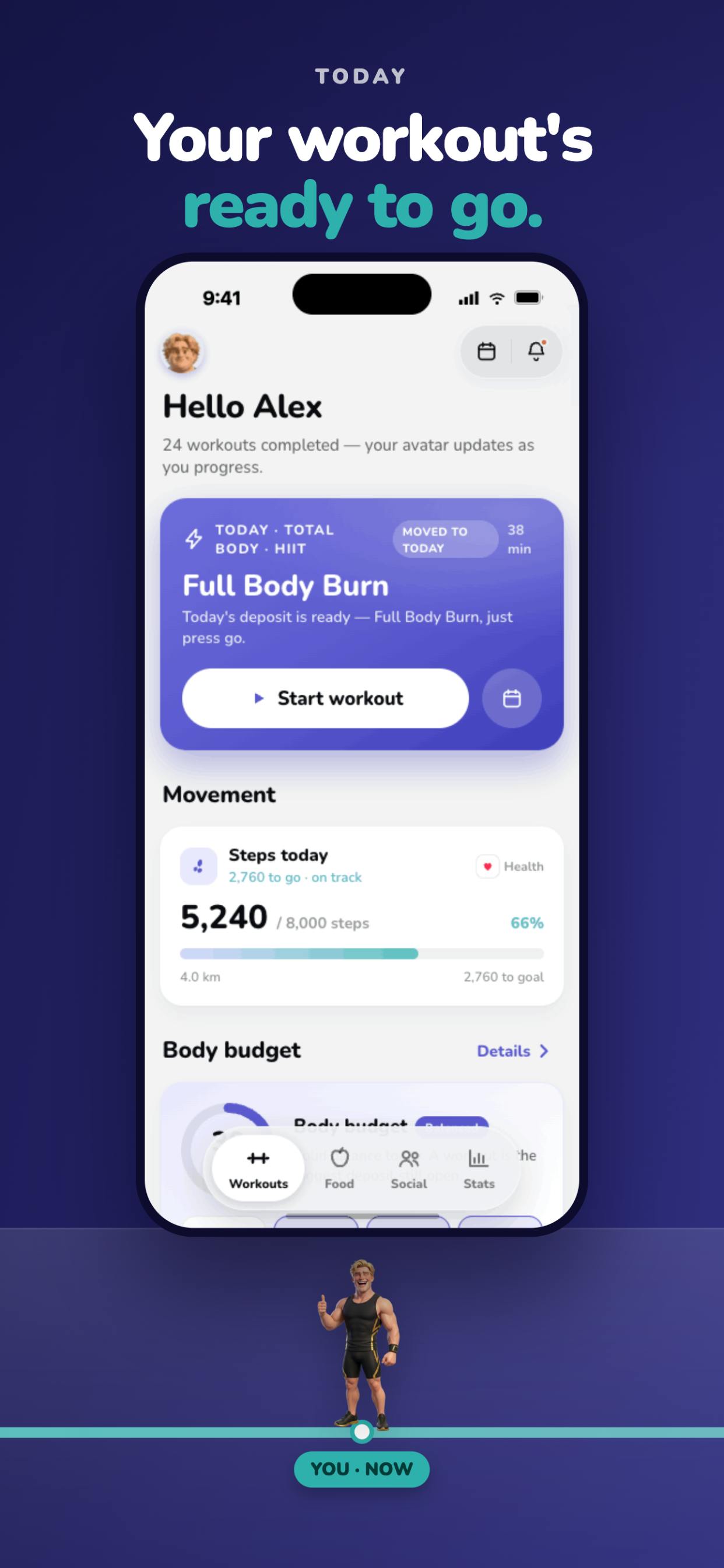
Taking it a step further, the app includes a built-in 3D digital avatar that evolves in real time as you progress through your training. When the real-world mirror can't immediately reflect your efforts, this continuously evolving virtual figure serves as a visual anchor for sustained motivation.
Full-Chain Automation from Training to Nutrition
Beyond visualization, Pocket Fit also strives to lower the barrier to entry at the foundational feature level:
- Smart Weight Selection & Progressive Overload: Training plans automatically select appropriate weights for users and gradually increase them based on progress—no manual calculations needed.
- Photo-Based Food Logging: Say goodbye to tedious manual input; a single photo captures your meal's caloric information.
- Muscle Coverage Tracking: Helps users understand whether they're training all muscle groups evenly, avoiding the common mistake of "only training upper body while neglecting legs."
Social Motivation: A Fitness Crew That "Roasts" You
Notably, Pocket Fit also introduces a lightweight social mechanism—a fitness crew that teases you when you slack off (like skipping leg day).
This humorous form of peer accountability, combined with in-app mood logging and streak-tracking mechanics, creates a complete behavioral motivation loop. From a product design perspective, this is a clever move that leverages social psychology beyond pure AI technology to further strengthen user retention.
Product Analysis: How AI Is Reshaping the Fitness App Experience
Precisely Targeting Fitness Enthusiasts' Real Pain Point
Pocket Fit's product positioning is remarkably precise. Rather than falling into the "feature bloat" trap, it stays laser-focused on the core of "progress visualization." Fitness is essentially a battle against delayed gratification, and AI-generated body predictions and dynamic avatars bring "future rewards" into the present—significantly boosting motivation to keep training on a psychological level.
Potential Concerns and Challenges
Of course, AI body prediction features come with room for skepticism. Body transformation is influenced by genetics, diet, training intensity, and numerous other factors, so the accuracy of a "6-month prediction" generated from a single photo is inevitably questionable. If predictions are overly optimistic and reality fails to match, it could actually intensify user frustration. Striking the right balance between "motivation" and "realism" will be key to the product's long-term reputation.
Additionally, as an indie product built by just two people, Pocket Fit still needs time and more real user data to validate its feature refinement and ongoing model optimization.
Conclusion
Pocket Fit represents an intriguing direction for AI fitness apps: instead of turning users into "data managers," it uses generative AI to transform abstract effort into intuitive visual feedback. For those who repeatedly hit the wall at "week three," an app that lets you "see" your body changing might be exactly the key to sticking with it.
In an era where AI and consumer applications are deeply converging, small-team products like Pocket Fit—ones that focus on niche scenarios and directly address psychological pain points—are well worth keeping an eye on.
Related articles

Gaussian Process Bandit Optimization: Exploration Strategies and Inference Regret Guarantees
Cumulative regret guarantees in Bayesian optimization fail to reflect final recommendation quality. This article examines a new study that provides inference regret guarantees for Gaussian process bandit optimization through exploration query strategies and fill distance analysis, validated on hyperparameter optimization and control tasks.

The Most Detailed Codex Guide on Bilibili: From Installation to Real-World Practice
The most detailed Codex guide on Bilibili: from app store installation to daily work mode configuration, with a real coffee shop project demonstrating file organization, data extraction, dashboard creation, and other practical tasks. Learn to use Plan Mode and desktop pets to leverage Codex efficiently.

Appearance Compensation in Volume Rendering: Why RGB Accuracy Cannot Guarantee Density Correctness
Volume rendering research reveals that volumetric data perfectly reproducing external RGB views may still contain density errors: appearance compensation can double central density and keep external rays unchanged even when L2 error exceeds 14.52%. Density recovery depends on appearance capacity, spatial resolution, and measurement design.