PocketLedger: A Local AI Bookkeeping Tool for Freelancers

PocketLedger uses a local vision model to auto-extract receipt fields, keeping freelancers' financial data on their own machines.
PocketLedger is a desktop bookkeeping tool submitted by developer SaikatDash for the Hacktoberfest Open Source AI Challenge, targeting solo operators like independent designers, developers, and consultants. Users upload receipt images or paste text, and the locally running Qwen2.5-VL 3B, invoked via Ollama, extracts fields such as merchant, date, amount, currency, and category to generate an editable draft; only after human confirmation is it written to the local SQLite ledger. The app also offers a searchable ledger, monthly summaries, category breakdowns, multi-currency records, and CSV export, plus manual entry when AI is unavailable. The tech stack uses only Python's standard library and vanilla frontend, with no extra dependencies or cloud APIs, and works offline. The business model is a one-time-fee desktop deployment. The author has not yet completed first real-user trials; next steps will validate entry time, manual correction frequency, and export usability.
PocketLedger: A Local AI Bookkeeping Tool for Freelancers
Freelancers spend the year scattering receipts across their inbox, photo library, and wallet, only to scramble at tax season trying to remember which client each expense belongs to and whether it's already been recorded. PocketLedger, submitted by developer SaikatDash for the second week of the Hacktoberfest Open Source AI Challenge, aims to automate this process using a locally running vision-language model—while keeping financial data on the user's own computer.
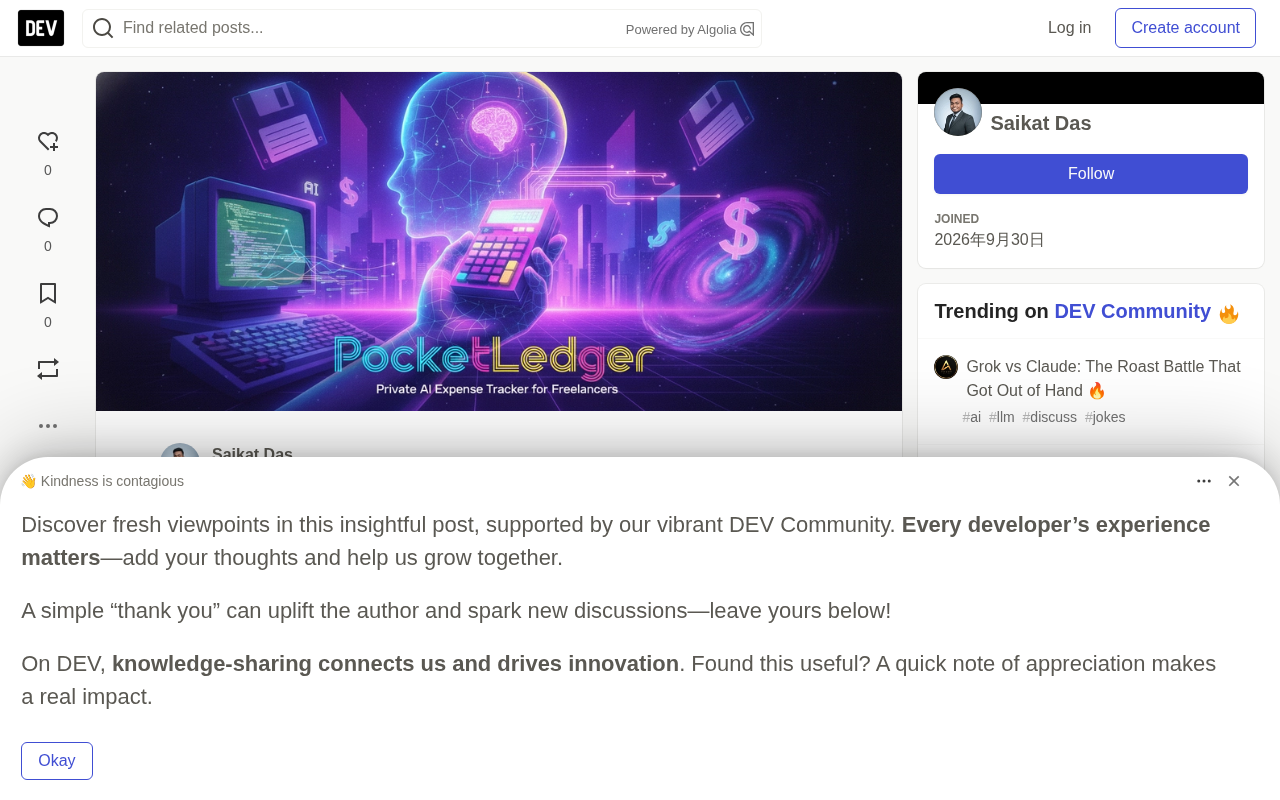
Product Positioning: Lightweight, Private, One-Time Purchase
PocketLedger targets solo operators such as independent designers, developers, photographers, and consultants. It positions itself as an alternative between heavyweight accounting software and cloud-based receipt tools. Its core workflow is short: users upload a receipt image or paste receipt text, the local AI extracts the merchant, date, amount, currency, category, and description, and generates an editable draft; the user reviews and corrects it, links it to a client or project, marks it as a deductible business expense, and only after confirmation is it written to the ledger.
Beyond receipt entry, the app also offers a searchable expense ledger, monthly spending summaries, category breakdowns, multi-currency records, CSV export for accountants, and manual entry when the AI is unavailable. Data is stored in a local SQLite database, with no cloud account required. The author's business model is a one-time-fee desktop deployment, supplemented by optional onboarding guidance and support services.
Tech Stack: Standard Library + Local Vision Model
The implementation avoids complex frameworks: Python's standard library handles the backend, SQLite handles storage, and the frontend is HTML, CSS, and vanilla JavaScript. Receipt understanding is handled by calling Qwen2.5-VL 3B through Ollama, with a structured JSON schema constraining the output fields, and the model's returned draft is filled into an editable form.
The practical value of this combination lies in its low deployment barrier—once Python, Ollama, and the vision model are installed, it runs locally with no additional Python packages and no dependency on any hosted AI API. Receipt images are processed in memory and discarded after extraction; only fields the user has confirmed are written to disk.
Ollama is an open-source local large-model runtime framework that provides a command-line interface and HTTP API. It can pull and run open-weight models such as Llama, Qwen, and Gemma with a single command, and automatically handles quantization formats and hardware acceleration (CPU, CUDA, Metal). For developers, its value lies in standardizing the "download model—load weights—serve inference" pipeline, so applications only need to send requests to a local port rather than writing their own inference code. PocketLedger uses this layer to wrap the vision model as a local service.
Qwen2.5-VL 3B is a multimodal vision-language model released by Alibaba's Qwen team. The 3B refers to roughly 3 billion parameters, a scale that can run on consumer laptops. It accepts both image and text input and is commonly used for OCR, chart understanding, and structured document extraction. Smaller models are less stable on complex layouts, handwriting, or blurry photos—which explains why the product insists on an interaction design where "the AI only produces drafts and humans must review."
Structured JSON schema-constrained output means attaching a field definition (such as merchant, date, amount, currency) when calling the model and requiring it to return JSON matching that structure. Compared with free text, this lets results map directly to form fields, making validation and programmatic parsing easier and reducing post-processing costs. However, small models can still fill in wrong values or miss fields; the schema only guarantees format, not correctness of content.
Why Local Inference Is Key to This Product
Receipts themselves carry a lot of sensitive information: spending habits, vendors, timing, and sometimes addresses or payment details. Sending every receipt to a cloud AI raises privacy concerns and implies ongoing per-call costs. In the original article, the author explicitly treats local open-weight models as a prerequisite for the product's viability and lists several direct benefits: images never leave the machine, there are no per-receipt API costs, the model works offline once downloaded, users can swap in compatible vision models themselves, and prompts and extraction schemas are modifiable.
More interesting is how the product defines the AI's role—the model only generates drafts and makes no irreversible bookkeeping decisions; every expense requires human confirmation. This design mitigates the limited accuracy of small local models on complex receipts. The trade-offs are equally real: users need sufficient local storage and hardware to run the model, and AI results still need to be reviewed item by item. For a tool that sells itself on privacy, this is a reasonable trade-off.
Open-weight models are models whose parameters can be publicly downloaded and that allow users to run and fine-tune them locally or on their own servers, as opposed to closed-source models accessible only through a vendor's API. They make "data never leaves the machine" possible and let users swap models and modify prompts themselves, shifting inference costs from per-call billing to one-time hardware investment—at the cost of users bearing responsibility for hardware, deployment, and fluctuations in model quality.
What Hasn't Been Validated Yet
The author openly admits that formal first-user trials have not yet been completed. The next step is to observe real freelancers working with real receipts and measure several metrics: how long it takes to enter an expense, how often AI extraction results require manual correction, whether client and project tracking is genuinely useful, and whether CSV export can integrate with existing bookkeeping workflows. These data will determine whether the product's focus should remain on refining receipt recognition or shift toward client management and export.
Future iteration directions include improving extraction on complex receipt layouts, receipt history and expense editing, more flexible client and project management, optional local encrypted storage, more export formats, and an onboarding flow that guides users in selecting a compatible local model.
A Brief Observation
The value of PocketLedger isn't in its technical complexity but in aligning a common yet overlooked scenario—freelancers' receipt organization—with the capability boundaries of local open-weight models. A 3B-parameter vision model running on a personal computer is sufficient for recognizing a single receipt, with human review as a fallback for errors, and the cost structure shifts from per-call payments to one-time hardware investment. Tools that are "small and specific" like this may fit the actual workflows of solo operators better than general-purpose accounting software. The project is open source on GitHub at SaikatDash/sideHustlers.
Related articles

Chain of Thought Isn't Just for AI: How Humans Can Use CoT to Improve Thinking Quality
Chain of Thought isn't just a prompt trick for large models. Starting from a Hacker News discussion, this article analyzes why CoT works for human thinking too, breaks down actionable ways to transfer it, and highlights the key differences between human CoT and machine CoT.
Cloudflare Teams Up with OpenAI: Closi…
Cloudflare Teams Up with OpenAI: Closing the Loop from Vulnerability Discovery to Defense with AI
Cloudflare uses OpenAI Daybreak to investigate security vulnerabilities and generate reviewable remediation plans, while developers use Codex to boost coding efficiency and quality.

Orca Multi-Agent Orchestration in Practice: A Guide to Parallel Collaboration with Claude and Codex
Orca is Stable AI's free open-source agent workbench supporting 34 agents like Claude Code and Codex in parallel. Learn its Git worktree isolation, multi-model orchestration, and mobile management.