PocketMage Review: The E-Paper Clamshell PDA Bringing Back the Physical Keyboard

PocketMage revives the PDA with an e-paper screen and physical keyboard for focused, distraction-free computing.
PocketMage is a crowdfunded clamshell PDA from Talisman Design that pairs an e-paper display with a physical keyboard, targeting writers and digital minimalists craving distraction-free devices. This review explores its retro design philosophy, the trade-offs of e-paper technology, and the growing market logic behind counter-mainstream, focus-first hardware.
The Unexpected Return of the PDA
The personal digital assistant (PDA) was the darling of the tech world before smartphones took over — the classic Palm Pilot remains a fond memory for many enthusiasts. PDA technology traces its roots to the 1992 Apple Newton MessagePad, but it was the 1996 Palm Pilot that truly brought handheld computing to the masses. With its Graffiti handwriting input system and minimal design, Palm once commanded over 70% of the handheld market. The 2007 launch of the iPhone reshaped the entire industry: touchscreen smartphones absorbed every function PDAs had offered, and standalone PDA devices all but disappeared within a few years.
Now, a handheld device called PocketMage is trying to reverse that trend. Launched by Talisman Design via crowdfunding, this clamshell PDA pairs a physical keyboard with an e-paper display, reigniting interest in retro handheld computing.
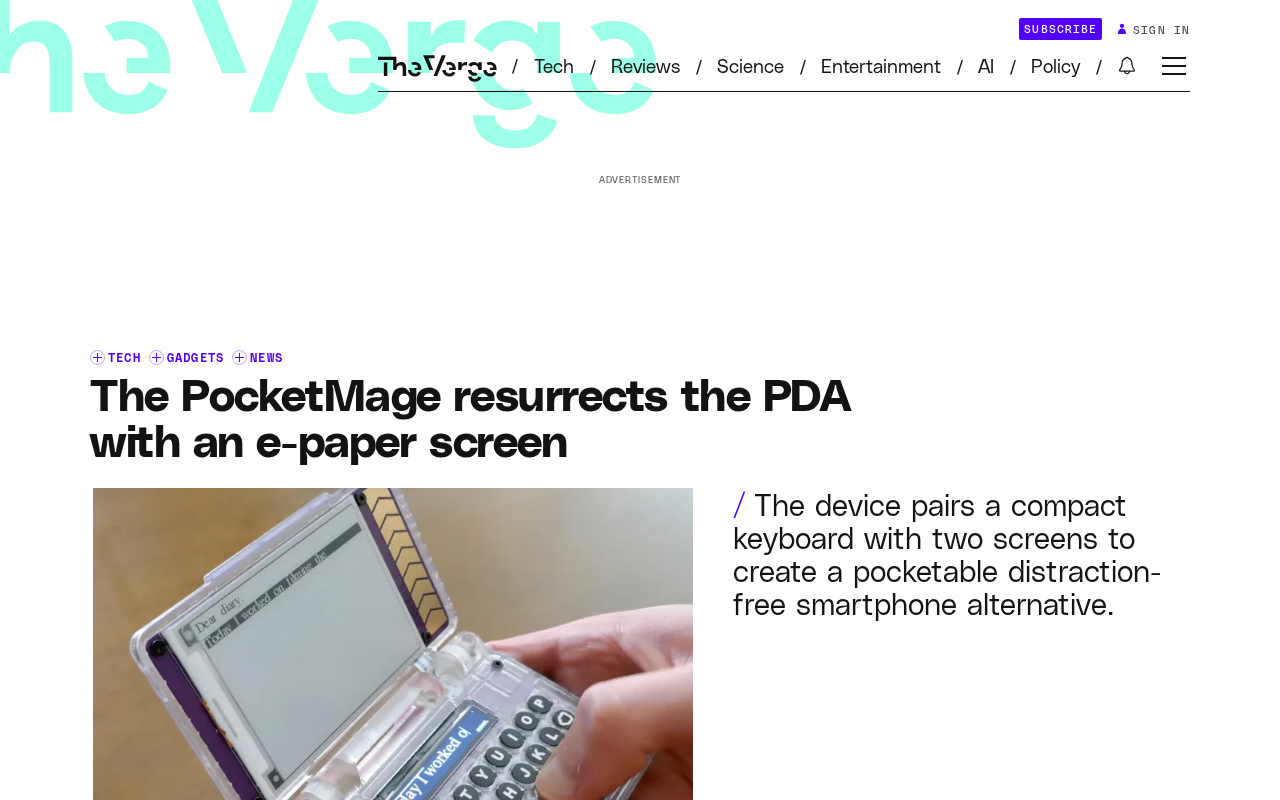
This isn't an isolated phenomenon. Much like Canon reissuing older digital cameras to cater to point-and-shoot enthusiasts, the hardware market is experiencing a wave of "retro revival." Consumer demand for pure, focused, distraction-free devices is giving rise to a new wave of counter-mainstream product design.
Design Philosophy: Reclaiming Focus and Tactility
The Clamshell Form and Physical Keyboard
PocketMage adopts the classic clamshell design, a form factor beloved during the feature phone era. But this isn't purely nostalgic — the clamshell has solid ergonomic merit. When closed, the screen and keyboard protect each other, significantly reducing wear in a pocket. The natural opening angle creates an optimal 110–130 degree viewing tilt, reducing neck strain. More importantly, the act of flipping open the device creates a psychological "mode switch" — highly consistent with behavioral psychology's concept of "contextual cues," where physical actions effectively prime the brain to enter a specific working state. Unlike today's sea of identical touchscreen slabs, the clamshell form not only provides physical protection but also a sense of ritual: opening the device signals the start of focused work or note-taking.
The device's most distinctive differentiator is its physical keyboard. In an era where virtual keyboards dominate mobile input, the tactile feedback of physical keys remains something heavy typists simply can't give up. For users who frequently take notes, write, or process large amounts of text, a physical keyboard consistently outperforms an on-screen keyboard in both efficiency and comfort.
The Trade-offs of an E-Paper Display
PocketMage's choice of an e-paper display is a highly deliberate decision. Electronic Ink technology, commercialized by E Ink in the late 1990s, works through microcapsule electrophoresis: each microcapsule contains positively and negatively charged white and black particles, which are moved by an applied electric field to form an image. This mechanism means e-paper only consumes power when refreshing — it draws virtually no power when displaying a static image. E-paper screens therefore offer three core advantages:
- Ultra-low power consumption: Static display uses almost no power, enabling extremely long battery life — theoretically weeks or even months of standby
- Eye-friendly: No backlight flicker, making long reading sessions far less fatiguing
- Sunlight-readable: Clear visibility even in bright outdoor conditions
The trade-offs are equally obvious — low refresh rates, inability to smoothly display dynamic content, and limited color reproduction. Although E Ink technology has continued to evolve (the Gallery 3 color e-ink display now supports over 4,000 colors), e-paper still has fundamental limitations compared to LCD/OLED when it comes to dynamic content. This is precisely what makes it a good fit for PocketMage's positioning: it doesn't aim to be a multimedia entertainment terminal, but rather a "digital notepad" focused on text and information capture.
The Market Logic Behind Counter-Mainstream Products
The Rise of Distraction-Free Demand
The emergence of PocketMage reflects an increasingly clear trend: more and more users are seeking focused-use devices that help them escape information overload. Computer science professor Cal Newport theorized this phenomenon in his 2019 book Digital Minimalism, arguing that users should actively evaluate the cost-benefit of their technology tools and refuse to be held hostage by the attention economy of platforms. Meanwhile, focused writing device Freewrite, the internet-free Light Phone, and the e-ink notebook reMarkable have each found market acceptance, collectively forming a small but highly motivated community of "digital minimalists."
Smartphones bundle communication, entertainment, and social media in one package — and for the same reason, they're the primary source of fragmented attention. A handheld device that does only a few things well becomes the ideal tool for a "digital detox." These users' core demand isn't about missing features — it's about actively reclaiming control of their own attention. This psychological motivation makes them willing to pay a significant premium over the hardware's cost for a purpose-built device.
The target audience for these products is clear and committed: writers, students, focus-conscious knowledge workers, and enthusiasts with a soft spot for retro tech. They're willing to pay for the philosophy of "less is more."
Why Crowdfunding Is a Natural Fit
Launching via crowdfunding aligns well with the business logic for this kind of niche hardware. Since Kickstarter's founding in 2009, it has become the standard path for niche hardware projects to validate market viability — early successes like the Pebble smartwatch (which raised $10.27 million in 2012) demonstrated the model's potential. For highly customized hardware like PocketMage, crowdfunding solves the core problem of "demand uncertainty." The potential audience size for an e-paper clamshell PDA is nearly impossible to quantify through traditional market research, but crowdfunding pre-order data directly reflects genuine willingness to pay. Traditional consumer electronics scale-up requires massive upfront investment and market validation, while crowdfunding lets small teams test real demand, lock in core users, and reduce financial risk before full production. Through this approach, Talisman Design both validates market enthusiasm and builds an early user community — one that, if successful, can provide invaluable feedback for future iterations.
The Deeper Meaning of the Retro Tech Revival
PocketMage's value lies not just in the product itself, but in the philosophical reflection it represents. In the tech race toward bigger, faster, and smarter, have the values of "good enough" and "focused use" been overlooked for too long?
From the resurgence of feature phones to the revival of film cameras to the rebirth of the PDA, these phenomena all point to one reality: technological progress isn't always linear, and users' genuine needs are far more diverse than any spec sheet can capture. Some people are actively choosing to "downgrade" functionality in exchange for a purer experience and fewer distractions.
For the tech industry, products like PocketMage offer a useful reminder: innovation doesn't always mean piling on more features. Sometimes, doing less opens up market space that the mainstream has long ignored. It may never become a mass-market hit — but for that specific group of users, this e-paper clamshell PDA might be exactly the tool they've been waiting for.
Key Takeaways
Related articles
Understanding GitHub's Availability Report: Platform Stability and Developer Response Strategies
Deep dive into GitHub's monthly availability report: analyzing service degradation impacts, CI/CD fault tolerance, and platform dependency risk strategies for resilient development.
OpenAI's Claim of Solving a Millennium Prize Problem Sparks Academic Controversy
OpenAI claims its AI solved a Millennium Prize Problem, sparking debates over attribution, verification, and AI's role in reshaping mathematical research.
Ledoit-Wolf Covariance Shrinkage in Practice: 57% Lower Turnover + 10x GPU Acceleration
Learn how Ledoit-Wolf covariance shrinkage reduces portfolio turnover by up to 57% and how cuML GPU acceleration cuts backtest time from 1.5 hours to 9 minutes.