Ponytail Plugin Tested: Teaching AI to Write Less Code — 54% Reduction, 100% Security Pass Rate

Ponytail's 7-rung ladder constrains AI coding urges — 54% less code, security checks fully intact.
Ponytail is a Claude Code plugin with 140,000 GitHub stars built around one idea: make AI work through a seven-rung decision ladder before writing any code — from confirming the requirement exists to checking libraries, standard APIs, native controls, and existing dependencies before resorting to new code. Tests show 54% fewer lines, 20% token and cost savings, ~25% speed gains, and 100% security pass rates. Four hard lines — trust boundaries, input validation, error handling, and accessibility — ensure restraint never becomes negligence. Compared to the Caveman plugin (which reduces AI verbosity), Ponytail focuses on implementation volume; the two are considered complementary.
The Best Code Is the Line You Never Wrote
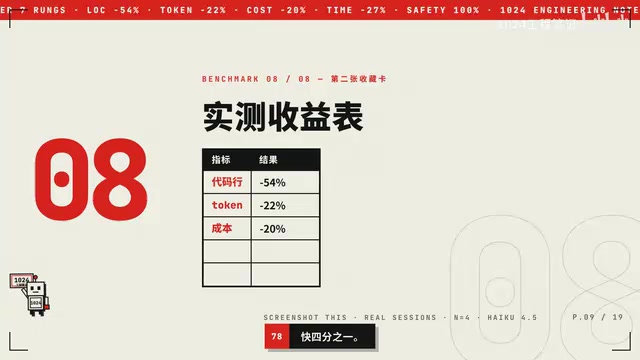
Ponytail, a Claude Code plugin that's earned 140,000 stars on GitHub, does one thing: it teaches AI to write zero unnecessary code — not a single line. Real-world testing shows a 54% reduction in code volume, roughly 20% fewer tokens consumed, and security checks still passing at 100%. These numbers speak to a pain point that plagues today's AI coding tools: AI is inherently too eager to write.
You've probably seen this before. You ask for a date picker, and AI scaffolds a custom component with three layers of nesting and a full theme system — when the platform's native control would've done the job in one line. The root cause is how AI is incentivized: more output signals more effort. Ponytail exists to put a leash on that impulse.

The Seven-Rung Ladder: Work Top-Down Before Writing a Thing
Ponytail's core methodology is a "seven-rung ladder" that requires AI to ask itself a sequence of questions — top to bottom — before touching the keyboard:
- Rung 1: Does this feature even need to exist? Kill it if the requirement isn't real.
- Rung 2: Does a library already handle this? Check dependencies first.
- Rung 3: Can the standard library solve it?
- Rung 4: Will a platform-native control do?
- Rung 5: Can an existing dependency be reused? Use it if so.
- Rung 6: Can this be done in one line? Write just one line.
- Rung 7: Only if everything above fails — write the minimal viable implementation. That's the floor.
The logic is straightforward: reach for "write new code" only as a last resort. If a higher rung solves the problem, stop there. You work from the top down, and the moment Rung 1 applies, you're done.
Underpinning this ladder is one guiding principle: be lazy about solutions, never about understanding requirements. Starting to code before you've fully read the spec isn't laziness — it's busywork. Ponytail promotes deliberate restraint, not cutting corners.
This ladder aligns with two well-established software engineering principles: the Minimal Dependency Principle and YAGNI (You Aren't Gonna Need It), which originated in Extreme Programming (XP). YAGNI's core argument is "don't write code for requirements that might be needed someday." The key difference is that YAGNI was traditionally a behavioral guideline for human developers, enforced by discipline alone. Ponytail converts it into a structured process that AI must complete before every code generation — making it a machine-enforceable constraint rather than a suggestion. That gap between "engineering standard" and "programming advice" is precisely the point.
Four Hard Lines: Restraint Doesn't Mean Skipping Security
Writing less code could easily become an excuse for sloppiness. Ponytail draws four lines it will never cross:
- Trust boundaries — security validation stays, always;
- Data validation — input checks are non-negotiable;
- Data loss handling — exception handling and persistence logic must be preserved;
- Security and accessibility — a11y cannot be sacrificed.
Only by holding these four lines does the benefit story make sense. This is why "100% security pass rate" is the most emphasized figure in the test results — code reduction is only meaningful when critical safeguards remain untouched.
Accessibility (a11y) refers to a product's usability for people with disabilities — covering screen reader compatibility, keyboard navigation, color contrast, and more. In many jurisdictions, public-facing digital products are legally required to meet standards like WCAG (Web Content Accessibility Guidelines). Listing a11y alongside security checks as a hard line signals that Ponytail's restraint is selective: it cuts redundant wheel-reinventing code, not compliance baselines or the promise of usability for all users.
Real Results: Five Numbers and One Honest Data Correction
According to testing by the YouTube channel "1024 Engineering Notes," Ponytail delivered five measurable outcomes: roughly half the lines of code, 20% fewer tokens, 20% lower cost, about 25% faster execution, and — most critically — 100% of security checks passed.
A note on methodology: the test used a real production project with 12 issues, each run four times with results averaged. There was a control group. Someone raised the obvious question — "couldn't you just write a good prompt telling AI to avoid unnecessary code?" Tested under the same conditions, a well-crafted prompt did reduce line count by about 30%, but security scores dropped to 95%. This demonstrates that Ponytail, as a structured plugin, provides more reliable safety coverage than prompt-based self-discipline alone.
One detail worth noting: early marketing claimed an 80–94% reduction. After community pushback, the author didn't dig in — they revised the number down to a more conservative 54% average. Willingness to revise a number downward is itself a sign of trustworthiness.
Where the Cuts Land: Hardest on AI's Favorite Overbuilding Zones
The reductions aren't uniform. As the analysis explains, the biggest cuts — up to 94% — come in the areas where AI most loves to overbuild. Code that was already minimal sees no reduction at all. This is consistent with the seven-rung ladder's logic: it targets bloat from over-engineering, not compression of necessary logic.
This brings up an interesting comparison. The neighboring plugin Caveman controls AI's "mouth" — it gets the model to say less, but actually increases token count by about 7%. Ponytail controls AI's "hands" — cutting code volume in concrete, measurable ways. The two are described as a perfect pair: Caveman handles expression, Ponytail handles implementation.

Caveman is another Claude Code prompt plugin designed to reduce how much AI says — making explanations, comments, and conversational responses more concise to avoid burning context window space. However, because it reduces intermediate reasoning output, the actual code generation becomes more direct, causing total token count to rise by roughly 7%. This contrast illustrates that "controlling expression" and "controlling implementation" are two separate dimensions. Caveman optimizes communication efficiency; Ponytail optimizes the scale of generated code. They operate at different layers — combined, they address both conversational noise and code bloat.
Command Panel: Five Modes and How to Install
Ponytail's command panel offers multiple modes for different scenarios:
- Flight: Lightweight mode;
- Ultra: Maximum reduction mode;
- Off: Disabled;
- Review: Change review with savings analysis;
- Audit: Full codebase scan;
- Debt: Technical debt accounting included;
- Gain: Benefit reporting.
Day-to-day use doesn't require typing commands — install it and the default Full mode activates immediately. You can also switch modes globally. Installation is simple: two commands, or search and install directly from the plugin marketplace. The official docs note support for 20+ agents, so it's not locked to a single toolchain. It uses the MIT license — described as "the shortest license that still lets you use it" — with essentially zero adoption friction.

Closing Thoughts
Ponytail's value isn't in any flashy feature. It's in turning restraint into an enforceable engineering standard. As the marginal cost of AI-generated code approaches zero, the genuinely scarce skill becomes knowing when not to write. The seven-rung ladder, four hard lines, a results table, and a command panel together form a mechanism that transforms AI from an over-eager construction crew into a craftsman who is lazy in exactly the right way.
Next time you hand off a task, consider having your AI climb the ladder first.
Related articles

Random Pruning of the DPO Computation Graph: 1.4x Training Speedup and Lower Peak Memory
DPO training too slow and memory-hungry? This paper proposes a random pruning framework for the DPO computation graph, sampling independently across position, sequence, and branch dimensions; branch pruning achieves a 1.426x step-time speedup and cuts training time by about 30%, with in-depth attribution of memory and time gains.

Why Does JEPA Underperform MLM in Longitudinal EHR Representation Learning?
New study compares JEPA and MLM for longitudinal EHR representation learning on MIMIC-IV: three JEPA variants train stably without collapse but underperform MLM; target size, not heterogeneity, drives prediction error.

Transfer Learning + Visible Light Communication: A New Approach to Energy-Efficient Indoor Positioning
A study proposes a transfer learning-based visible light communication indoor positioning method, achieving 47% accuracy improvement on the BOSCH factory dataset, 67.5% model efficiency under high noise, and introducing the ME composite metric for energy-efficient positioning in energy-constrained industrial IoT scenarios.