Popcraft: A Single URL Lets AI Agents Generate Video, Images, and Audio

Popcraft lets AI Agents directly invoke 20+ multimodal generation models via a single URL.
Popcraft is a developer tool on Product Hunt that packages multimodal generation into a single URL—paste it into Claude, ChatGPT, Cursor, or Claude Code and the Agent handles planning, cost preview, and generation. It aggregates 20+ models including Seedance 2.5, Veo 3.1, Kling 3.0, and Nano Banana Pro across video, image, music, and sound effects, with OAuth login, no API Key, and 100 free credits for new users. Its differentiation is an upfront plan and credit estimate before generation to control trial-and-error costs. Still early-stage, its multi-model stability and pricing remain to be validated.
AI Agents are evolving from conversational tools into productivity engines capable of executing complex tasks, but multimodal generation remains a key gap. Popcraft, newly launched on Product Hunt, aims to fill that gap: simply paste a URL into an Agent like Claude, ChatGPT, or Cursor, and it can directly invoke more than 20 top-tier generation models to create videos, images, music, and sound effects.
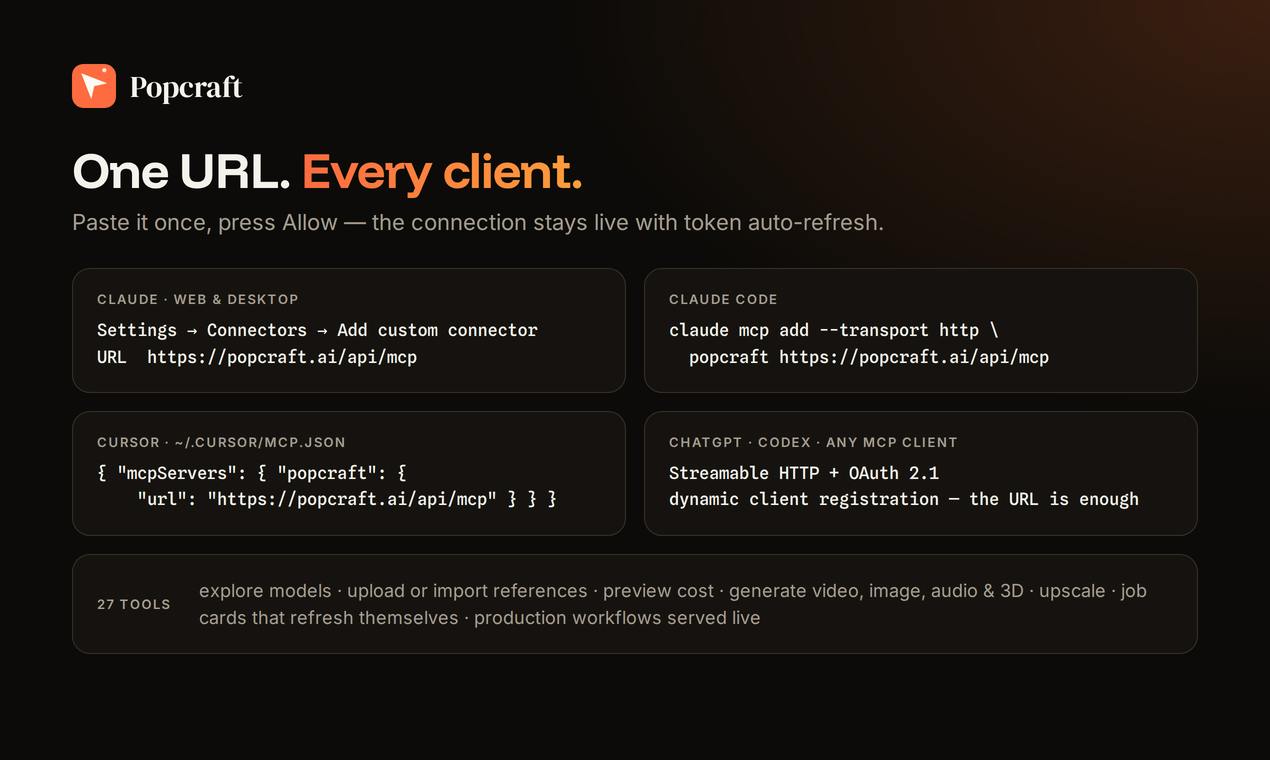
One URL Connects Agents to Generation Models
Popcraft's core idea is minimal-friction access. Traditionally, getting an AI Agent to call external generation services often requires configuring API Keys and writing function-calling logic—a cumbersome and error-prone process. Popcraft encapsulates this complexity into a single URL—users simply paste it into Claude, ChatGPT, Cursor, or Claude Code, and the Agent can autonomously handle the entire process from planning and cost preview to actual generation.
According to its Product Hunt page, Popcraft supports OAuth login with no API Key required, eliminating the hassle of manually managing keys for developers. New users receive 100 free credits to test the generation quality of various models.
MCP (Model Context Protocol) is an open protocol proposed by Anthropic, designed to let AI Agents connect to external tools and data sources in a standardized way. Before MCP existed, Agents typically relied on platform-specific plugin mechanisms or function-calling formats to invoke external services, resulting in a severely fragmented ecosystem. MCP defines a unified client-server architecture: the Agent acts as the client, requesting tool lists, reading resources, and executing operations from MCP servers via the protocol. Popcraft's "paste a URL and go" approach essentially packages itself as a remote MCP server within the MCP ecosystem, so that MCP-compatible clients like Claude and Cursor can discover and invoke its generation capabilities without additional coding.
OAuth vs. API Key: An API Key is a static credential—whoever holds it can call the service, posing high leak risk and making fine-grained authorization difficult. OAuth, by contrast, uses an authorization code flow that lets users grant third parties limited-scope access without exposing their passwords, and supports token expiration and revocation. Popcraft's use of OAuth login means that when an Agent accesses services on behalf of a user, permission boundaries are clearer, and per-user billing and auditing are easier to implement.
Supported Model Lineup
Popcraft aggregates current mainstream multimodal generation models across four major categories: video, image, music, and sound effects. Listed models include Seedance 2.5, Veo 3.1, Kling 3.0, Nano Banana Pro, and more than 20 others.
The value of this aggregation strategy is that users don't need to switch accounts and billing systems across multiple platforms. Through unified Agent orchestration, different models can handle different parts of the same project—for example, using Veo 3.1 to generate the main visual video, Kling 3.0 to supplement dynamic shots, and Nano Banana Pro to handle image assets.
The models listed belong to different vendors and technical approaches: Veo 3.1 is Google DeepMind's video generation model, known for high fidelity and native audio synchronization; Kling 3.0 comes from Kuaishou, excelling in large motion amplitude and rich cinematic language; Seedance 2.5 is ByteDance's video generation model, emphasizing multi-shot narrative consistency; Nano Banana Pro is Google's image generation/editing model (the codename for Gemini's image capabilities), skilled at instruction following and text rendering. The core engineering challenge for a multi-model aggregation platform is "model routing"—mapping user intent to the most suitable model, and unifying input parameters (such as resolution, duration, aspect ratio) and output formats across vendors. Additionally, billing units vary greatly across models (per second, per image, per credit), so the aggregator must establish a unified credit conversion system—this is also the prerequisite for the cost preview feature.
Planning and Cost Preview Reduce Trial-and-Error Costs
The cost of generative creation is often unpredictable. Popcraft's differentiating design is to have the Agent output a plan and cost estimate before actual generation. Users can see which models the Agent intends to call, what content it will generate, and how many credits it expects to consume—all before spending any credits—so they can make adjustments.
This mechanism is especially useful for teams that need to generate assets in bulk. Compared to blindly calling APIs and checking the bill afterward, upfront cost preview effectively controls budgets and avoids high expenses caused by the Agent misjudging requirements.
Agent Planning refers to the process by which a model decomposes high-level goals into executable steps before taking action. In generative creation scenarios, planning means the Agent must determine: what assets are needed to complete a video, which model to use for each asset, the generation order, and whether to generate images first and then animate them. Cost preview requires the Agent to estimate the token or credit consumption of each step during the planning phase, which depends on the model pricing metadata exposed by the platform. This "plan first, execute later" pattern is known in Agent design as a human-in-the-loop approval step, which can significantly reduce wasted spending caused by autonomous Agents misinterpreting intent—and is a key design consideration as Agent products move from "functional" to "controllable."
Potential Changes to Developer Workflows
Popcraft positions itself as a developer tool. In coding environments like Cursor or Claude Code, developers can write code while having the Agent generate accompanying demo videos, product screenshots, or background music—without leaving the editor. This approach of embedding creation capabilities into coding workflows could change how small teams produce product assets.
However, the product is still in its early stages: it received 67 upvotes and ranked 15th on Product Hunt, with only 1 comment and limited community feedback. The actual stability of multi-model aggregation, consistency of generation quality, and reasonableness of credit pricing all need validation from more users.
Signals Worth Watching
Popcraft represents a trend in the AI Agent ecosystem—Agents are no longer just orchestration layers for calling text tools, but are gradually gaining the ability to directly operate multimodal generation resources. The one-URL access method is simple on the surface, but the real engineering challenges lie in OAuth authorization, model routing, and cost control. For developers who want Agents to take on more creative tasks, this type of tool is worth keeping an eye on.
One-line Summary
Popcraft lets AI Agents directly invoke 20+ multimodal generation models via a single URL.
Paragraph Summary
Popcraft is a developer tool launched on Product Hunt whose core idea is to package multimodal generation capabilities into a single URL—users paste it into AI Agents like Claude, ChatGPT, Cursor, or Claude Code, and the Agent autonomously handles planning, cost preview, and actual generation. The platform aggregates 20+ models including Seedance 2.5, Veo 3.1, Kling 3.0, and Nano Banana Pro across video, image, music, and sound effects, supports OAuth login with no API Key required, and offers 100 free credits to new users. Its differentiation lies in having the Agent output a plan and credit estimate before generation, helping users control trial-and-error costs. The product is still early-stage with limited community feedback, and the stability of multi-model aggregation and reasonableness of pricing remain to be validated.
Related articles

Gemini 4 Argon Hands-On: AI Builds Board Games, Constructs Temples, and Trains Robots Autonomously
Gemini 4 Argon hands-on roundup: AI autonomously builds a desk racetrack and temple in Blender, writes a ray tracing engine, trains a humanoid robot to sink 7 shots, plus API pricing and developer access.

The Magic Octagonal Coin: Why Only 9% of People Can Predict Its Flip?
Only 9% of people can correctly predict the Magic Octagon coin flip. This article explains its spatial rotation mechanism, common cognitive pitfalls, and a new hypothesis based on Relevance Theory, exploring the limits of human spatial reasoning.

Sam Altman: AI Is Entering the Era of Scientific Discovery — Math Breakthroughs Will Replicate in Biology and Energy
Sam Altman says AI is entering the era of scientific discovery — math breakthroughs will replicate in biology, materials science, and energy to help develop new drugs and energy sources.