Port Congestion + Carbon Reduction: A New NSGA-II Multi-Objective Route Optimization Framework
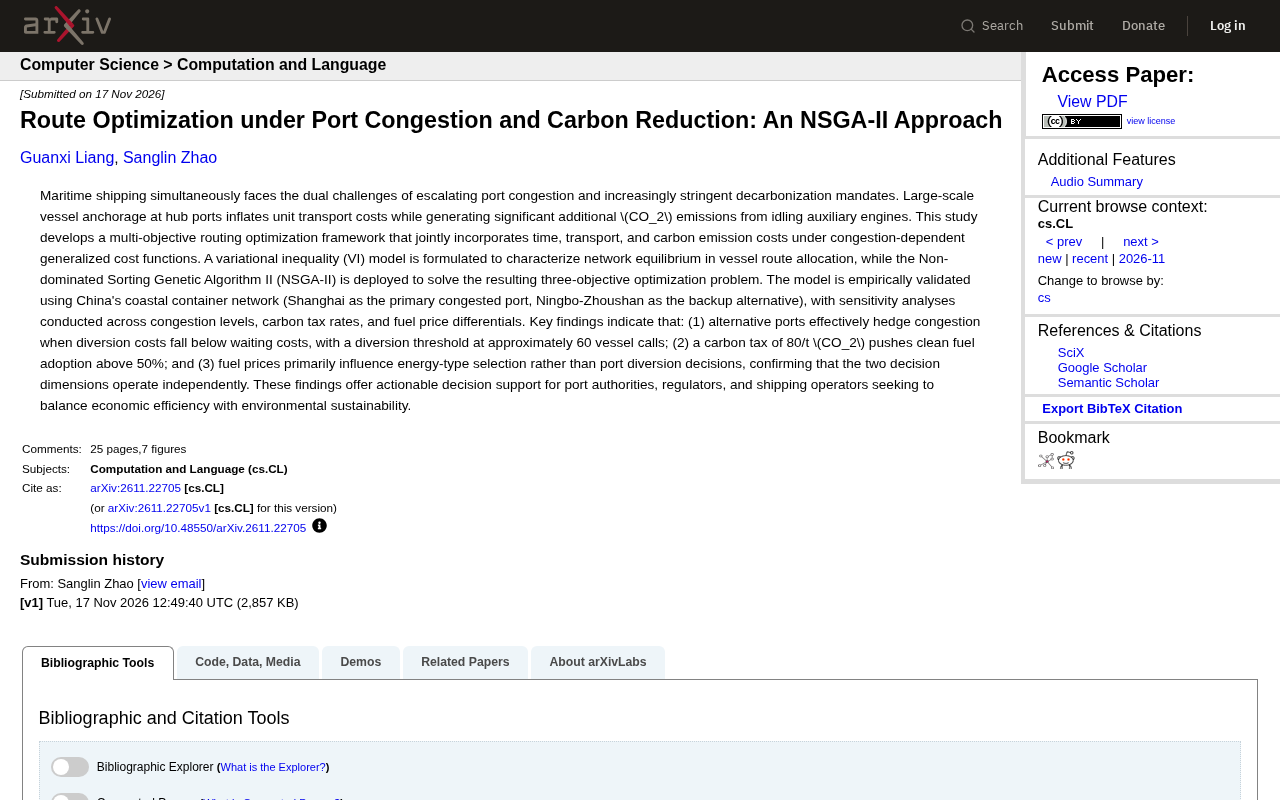
The study incorporates congestion idle emissions into costs, builds a three-objective route optimization framework, and identifies diversion thresholds and carbon tax tipping points.
Addressing the dual pressures of hub port congestion and decarbonization regulation in shipping, this study points out that vessel idling at anchor is both a cost burden and a hidden carbon emission source. The authors couple time, transport, and carbon emission costs into a congestion-dependent generalized cost function, use variational inequality to characterize the network equilibrium of ship route assignment, and employ NSGA-II to solve the three-objective Pareto front. Using the Shanghai–Ningbo Zhoushan network as an empirical case, sensitivity analysis yields three conclusions: about 60 vessel calls is the threshold for initiating diversion; clean fuel adoption exceeds 50% when the carbon tax reaches 80 USD/ton CO₂; and fuel prices mainly affect fuel type selection and are independent of port diversion decisions. The study argues that congestion management and carbon reduction can be incorporated into a unified framework, and the methodology can be transferred to inland waterway shipping and multimodal transport scenarios.
When Congestion Meets Carbon Tax: The Shipping Industry's Dilemma
Global maritime shipping is under two simultaneous pressures: congestion caused by large-scale anchoring of vessels at hub ports, and increasingly stringent decarbonization regulations. Notably, these two are not independent of each other—when ships wait at anchor, auxiliary engines keep idling, which both drives up unit transport costs and generates considerable additional CO₂ emissions. In other words, congestion itself is a hidden source of carbon emissions.
The idea proposed in this study is: rather than treating time and emissions as two isolated metrics to be optimized separately, it is better to unify them into a generalized cost function that depends on congestion states, constructing a multi-objective route optimization framework coupling three costs—time, transport, and carbon emissions. For the shipping industry, this is a modeling perspective that is closer to reality.
Methodology: The Combined Approach of Variational Inequality + NSGA-II
The study makes two layers of design in its methodology.
Characterizing Network Equilibrium with Variational Inequality
Ship route assignment is essentially the result of a game among many operators under limited port resources. The study adopts a Variational Inequality (VI) model to characterize this network equilibrium—each decision-maker optimizes their own cost given the choices of others, ultimately converging to an equilibrium state that no one can unilaterally improve. Compared with simple flow assignment models, VI better reflects the mutual influence of ship rerouting behavior under congestion conditions.
Variational Inequality (VI) is a classic tool in operations research and transportation network analysis, with the general form: find a vector x* ∈ K such that for any x ∈ K, F(x*)·(x − x*) ≥ 0. In transportation networks, F typically represents the impedance (cost) function of each path, and K is the feasible flow set. The core advantage of VI lies in its ability to uniformly express various equilibrium conditions such as user equilibrium and system optimum, and to allow asymmetric cost functions—that is, the mutual influence of path A on path B's flow need not equal that of B on A, which is particularly critical when congestion spillover is pronounced. Compared with equivalent optimization methods such as the Beckmann transformation that apply only to symmetric cost functions, VI has broader applicability, but for this reason it is difficult to directly convert into standard mathematical programming problems, and typically requires iterative solution via projection algorithms, relaxation algorithms, or Frank-Wolfe-type methods.
Solving the Three-Objective Problem with NSGA-II
On top of the equilibrium constraints, time cost, transport cost, and carbon emission cost constitute three conflicting objectives. The study deploys the Non-dominated Sorting Genetic Algorithm with elitism, NSGA-II, to solve the problem, outputting a set of Pareto front solutions rather than a single optimal solution—which is more practically valuable for decision-makers who need to trade off between economy and environmental performance: port authorities with different preferences can select suitable schemes from the same front.
NSGA-II (Non-dominated Sorting Genetic Algorithm II) was proposed by Deb et al. in 2002 and is one of the most widely cited benchmark methods in multi-objective evolutionary algorithms. Its three major mechanisms are: fast non-dominated sorting, which stratifies the population according to Pareto dominance relations; crowding distance calculation, which maintains the uniformity of front distribution among solutions in the same layer; and elitist preservation strategy, which merges parent and offspring populations and selects the best, preventing loss of already-found superior solutions. The so-called Pareto front refers to the set of solutions that cannot be further improved in any objective without sacrificing another objective, and solutions on it are mutually non-dominated. For shipping decision-makers, each point on the front represents a time-cost-emission trade-off combination, and decision-makers can choose according to their own preferences. The computational complexity of NSGA-II is approximately O(MN²) (M is the number of objectives, N is the population size), suitable for problems with a small number of objectives (typically no more than three), which matches the setting of this study.
Empirical Test: The Shanghai–Ningbo Zhoushan Dual-Port Scenario
The model takes China's coastal container network as the empirical object, setting Shanghai as the main congested port and Ningbo Zhoushan as the alternative diversion port, and conducts sensitivity analysis around three types of parameters: congestion level, carbon tax rate, and fuel price differential. The study presents three core conclusions.
Diversion Threshold: About 60 Vessel Calls
When rerouting cost is lower than waiting cost, the alternative port can effectively hedge congestion risk. The study identifies a diversion threshold of about 60 vessel calls—beyond this level, the cost-effectiveness of diverting to Ningbo Zhoushan begins to emerge. This threshold has direct reference significance for port authorities: it roughly marks the magnitude at which hub port congestion requires activating diversion contingency plans.
The cost of anchoring congestion is not merely reflected in schedule delays. When ships wait at anchor, the main engine is shut down while auxiliary engines continue running to maintain power supply and basic systems; although their fuel consumption rate is lower than in sailing状态, the accumulated emissions and fuel expenditure over long periods are considerable. This part of the cost is often overlooked in traditional route optimization because it is not reflected in sailing distance or port operation time. Converting idle emissions into the generalized cost function is in effect internalizing the externality of congestion, enabling the economic and carbon accounts of diversion decisions to be calculated in sync. The meaning of the 60 vessel-call threshold is: when hub port call demand exceeds this magnitude, the waiting cost at anchor (including time value and idle emission cost) will exceed the additional sailing cost of rerouting to the alternative port, making diversion economically rational.
A Carbon Tax of 80/ton CO₂ Is the Tipping Point for Clean Fuels
Sensitivity analysis shows that when the carbon tax reaches 80/ton CO₂, the adoption rate of clean fuels will be pushed above 50%. This means there is an observable critical range for carbon pricing policy, which regulators can use as a reference when designing carbon tax pathways to judge what tax rate level can truly leverage the fuel structure transformation of the fleet.
The logic by which carbon tax acts on shipping is to change the relative costs of different fuels. Taking marine low-sulfur fuel oil and alternative fuels such as green methanol and ammonia as examples, the latter typically have higher unit energy costs, and their competitiveness depends on whether the carbon tax can offset this price differential. When the carbon tax level is low, it is still cheaper for shipowners to pay the carbon tax than to switch fuels; as the tax rate rises, the price differential is gradually compressed until, after a certain critical point, the total cost of ownership of clean fuels becomes superior. The adoption rate jumping above 50% at 80 USD/ton CO₂ indicates that this tax rate has crossed the fuel-switching break-even range for most ship types. It should be noted that this tipping point is closely related to fuel price differentials and ship energy efficiency levels, and will shift with changes in oil prices and alternative fuel production capacity; therefore it is not a fixed constant but a reference anchor that needs dynamic calibration in policy design.
Fuel Prices Affect Ship Selection, Not Port Selection
A rather insightful finding is: fuel price differentials mainly affect the choice of energy type, while barely changing port diversion decisions. The study accordingly confirms that fuel decisions and port decisions are two mutually independent dimensions. This conclusion corrects the intuition that conflates the two—shipowners will not change port call choices just because oil prices change, and port authorities need not worry that oil price fluctuations will disrupt diversion patterns.
Three Implications for the Industry
First, congestion management and carbon reduction can be incorporated into a unified decision framework. Counting idle emissions into congestion costs enables port diversion decisions to generate both environmental and economic benefits.
Second, carbon tax design needs to identify the critical point. The jump in clean fuel penetration at 80/ton CO₂ shows that a carbon price that is too low can hardly form effective incentives, and policy intensity needs to cross a specific threshold.
Third, multi-objective algorithms have practical application space in shipping planning. The Pareto solution set output by NSGA-II is more suitable than single-objective optimization for real-world maritime networks where multiple interests coexist.
The methodology of this study can also be transferred to other transport network scenarios with congestion spillover and emission constraints, such as coordinated scheduling of inland waterway shipping and multimodal transport hubs.
Related articles

Zero-Code Replication of a $10,000 3D Website with Claude Code: A Six-Tool Breakdown
Bilibili creator Yomi used Claude Code plus five free tools to build a 3D product landing page quoted at $10,000 overseas—zero code. Breakdown of the six-tool division of labor, image-to-3D workflow, and the core collaboration method: "give AI a reference, not 'make it look better.'"
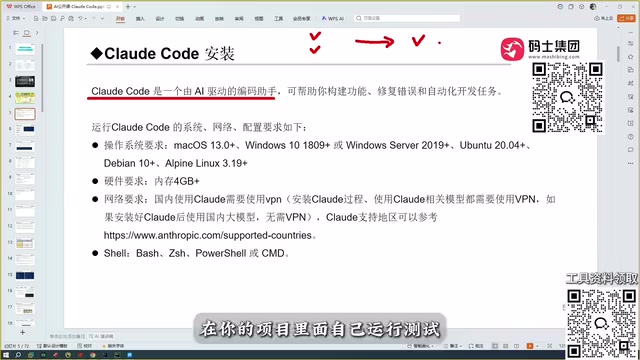
Claude Code in Practice: Install, Connect Models, Calculate Tokens, and Ship a Full-Stack Project with a Single Document
Based on a Bilibili public course demo, this covers Claude Code installation, model connection, token cost calculation, and the practical path of shipping a full-stack project with a single document, plus comparisons with Copilot, Cursor, Trae, and other coding assistants.

Who Accepts AI-Written Code? A 25-Minute Deep Dive into Verification Loops and the New Code Review Paradigm
After AI writes lots of code, how should Code Review verify it? This article breaks down the Claude Code team's verification loop framework: surface-level end-to-end verification, setup/drive/check three-stage skills, hybrid end-to-end testing and reliability checklists, and how to tighten the loop when issues slip through.